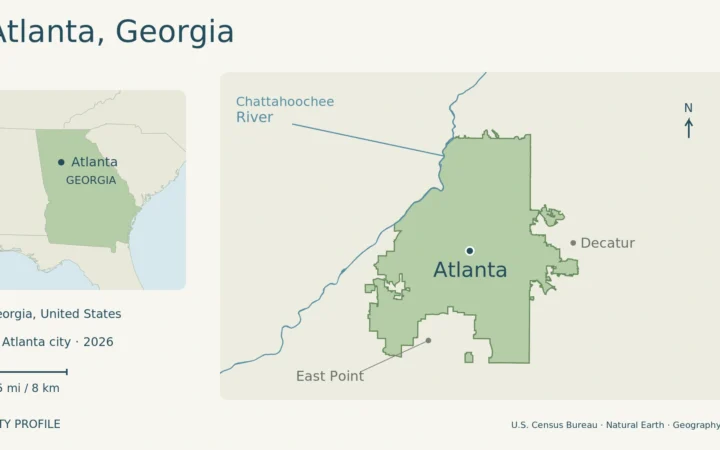
Atlanta is the capital of Georgia, the U.S. state, and a city best visited in connected pieces rather than one long sightseeing loop. Downtown’s major attractions, Midtown’s art and parkland, and the neighborhoods east of the center each reward a different kind of day.
Three areas, not one cross-city checklist
For a first Atlanta visit, allow two or three full days: one for downtown attractions, one for Midtown’s museum and park, and a third for Sweet Auburn and the eastside neighborhoods. Stay near a useful MARTA station, and treat Stone Mountain as a separate excursion rather than another downtown stop.
How to use this article: Start with the two-day version, plan a weekday Capitol stop, or compare airport rail and taxis.
Practical information checked November 18, 2026. Day groupings are editorial suggestions, not timed tours; recheck operator notices for your dates.
1. Build the visit around two or three areas
| Day | Main visit | Flexible second part |
|---|---|---|
| 1: Downtown | Georgia Aquarium or your preferred major attraction | Centennial Olympic Park; Capitol only if hours and energy fit |
| 2: Midtown | High Museum of Art | Piedmont Park and dinner nearby |
| 3: East of downtown | Martin Luther King, Jr. National Historical Park | A chosen Eastside Beltline segment and a market meal |
The value of this arrangement is fewer cross-city transfers. It leaves space for meals, the walk between a station and an entrance, and exhibits that deserve more than a photograph. A third full day gives the civil-rights sites their own time instead of squeezing them between ticketed attractions.
With two days, choose what matters most
Keep downtown on the first day. On the second, choose either Midtown’s art-and-park combination or Sweet Auburn followed by the eastside. If King’s life and civil-rights history are your main interest, prioritize that visit over the aquarium. With only a half-day, stay in one area rather than trying to sample all three.
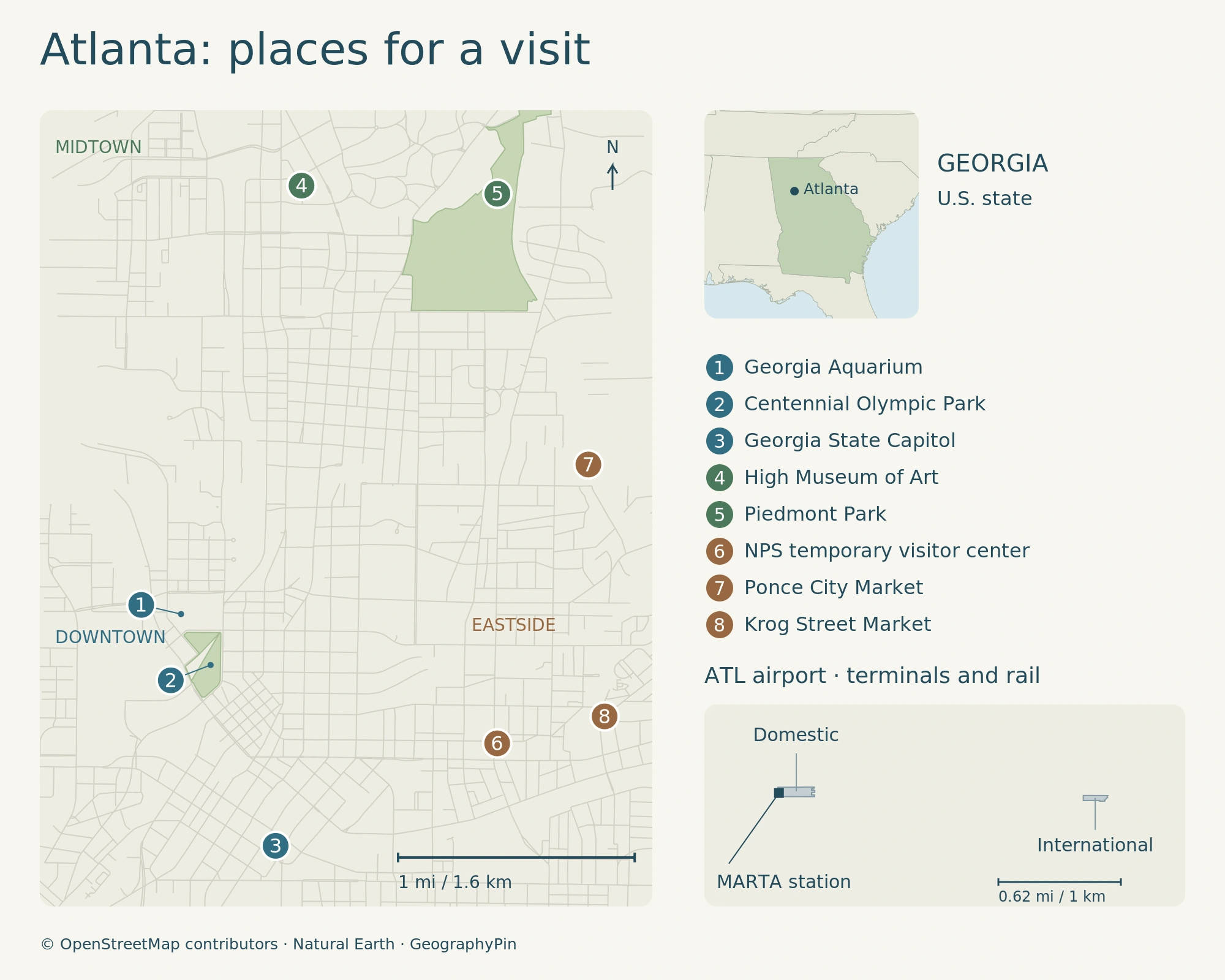
Group nearby visits rather than following the numbers as a walking route. The airport lies south of central Atlanta and is shown separately; the MARTA station is beside the Domestic Terminal. Insets use different scales. Enlarge map.
For the city’s setting and historical development, see the Atlanta city profile.
2. Downtown sights and a weekday Capitol visit
Georgia Aquarium: make this the morning’s main booking if marine life is your priority. The aquarium’s visitor guidance recommends about three to four hours, lists changing daily hours and explains that dolphin and sea-lion presentation reservations are made on the day. Buying entry does not remove the need to arrange those seats. The Georgia Aquarium visitor guide compares admission, presentation reservations and paid extras, with a downtown orientation map.
After lunch, Centennial Olympic Park provides outdoor space and a direct connection to Atlanta’s 1996 Olympic legacy. Use it as a pause between indoor visits, not a reason to stack every nearby paid attraction into one day. Check the park’s event notices before relying on a particular area for access.
The Capitol belongs on a weekday plan
The Georgia State Capitol is the government building, not another spelling of the city’s role as state capital. At the November 2026 check, the Capitol Museum visitor page listed Monday–Friday access, 8 a.m.–5 p.m., excluding state holidays, with the public entrance on Mitchell Street. Guided walk-in tours have a separate calendar; building hours are not a promise of a tour.
For a government-and-history day, visit the Capitol instead of making the aquarium the anchor. If combining both, allow a separate transfer and a substantial break rather than treating the Capitol as next door to the park. A weekend-only trip should not depend on going inside.
Travelers who need an accessible entrance should follow the accessibility guide linked from the museum’s visitor page. Avoid choosing the approach solely from a photograph of the front steps.
3. Midtown art, park time and Sweet Auburn
Midtown: begin with the High Museum of Art, then leave the afternoon for Piedmont Park. The museum’s published schedule at this check was Tuesday–Saturday, 10 a.m.–5 p.m., and Sunday, noon–5 p.m.; it closes Mondays and issues the last ticket an hour before closing. Put it on a day when you can arrive well before that cutoff.
The official Midtown neighborhood guide places art institutions and Piedmont Park in the same broader district, but that does not make every entrance adjacent. Choose a park entrance that fits your journey from the museum, and use a short ride if the additional walk would spoil the afternoon. The park works well as the flexible part of the day: a short stroll or a longer outdoor break.
Sweet Auburn: start a separate morning at the national historical park’s temporary visitor center, Historic Fire Station No. 6 at 39 Boulevard NE. Ask which buildings and programs are available that day, then organize the visit around the places interpreting King’s life and the neighborhood rather than a guaranteed house tour.
Birth Home entry needs particular care: the NPS tour page advertises same-day, in-person reservations, while another official page still says tours are on hold for renovation. Confirm with the park before making the interior visit the reason for your trip.
The eastside afterward: the Beltline’s Eastside Trail connects neighborhood walking with food and shopping at Ponce City Market and Krog Street Market. Pick one market and a manageable out-and-back section rather than promising yourself the whole corridor. It is a shared-use trail, so leave space for cyclists and other users when stopping.
Sweet Auburn and the Beltline are a day pairing, not a claim that every stop lies on the same path. Choose the transfer to your intended trail entrance before setting off. For a shorter day, finish after the historical park and lunch; the neighborhood walk can stand on its own another time.
4. Choose a base by your evenings and station
Downtown: suits a trip centered on the aquarium, Olympic Park or a specific event. Compare the actual walk from the hotel to your main entrance and to rail, rather than assuming all downtown addresses are equally convenient. An event-focused stay benefits most from being close to that event.
Midtown: is the more useful starting choice for a mix of museums, park time and evenings nearby. A location near a station can combine those interests with airport rail, while a room nearer the park may trade a longer station walk for easier outdoor time. Decide which journey you will repeat more often.
Old Fourth Ward or Inman Park: suits a stay built around the eastside, meals and neighborhood wandering. Verify the exact address and transport connection: proximity to the Beltline does not necessarily mean a short walk to heavy rail. Do not choose a distant apartment solely because its listing says “Atlanta.”
For this itinerary, there is little reason to change accommodation each night. Compare the full cost of parking or daily rides with a better-located room. Airport accommodation makes most sense for a late arrival or early departure, not as the default base for three days of city sightseeing.
5. Arrive by rail or road, then keep days compact
Airport rail and taxis solve different journeys
MARTA’s Airport Station is at the Domestic Terminal, on the Red and Gold lines. Travelers emerging at the International Terminal need the terminal connection rather than expecting a rail platform there. MARTA describes a free international-terminal shuttle; check your airline’s departure check-in instructions for the return journey.
The standard MARTA fare was $2.50 at the November 18 check. Use the current payment instructions, not an old guide to a retired Breeze card. For a late flight, check the actual last departure and any service changes rather than assuming airport rail runs all night.
A taxi can make more sense with substantial luggage, a group or accommodation far from a station. The airport’s ground-transportation page identifies domestic taxis in Aisle A of the Ground Transportation Center and international taxis outside arrivals door A1. Rideshare pickup is a different arrangement; follow your terminal’s signs and the app rather than waiting at an arbitrary curb.
For city days, combine rail between useful stations with walking inside each sightseeing area. Check the last stretch to the entrance as carefully as the train route. If stairs are a problem, consult live elevator status before committing to a particular station.
A rental car is more useful when leaving the city than when moving between these clusters. If Atlanta begins a longer road trip, compare collecting it on departure day with paying for several nights of parking. The Georgia state travel guide separates northern mountain routes from coastal trips.
6. Make room for weather and a separate excursion
Keep outdoor portions flexible. The national park’s conditions page links local forecasts, air-quality information and pollen reports. If a hot, stormy or high-pollen day makes a long park visit unattractive, shorten the walk and give the indoor anchor more time. In cooler weather, an earlier outdoor stop leaves less of the route after dark.
Stone Mountain is a separate excursion east of Atlanta. Use the park operator’s directions and current attraction calendar to plan that day. Transport to the park, a mountain walk and ticketed attractions are different decisions. Do not add it after an already full downtown itinerary or assume one admission covers every activity.
Before buying a multi-attraction pass, list the places you genuinely intend to enter and compare their current individual prices and reservation requirements. A pass that encourages extra cross-city journeys can cost you the relaxed park afternoon or neighborhood meal you wanted more.
What Did We Learn Today?
A satisfying Atlanta trip comes from grouping places, not collecting the longest attraction list. Give downtown, Midtown and the eastside separate time; put the Capitol on a weekday and confirm individual historic-site access. Choose accommodation around repeated journeys, use airport rail when the connection works, and save Stone Mountain for a separate outing.
Sources & Data Notes
View transport and attraction sources
Checked November 18, 2026. Suggested day groupings and base choices are editorial planning advice, not measured routes. NPS Birth Home pages disagree about tour availability, so entry is not promised. Exact taxi fares, attraction prices and temporary event schedules are omitted.
Original GeographyPin map using OpenStreetMap contributors (ODbL), with Natural Earth state context and a Census city locator point. Location checks: November 18, 2026. Lines beside numbers are label leaders, not routes; markers are representative site positions, not entrances.
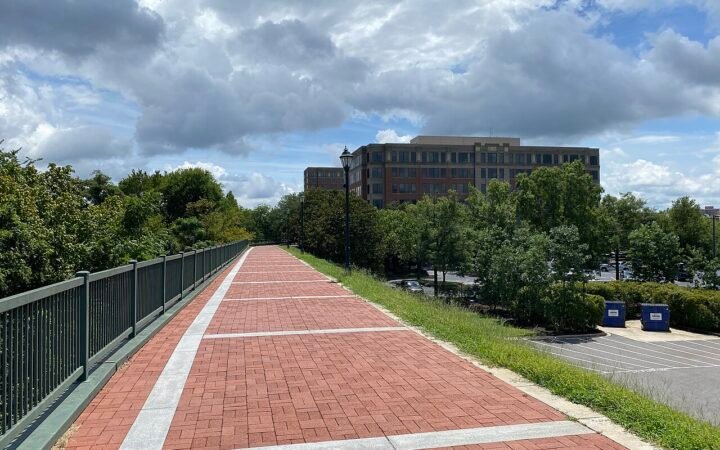
Photograph: Midtown Atlanta from Freedom Parkway, Marc Merlin, May 22, 2016, CC BY-SA 4.0, via Wikimedia Commons. Resized without cropping; the photograph records the skyline in 2016.
- Discover Atlanta: Midtown
- Georgia Aquarium: visitor information
- Centennial Olympic Park
- High Museum: plan your visit
- Georgia Capitol Museum: visitor information
- NPS: temporary visitor center
- NPS: Birth Home tours
- NPS: permits and reservations, conflicting closure notice
- Atlanta Beltline: Eastside Trail
- MARTA: Airport Station
- MARTA: fares and transfers
- ATL Airport: ground transportation
- NPS: local conditions
- Stone Mountain Park: directions