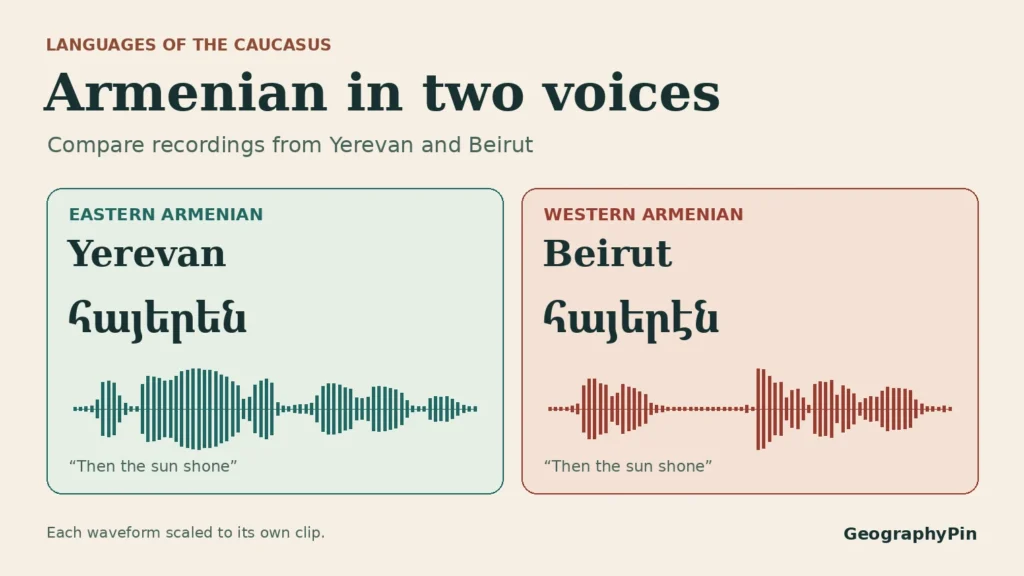
Two Armenian speakers can read the same story and sound noticeably different. Neither is speaking a different alphabet. You’re hearing two varieties of a language that developed literary standards in different places and traveled with the people who speak it.
Armenian forms its own branch of the Indo-European family and has its own alphabet. Eastern Armenian predominates in Armenia and is also spoken in Iran, Georgia and Russia. Western Armenian is spoken in diaspora communities including Beirut, Istanbul and Los Angeles. The two standards differ in pronunciation and grammar, and spelling does not always follow the speech divide.
How to use this article: See how communities cross the Eastern–Western divide, play the three paired speech samples, or go straight to the two spelling traditions.
Where is Armenian spoken?
Armenian is the state language of the Republic of Armenia, where you will generally hear Eastern Armenian. Article 20 of the constitution names Armenian, without defining a dialect. Linguists also document Eastern Armenian communities in Georgia, Russia and Iran. The Eastern standard is not the only way Armenian is spoken in those places.
Communities do not stop at the dialect labels
Western Armenian developed in the Ottoman Armenian world. Today you can hear it in communities in Beirut, Istanbul, France and California, among other places. But the diaspora is not uniformly Western-speaking. Los Angeles also has Eastern Armenian speakers, and some people in Armenia speak Western Armenian. Family history and migration often tell you more about someone’s variety than their address does. For that wider story, see Armenian identity and diaspora.
Hear Eastern and Western Armenian side by side
A speaker from the Yerevan area and a speaker brought up in Beirut read parallel versions of The North Wind and the Sun for a phonetics study. The clips below give the same three everyday ideas in both varieties. They are excerpts from a reading, not staged conversations or synthetic speech.
Three phrases, two speakers
1. Then the sun shone
Yerevan: Հետո Արևը փայլեց
Beirut: Յետոյ Արեւը փայլեցաւ
2. And the traveler warmed up
Yerevan: և ճանապարհորդը տաքացավ
Beirut: եւ ճանապարհորդը տաքցաւ
3. He immediately took off his coat
Yerevan: Նա անմիջապես հանեց իր վերարկուն
Beirut: Ան անմիջապէս հանեց իր վերարկուն
In clip 2, listen for the t-like beginning of տաքացավ in Yerevan and the d-like beginning of տաքցաւ in Beirut. They begin with the same Armenian letter on the page. The comparison is for these speakers and words, not a rule for every letter and every Armenian dialect.
The Armenian alphabet and its two spelling traditions
Armenian is written in the Armenian script. Its earliest attested written form is Classical Armenian, documented from the fifth century. Neither modern standard requires you to learn a different script. The main differences on the page come from spelling conventions, just as differences in sound come from the spoken varieties.
What changes on the page
Compare հայերեն and հայերէն, both meaning “Armenian” as a language name. The first uses the reformed spelling common in Armenia; the second uses traditional spelling, common in Western Armenian. Eastern Armenian writers in Iran also traditionally use the older spelling convention, so you cannot reliably infer the spoken variety from the spelling alone. The Unicode Armenian alphabet reference lists the script’s characters.
How different are Eastern and Western Armenian?
Speakers share a good deal of vocabulary and structure, but differences go beyond accent. In clip 3, the Eastern recording uses Նա for “he” and the Western recording uses Ան. In the same lines the written words for “took off his coat” look alike, but you can hear that the speakers do not pronounce every letter in the same way.
If you are learning, pick examples from the people you want to talk with. The standard taught for use in Armenia will generally be Eastern; a class for a family or community with roots in Beirut may use Western. Plenty of speech falls outside these two recordings, and knowing the name of a standard isn’t a test of how much one listener will understand.
Frequently Asked Questions
Is Classical Armenian the same as Western Armenian?
No. Classical Armenian is the much older written stage of the language. Western Armenian is a modern standard. Keeping traditional spelling does not make a passage Classical Armenian.
Is Armenian a Slavic language?
No. Armenian and Slavic languages such as Russian belong to the broad Indo-European family, but to different branches. Hearing Russian alongside Armenian in a community does not make Armenian Slavic.
What Did We Learn Today?
Listen for sound, look for spelling, and keep the speaker’s community in mind. Those are three different clues. The Yerevan and Beirut recordings show real contrasts within Armenian, while the overlap across countries and spelling conventions explains why the Eastern and Western labels do not tell you everything about a speaker.
Sources & Data Notes
View audio credits, spelling sources and study notes
The two voices represent the Yerevan and Beirut readings in a specific study, not every Eastern and Western variety. The cover plots the first clip in each voice with each waveform independently scaled to fill its panel; it does not compare durations or loudness at a common scale.
- Scott Seyfarth, Hossep Dolatian, Peter Guekguezian, Niamh Kelly and Tabita Toparlak, Armenian (Yerevan Eastern Armenian and Beirut Western Armenian), Journal of the International Phonetic Association 54(1), April 2024. See the supplementary material for the original readings and aligned transcripts. Audio excerpted from the Yerevan (speaker SK) and Beirut (Hossep Dolatian) recordings, padded, volume-adjusted and converted to MP3; the cover waveforms use the same source. CC BY 4.0.
- Constitutional Court of Armenia: constitution, Article 20, state language.
- Proceedings of Digital Armenian (2022), differences between traditional and reformed orthography; Karapetian’s UCLA research on Eastern Armenian heritage speakers, on Iranian and diaspora usage.
- The Unicode Standard: Armenian character names, for the script reference.