On Vardavar, a Sunday in an Armenian church and an afternoon in a Yerevan square can look like two entirely different holidays. They share a name and a date, but the church service and the water games come from different traditions.
Vardavar is Armenia’s summer water festival, celebrated on Sunday, July 4, 2027. People splash one another with water in streets, squares, and courtyards. It’s also the Armenian Apostolic Feast of the Transfiguration, which honors the Gospel account of Jesus appearing radiant before three disciples. The feast date is set; local programs are announced separately.
How to use this article: See why the date moves, read the stories behind the water, or check where to find Yerevan’s program before making plans.
When Is Vardavar?
The Armenian Apostolic Diocese in Georgia and the Armenian Apostolic Church of Holy Resurrection in Sydney both list July 4, 2027. The date applies to the church feast, not to every concert, procession, or parish gathering.
Why the Date Changes Every Year
The Armenian Apostolic Church celebrates the Transfiguration 98 days after Easter Sunday, exactly 14 weeks later. That’s why it always falls on a Sunday but not on the same date each year: in 2026 it was July 12; in 2027 it moves eight days earlier.
What the Church Celebrates and Why People Splash Water
During the Divine Liturgy, the church commemorates the Transfiguration of Jesus. Matthew, Mark, and Luke all describe the event, in which Peter, James, and John witness a striking change in Jesus’ appearance. Outdoors, the best-known custom looks very different: people bring buckets and water blasters and splash one another. The water play is a popular custom, not a reenactment of the Gospel story.
Armenian ethnographer Lusik Aguletsi, speaking to Armenian broadcaster A1+, recalled a striking example: a daughter-in-law who ordinarily would not address her father-in-law could splash him on Vardavar. In her account, the water briefly upended an everyday social rule. That’s one example of how the custom was practiced, not a description of every Armenian family today.
Where the Roses and Noah Stories Come From
The Armenian parish in Sydney recounts a tradition linking the older festival to Astghik, a pre-Christian Armenian goddess associated with love and beauty, whose celebrations are said to have featured roses, doves, and water games. Yerevan’s tourism office records a different story: Noah sprinkled his family with water in remembrance of the flood. These stories explain some of the meanings people give the custom; they don’t establish exactly how or when the water games began.
What to Expect in Yerevan
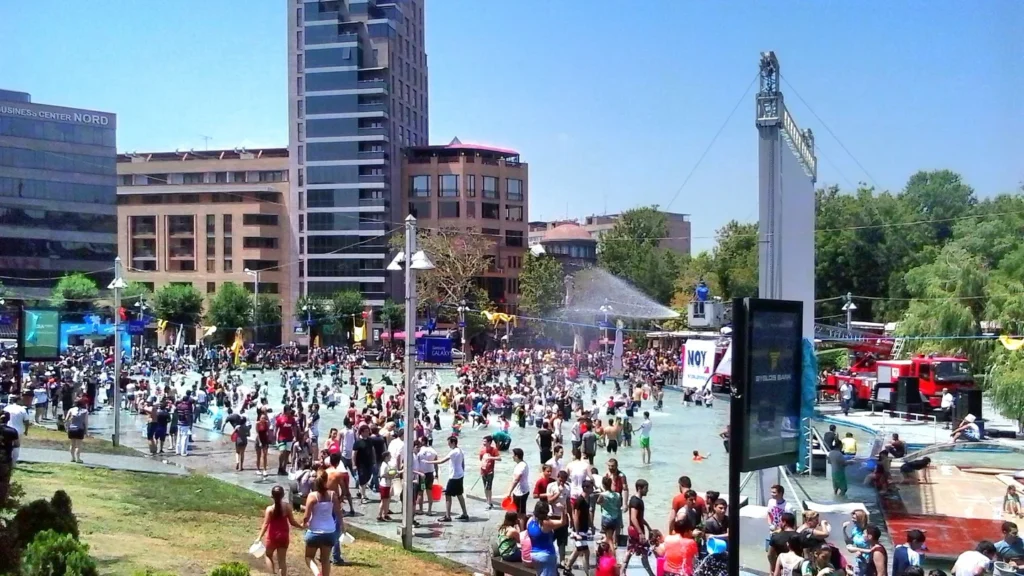
In Yerevan, the capital of Armenia, you may see water play away from the main stage, too. Expect to get wet if you walk into the games, and keep your phone and anything you need to stay dry in a sealed pouch. If you join in, aim at willing participants and give people trying to pass through some room.
Where to Find Yerevan’s 2027 Program
Yerevan’s festival overview names Swan Lake as a customary gathering spot. But the city’s July 2026 announcement put that year’s main program in Republic Square, with water activities, a children’s area, and a concert. That’s a good reason to check the municipality’s dated announcement for your year rather than assuming the same location. No official 2027 Yerevan program was found as of November 28, 2026.
Frequently Asked Questions
Are Vardavar and Vartavar the same festival?
Yes. Both spellings refer to the Armenian feast and its associated water celebration. Yerevan’s tourism office uses Vardavar; the Armenian parish in Sydney uses Vartavar.
Can I celebrate Vardavar outside Armenia?
Yes. Armenian Apostolic parishes outside Armenia observe the feast, though they don’t all hold outdoor water games. Check the local parish calendar for the service and any public program.
What Did We Learn Today?
The church calendar tells you when Vardavar falls, while local customs tell you what it looks like. The Transfiguration is the religious observance; street splashing is the best-known popular tradition. If you’re visiting Yerevan, use the feast date to pick your day and the city announcement to choose where to go.
Sources & Data Notes
Calendars, local accounts and photo credit
The date follows the Armenian Apostolic calendar. The 2026 municipal schedule is a documented example, not a forecast of the 2027 location or hours. The photograph shows Swan Lake in 2014.
- Armenian Apostolic Diocese in Georgia: Feast of the Transfiguration dates
- Armenian Apostolic Church of Holy Resurrection: 2027 date, feast and traditions
- Yerevan Municipality: July 2026 event announcement (Armenian)
- Yerevan Municipality: Yerevan festivals and water games
- Visit Yerevan: liturgy and the Noah tradition
- A1+: account from ethnographer Lusik Aguletsi
Featured photograph: Vartavar 2014 Yerevan (5) by Zyzzzzzy, Wikimedia Commons, CC BY-SA 4.0, cropped and resized.