On a street sign in Baku, Azerbaijani uses Latin letters. An Azerbaijani text from northwestern Iran may run from right to left instead. The writing changes across the border, but the script alone doesn’t tell you which language you’re reading.
Azerbaijani, also called Azeri, is an Oghuz Turkic language spoken mainly in the Republic of Azerbaijan and northwestern Iran. It is Azerbaijan’s official language and uses a Latin alphabet there. In Iran it is commonly written in a Perso-Arabic script. Azerbaijani and Turkish are closely related but not identical or automatically understood by each other’s speakers.
How to use this article: Compare Baku and Tabriz, read one name in three scripts, or jump to the Azerbaijani and Turkish phrase pairs and what speakers understood in tests.
Where Azerbaijani is spoken
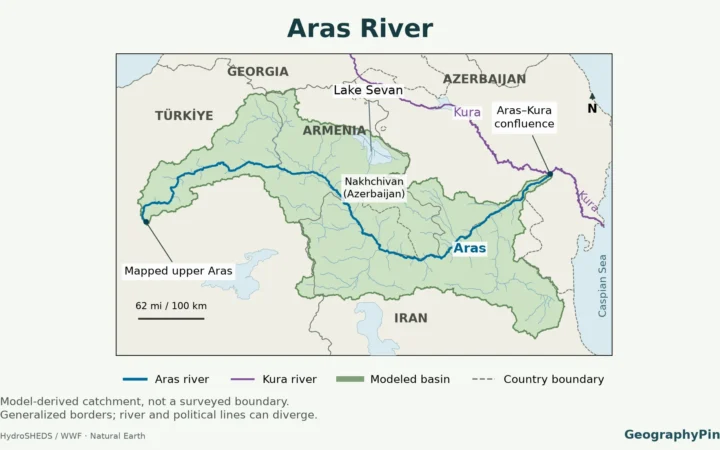
In the Republic of Azerbaijan, Azerbaijani is the state language. In northwestern Iran, it is widely spoken in and around places such as Tabriz, Ardabil and Zanjan, but Persian is Iran’s official language. Azerbaijani also has communities outside those two main areas, including in southern Dagestan, Russia. Where a language is spoken is a different question from what status it has in government.
Baku and Tabriz are reference points, not dialect boundaries
Linguists often group Azerbaijani varieties into northern and southern groups. Standard Azerbaijani in the republic draws on varieties around Baku and elsewhere; Tabriz provides a widely cited speech example from the Iranian group. These are not the only ways to speak the language, and some scholars emphasize smaller local groupings. The term “Iranian Azerbaijani” identifies a variety and its setting, not the same thing as being a speaker of Persian.
In Article 21 of Azerbaijan’s constitution, the state-language sentence reads Azərbaycan Respublikasının dövlət dili Azərbaycan dilidir.
It says that the state language of the Republic of Azerbaijan is Azerbaijani. In English, Azeri is another name for this language; it is not the name of a separate official language.
Why Azerbaijani has more than one script
Scripts are ways to write a language, not separate languages. The Republic of Azerbaijan restored a Latin-based alphabet in 1991, but Soviet-era Cyrillic did not disappear immediately. A 2001 decree required Azerbaijani-language printed material to move to Latin script. A Soviet-era book and a modern public sign can therefore look quite different even when both are in Azerbaijani.
In Iran, Azerbaijani is commonly written with a version of the Perso-Arabic script, read from right to left. A 2025 study of social-media writing also documented some Iranian Azerbaijani users mixing scripts or writing in Latin. In Dagestan, the Russian Academy of Sciences catalog documents Azerbaijani Cyrillic use, while the Azerbaijani section of the Derbent newspaper gives a current example in Latin. Neither region can be reduced to a single rule for every writer.
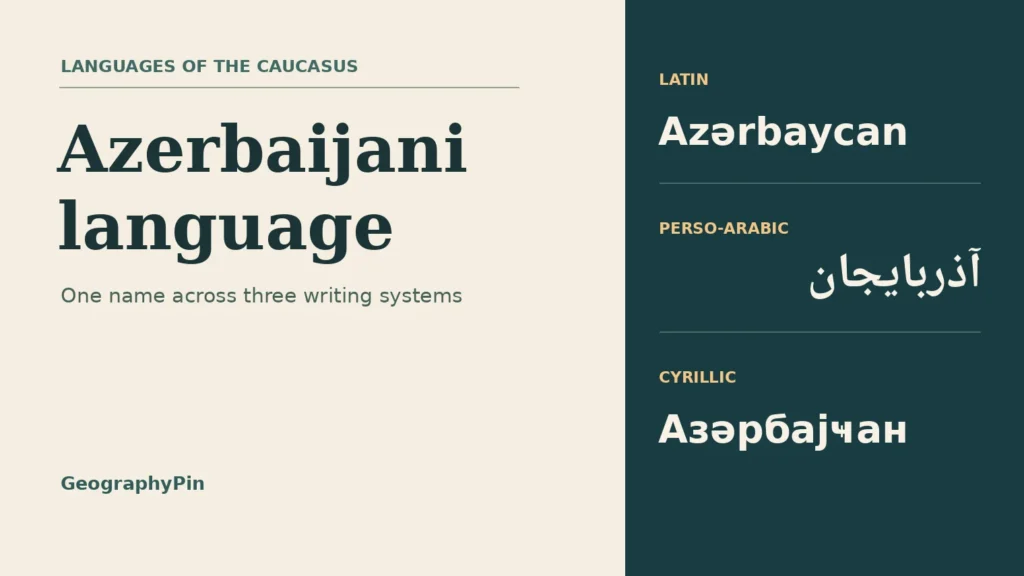
One name written three ways
- Latin: Azərbaycan, as in the current Azerbaijani constitution.
- Perso-Arabic: آذربایجان, as in the 1918 masthead of the newspaper Azərbaycan.
- Cyrillic: Азәрбајҹан, as in works cataloged by the National Library of Azerbaijan.
The three examples are the name Azerbaijan. The historical masthead also shows why a Perso-Arabic text isn’t necessarily from Iran: that script was used in Baku before later alphabet reforms.
How close is Azerbaijani to Turkish?
Azerbaijani and Turkish belong to the same Oghuz branch of the Turkic language family. Unrelated languages can share a script, and related languages can use different scripts. In this case, the modern Latin alphabets make the words easy to compare visually, but they don’t make the vocabulary or the sound of every word the same.
Three everyday phrases side by side
| English | Azerbaijani | Turkish |
|---|---|---|
| Hello | Salam! | Merhaba! |
| Thank you very much | Çox sağ olun! | Çok sağ olun! |
| Good evening | Axşamınız xeyir! | İyi akşamlar! |
Çox sağ olun and Çok sağ olun look close on the page. The evening greeting is only partly similar: the words for “evening” are recognizable as relatives in those two phrases, but the whole expressions are built differently. The table gives one useful option per situation, not the only greeting speakers use.
What helps speakers understand each other?
Recognizing a greeting is easier than following an unfamiliar conversation. Similar vocabulary offers clues, especially when the situation makes the meaning predictable. A speaker might work out “good evening” in context but miss the most important word in a longer sentence.
What listening and reading tests show
In a study published in 2012, 30 Turkish speakers were tested on written and spoken Azerbaijani. The researchers found less comprehension than the languages’ close relationship might suggest. A different 2017 experiment gave 40 Iranian Azerbaijani speakers short Turkish TV clips. In its translation tasks, unfamiliar words made comprehension harder, though participants could sometimes infer a word from context.
Those studies tested different people and different tasks. They don’t give a universal percentage or prove that one direction is always easier. Familiarity from conversation or media may make a difference, but shared ancestry alone is not a guarantee that two strangers will understand each other.
Frequently Asked Questions
Is the Azerbaijani letter Ə the same as E?
No. The current Latin alphabet has both Ə and E. The Azerbaijani Presidential Library illustrates them with different words: əl means “hand,” and ev means “house.”
Is Azerbaijani taught in schools in Iran?
Iran’s constitution requires official texts and textbooks to be in Persian, while allowing regional languages in the media and the teaching of their literature. That provision does not make Azerbaijani a nationwide language of instruction or tell you what any particular school offers.
What Did We Learn Today?
To identify an Azerbaijani text or conversation, separate three questions: where a variety is spoken, how someone writes it, and what a listener understands. Those answers can change across borders and across generations, even when speakers share the Azerbaijani language or recognize some words in Turkish.
Sources & Data Notes
View linguistic sources, script examples and study notes
The script examples use a single proper name; they are not an alphabet chart. The three phrase pairs are drawn from the same multilingual reference. The comprehension studies used different tasks and samples, so their results are not directly comparable.
- Constitution of Azerbaijan, Article 21; Constitution of Iran, Article 15 (English text hosted by UNESCO).
- Ghaffarvand Mokari and Werner, Azerbaijani, Journal of the International Phonetic Association (2017): classification and Tabriz speech.
- Azerbaijan’s Presidential Library: the language and alphabet reforms; Constitutional Court ruling describing the 2001 Latin-script deadline.
- The Politics of Writing in Iran (2025): northwest Iranian speaker regions and social-media writing; Institute of Linguistics, Russian Academy of Sciences: Azerbaijani, including Cyrillic in Dagestan.
- ADA University: 1918 Azərbaycan newspaper facsimile, vol. I; National Library of Azerbaijan historical bibliography, which reproduces Azerbaijani Cyrillic titles. These and the constitution support the cover’s typography.
- Danışıq Lüğəti (6 dildə), compiled by Mirvari İsmaylova (ADPU, 2025): Azerbaijani and Turkish expressions. Azerbaijan Tourism Board vocabulary supports the English glosses.
- Sağın-Şimşek and König’s study of Turkish speakers reading and hearing Azerbaijani (2012); the Iranian Azerbaijani study using Turkish TV clips (2017).