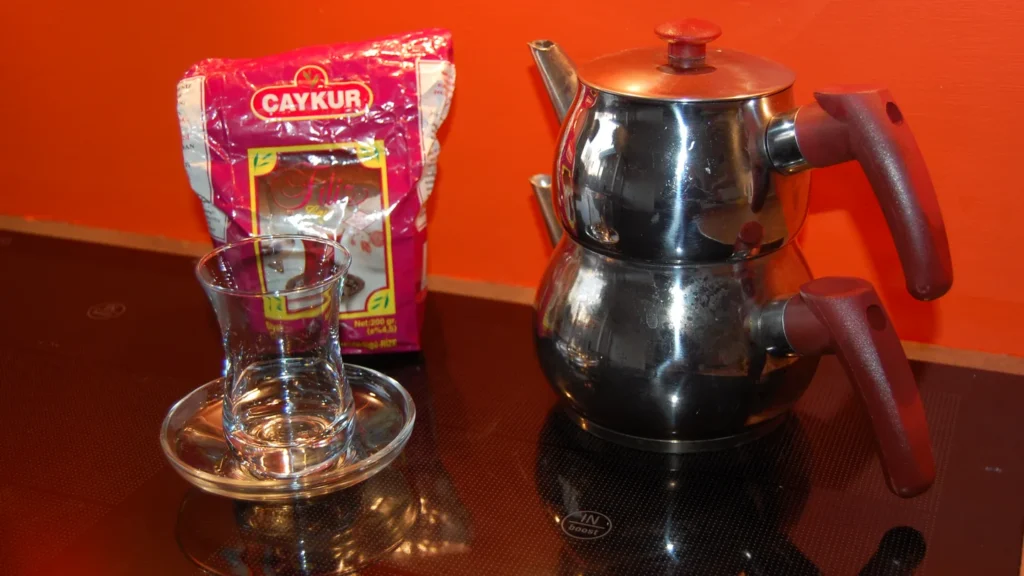
A Turkish double teapot lets you brew one batch of tea for people who like it at different strengths. The trick is to keep the strong brew and the hot water separate until you pour them into the glass.
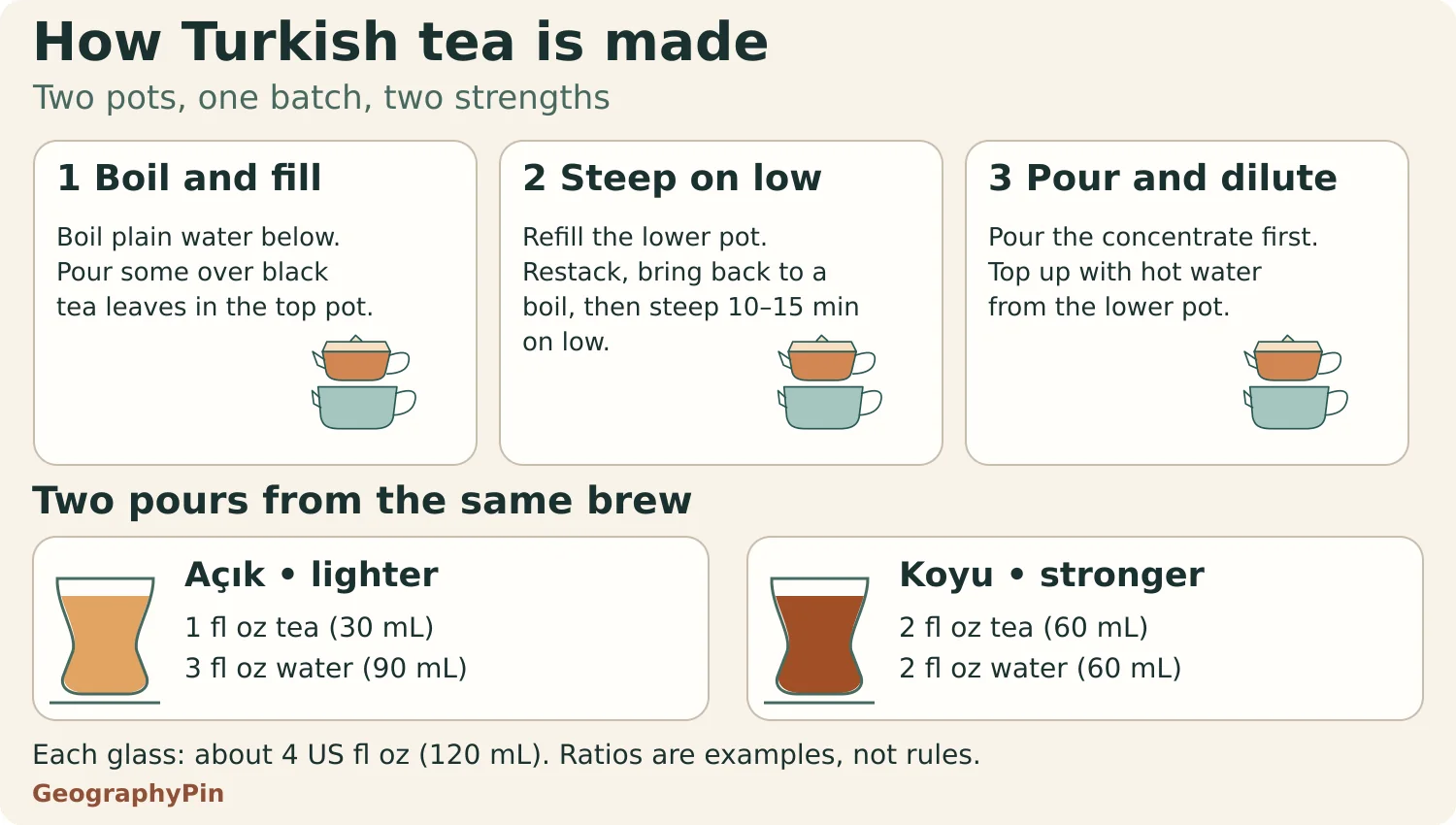
To make Turkish tea, boil plain water in the bottom pot of a çaydanlık and pour some over loose black tea in the top pot. Refill and restack the pots. Once the lower pot returns to a boil, turn down the heat and steep for 10–15 minutes. Pour the strong tea first, then add hot water to taste.
How to use this article: Check how much loose tea to start with, find when to start timing the brew, or skip to the two measured pours.
1. What goes in each pot?
Use a çaydanlık, the pair of stacked pots shown in the photo; loose black tea; water; and a heatproof glass or cup. The small pot on top holds the leaves and the brewing water. The larger pot below sits on the burner and holds plain water. It keeps the top pot warm and supplies the water that will dilute the tea. The leaves never go into the lower pot.
A measured starting point for the leaves
Türkiye’s Ministry of Health cookbook lists about 0.53 oz of black tea by weight (15 g) for about 2.1 US cups of water (500 mL, approximately 500 g of water). For a smaller starting batch, scaling that ratio gives about 0.26 oz of leaves (7.5 g) for about 1 US cup (250 mL) of brewing water. Use enough separate water in the lower kettle for heating and topping up the glasses. These are starting quantities, not a rule for every blend or a measured final yield.
2. How to brew Turkish tea
- Boil the water below. Put plain water in the larger pot and loose black tea in the smaller one. When the water comes to a boil, pour the amount you need over the leaves in the upper pot.
- Refill and restack. Replenish the plain water below, set the upper pot back on top with its lid on, and bring the lower pot to a boil again.
- Turn the heat down. Let the upper pot steep over the lower one. To serve, pour from the top pot first and use the lower pot to top up the glass.
When to start the 10–15 minute timer
Go Türkiye’s boiled-water-first method starts the 10–15 minutes after the replenished lower pot returns to a boil and you turn the heat down. The tea steeps in the upper pot; you don’t put the leaves over direct heat. As you learn your blend, change either the amount of concentrate in the glass or the next batch’s steeping time, not both at once. Diluting makes the flavor less intense. If a lighter glass still tastes too bitter, shorten the steep on the next batch.

3. How to pour açık and koyu from the same batch
Açık çay is lighter tea; koyu çay is stronger and usually darker. The words describe what you pour into the glass, not two different tea leaves or two different brewing times. Compare equally sized glasses filled to the same level.
Two examples for a 4-fl-oz glass
- Açık, lighter: About 1 US fl oz of concentrate (30 mL) plus 3 US fl oz of hot water (90 mL). That’s one-quarter concentrate.
- Koyu, stronger: About 2 US fl oz of concentrate (60 mL) plus 2 US fl oz of hot water (60 mL). That’s half concentrate.
Both examples make about 4 US fl oz (120 mL). The stronger glass uses twice as much of the same concentrate and less plain water, but the exact strength still depends on the brew. If you have a smaller glass, keep the proportions rather than forcing the full amounts into it. Turkish tea is traditionally served hot in small glasses; the brewing method works in a heatproof cup, too. See what comes alongside it in the Turkish breakfast guide.
Frequently Asked Questions
Can I make it without a çaydanlık?
Yes. Brew a strong black tea in a heatproof teapot and keep plain hot water in a separate kettle. Combine them in the glass. You’ll get the same control over dilution, although a stand-alone teapot doesn’t get the same steady warmth from below.
How do I keep loose leaves out of the glass?
Pour the concentrate through a small tea strainer. You don’t need to strain the top-up water because the lower pot holds no leaves.
What Did We Learn Today?
The double teapot separates brewing from serving. Keep the leaves and concentrate upstairs and the plain water downstairs, then decide the strength when you pour. That’s how one batch can make both a lighter and a stronger glass.
Sources & Data Notes
Show sources and notes
- Go Türkiye’s step-by-step Turkish tea guide: the boiled-water-first sequence, 10–15 minutes on low, and topping up the concentrate to taste.
- Türkiye Ministry of Health: Turkish Cuisine, p. 52: the published leaf-to-water ingredient ratio. The half-batch is a scaled example, and the glass proportions illustrate dilution rather than a required standard.
- Türkiye Ministry of Trade: Black Tea: the traditional serving glass and terms açık and koyu.
- Cover: Photograph by Ellywa, via Wikimedia Commons; cropped and resized under CC BY-SA 4.0. Diagram: GeographyPin.