The Sea of Galilee is a freshwater lake in northern Israel. Matthew calls it a sea; Luke calls it the Lake of Gennesaret. In a modern water report it is Lake Kinneret. The names all point to the same body of water, but each tells you something different about who was naming it.
The Sea of Galilee is called a sea because that historical name was carried into English through the Bible, not because the lake is salty or connected to an ocean. Kinneret is the modern Hebrew name. Tiberias and Gennesaret are names tied to places along the shore.
How to use this article: Compare how Matthew and Luke name it, trace Tiberias from a city to a lake label, or match a name to its source.
1. Why a Freshwater Lake Is Called a Sea
The lake sits in the northern part of the Jordan Rift Valley, east of the Galilee hills. The Upper Jordan flows in from the north, and the Lower Jordan begins at its southern end, where outflow is regulated. Farther south, that river reaches the Dead Sea, a separate, very salty lake with no river outlet. The two “seas” belong to the same river system, but their names tell you nothing about how alike their water is. Read more about the Jordan River and the Dead Sea.
Matthew Says “Sea”; Luke Says “Lake”
Matthew 4:18 uses Sea of Galilee in the story of Jesus encountering two fishermen. Luke 5:1 describes Jesus by the Lake of Gennesaret before a story about fishermen and their boats. The names are different, but the shoreline is the same lake. That is the clearest way to read the word “sea” here: as part of a familiar name, not as a scientific classification.
2. Where the Other Names Came From
Kinneret and the Older Chinnereth Spelling
In modern Hebrew the lake is Kinneret (כנרת), and you may hear Yam Kinneret. An older English spelling, Chinnereth, appears in some Bible translations. In Numbers 34:11, the New American Standard Bible uses Sea of Chinnereth in a description of a boundary. A 2021 Geological Survey of Israel report puts the modern names side by side in its title: Lake Kinneret (Sea of Galilee).
Tiberias: From a City to a Lake Label
Tiberias is a city on the western shore. The historian Josephus wrote that Herod Antipas named it in honor of the Roman emperor Tiberius. John 6:1 puts Sea of Galilee and Sea of Tiberias together, a direct clue that they mean the same water. John 21:1 also uses Tiberias in the King James Version; some modern translations put the familiar Galilee name in the text and retain Tiberias in a note.
The city’s name traveled beyond Bible translations. A Survey of Palestine map dated July 1937, reproduced by the United Nations in 1947, labels the water Lake Tiberias. Both “Sea of Tiberias” and “Lake Tiberias” use the same city name.
Gennesaret: A Lake and the Land Beside It
In Luke 5:1, Lake of Gennesaret means the whole lake. In Matthew 14:34, Gennesaret means land the travelers reach when they cross the water. Josephus spells the name Gennesareth in one English translation and says the lake took the name of the country adjoining it. In other words, the bare place-name and the lake name aren’t interchangeable, even though they are connected.
3. A Name-by-Name Lookup
Where You’ll See Each Name
Use the wording around the name before assuming it means a different place. “Lake of Gennesaret” names water; “land of Gennesaret” names a shore area. “Tiberias” on its own names the city in the passages discussed here.
| Name | Where it appears |
|---|---|
| Sea of Galilee | Matthew 4:18 and modern English usage |
| Kinneret / Chinnereth | 2021 Geological Survey report / Numbers 34:11 (NASB) |
| Sea of Tiberias / Lake Tiberias | John 6:1 and the July 1937 survey map, respectively |
| Lake of Gennesaret | Luke 5:1; Josephus uses a spelling with a final h in Whiston’s translation |
Frequently Asked Questions
Is the Sea of Galilee part of the Mediterranean Sea?
No. It is an inland freshwater lake in the Jordan River basin. The Mediterranean is a separate body of salt water west of the Galilee hills.
Does every Bible translation use “Sea of Chinnereth”?
No. The New American Standard Bible uses “Sea of Chinnereth” in Numbers 34:11. If the spelling differs in the translation you have, compare the verse reference rather than looking for a second lake.
What name should I look for on a Hebrew map?
Look for כנרת (Kinneret) or ים כנרת (Yam Kinneret). In English, “Lake Kinneret” is also used.
Is Gennesaret a lake or a plain?
Both uses are possible. The full phrase “Lake of Gennesaret” means the whole lake. In Matthew 14:34, the “land of Gennesaret” refers instead to a plain on the lake’s western side.
What Did We Learn Today?
The Sea of Galilee is freshwater, and its name is not a description of its water. Kinneret is the modern Hebrew name, Tiberias connects the lake to a city on its shore, and Gennesaret can mean the lake or the neighboring land, depending on the words around it.
Sources & Data Notes
View passages, map and photo credit
The cited passages document usage, not when each name was coined. The survey date is the date of the map base, not the date of the UN reproduction.
- Matthew, Luke and Numbers in selected English translations; John 6:1 and 21:1 in the King James Version; John 21:1 across translations.
- Josephus, The Jewish War, Book 3, Chapter 10 and Jewish Antiquities, Book 18, Chapter 2, in William Whiston’s English translation; NET note on Matthew 14:34, for the plain.
- Survey of Palestine map base (July 1937), reproduced by the United Nations (May 1947), for the Lake Tiberias label.
- Geological Survey of Israel report (2021), for the modern English names; Israel Water Authority watershed map, for the Hebrew label; Israel Water Authority: The Kinneret Watershed, for location and the river; Geological Survey-hosted hydrology research (2016), for the freshwater and terminal-lake distinction.
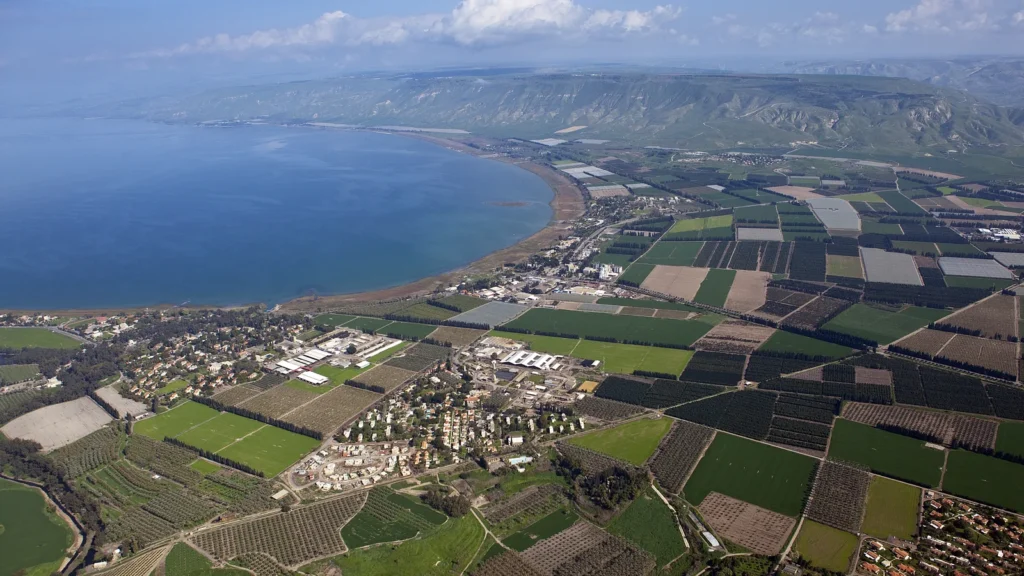
- Cover: Itamar Grinberg / israeltourism via Wikimedia Commons, February 2010. Cropped and resized; shared under CC BY-SA 2.0.