A flower close-up, a New York tower and a New Mexico hillside can all belong to Georgia O’Keeffe’s work. The connection is not a single subject, but the way she looked at forms and transformed them.
Georgia O’Keeffe and the art of place
Georgia O’Keeffe was an American modernist artist whose paintings connected close observation with abstraction. Born in Wisconsin in 1887, she became associated with New York and, later, northern New Mexico. Her landscapes grew from specific places, including Ghost Ranch and Abiquiú, but transformed their forms rather than simply recording their appearance.
Choose a starting point: Understand observation and abstraction, compare her two New Mexico homes, or distinguish the White Place and Black Place.
1. An artist shaped by more than one landscape
O’Keeffe’s enlarged flowers and New Mexico landscapes are familiar, but neither category describes her entire career. She also painted city architecture, made abstract drawings and explored views from the air. Place supplied subjects; her decisions about scale, color and composition made them into art.
She studied traditional painting before developing a different approach under the influence of Arthur Wesley Dow’s teaching. Abstract charcoal drawings brought her work to photographer and gallery owner Alfred Stieglitz, who exhibited it in 1916. He later became her husband. By the mid-1920s, she had established a reputation through both flowers and New York skyscrapers.
2. A selective timeline of her changing home ground
The distinction between a visit and a permanent move matters. O’Keeffe saw Santa Fe in 1917, well before the extended 1929 trip that redirected her painting. She continued moving between New York and New Mexico for roughly two decades before settling in the Southwest.
| Year | Place and turning point |
|---|---|
| 1887 | Born near Sun Prairie, Wisconsin. |
| 1917 | Stops in Santa Fe during a journey back to Texas. |
| 1918 | Moves to New York to pursue her art. |
| 1929 | Makes an extended New Mexico stay, working in Taos. |
| 1934–1940 | First visits Ghost Ranch in 1934; buys her house there in 1940. |
| 1945–1949 | Buys the Abiquiú property in 1945; settles permanently in New Mexico in 1949. |
| 1986 | Dies in Santa Fe, aged 98. |
3. From New York buildings to close-up forms
Observation and abstraction
Abstraction simplifies or reorganizes what an artist sees rather than reproducing every visible detail. The Metropolitan Museum of Art describes how O’Keeffe enlarged flowers until their lines and shapes could almost become independent subjects. Her close views of rocks and cliffs used a related approach.
New York offered a different scale. Skyscrapers and elevated viewpoints became subjects during the 1920s, while summers at Lake George supplied landscapes and botanical forms. The city and countryside were not two separate artistic identities: both offered structures she could isolate and rearrange.
Her paintings should therefore not be read as exact scenic records. A skull placed against distant hills or a cliff filling the canvas involves choices about proportion and framing. Recognizing a real location helps explain the work, but it does not remove the artist’s interpretation.
4. Ghost Ranch and Abiquiú were different homes
A dry retreat and an irrigated village garden
O’Keeffe bought a house on a parcel at Ghost Ranch in 1940, not the whole ranch. It became her summer home. In 1945 she bought a ruined compound in Abiquiú, where Maria Chabot carried out restoration under her supervision. The restored home combined regional adobe building traditions with modern interiors and light.
Water helps explain the difference between the properties. In a cultural-landscape presentation hosted by the National Park Service, researcher Katherine Boles describes the dry Ghost Ranch setting and contrasts it with Abiquiú’s existing garden and irrigation. An acequia, an irrigation channel, connected the village property to a working landscape rather than an isolated desert scene.
The Abiquiú studio looked north toward the Rio Chama and its cottonwoods. Farmland and irrigation belonged to the surroundings as much as distant mountains. Reading this setting only as empty wilderness misses the cultivated valley and the everyday systems that supported life there.
The house itself also became a subject. Its walled patio and dark doorway provided arrangements of light, shadow and geometric form. A painting inspired by Abiquiú might therefore begin with domestic architecture, not a distant mountain.
5. The White Place and the Black Place
Two landscapes, not two museum buildings
The White Place is Plaza Blanca, a landscape of pale rock formations near Abiquiú. O’Keeffe returned there and made several paintings, including The White Place in Sun (1943). A 1957 photograph of her walking among the formations was made by Todd Webb: the artist in a photograph is not necessarily its photographer.
The Black Place was another landscape she repeatedly painted. The O’Keeffe Museum documents more than a dozen major works made there between 1936 and 1949. Those excursions required overnight stays with camping equipment, food and water. They were journeys to work with a particular terrain, not simply views from her front door.
A 2018 museum exhibition paired her work with Michael Namingha’s digitally reworked photographs of the same landscape. That comparison shows why a place cannot be reduced to one artist’s vision: different tools and choices can produce markedly different images from the same ground. The exhibition is a historical example, not a current event listing.
6. Paintings, historic homes and the living region
The museum galleries in Santa Fe, the Abiquiú Home and Studio, and O’Keeffe’s Ghost Ranch house are different places. A gallery visit is not a visit to her studio, and visiting the wider Ghost Ranch does not by itself mean entering her former home. The museum’s historic-homes information explains the distinction; consult its booking information before arranging access.
O’Keeffe was one participant in a much longer regional history. Her Abiquiú home drew on Native American and Spanish Colonial architectural traditions. The village, gardens and valley were not created by her arrival. Understanding those surroundings makes her work more geographically specific without treating New Mexico as merely the backdrop to a famous life.
What Did We Learn Today?
O’Keeffe’s career connects the built forms of New York with the hills, homes and cultivated landscapes of northern New Mexico. Her movements explain when particular settings entered her work; abstraction explains why the resulting paintings are more than records of scenery. Ghost Ranch, Abiquiú and the painted landscapes each played a different role.
Sources & Data Notes
Historical evidence and place distinctions
The timeline distinguishes the 1917 Santa Fe stop, the extended 1929 New Mexico stay and the permanent move in 1949. Cultural-landscape discussion draws on Katherine Boles’s 2020 presentation, not a claim that every proposed research phase was completed. Historic exhibitions are identified by year; access arrangements should be checked with the museum.
- Georgia O’Keeffe Museum: biography
- Georgia O’Keeffe Museum: timeline
- The Metropolitan Museum of Art: Georgia O’Keeffe (1887–1986)
- Georgia O’Keeffe’s Homes
- National Park Service: The Cultural Landscapes of Georgia O’Keefe
- Georgia O’Keeffe Museum: Report from the Faraway: Plaza Blanca
- The Black Place: Georgia O’Keeffe and Michael Namingha
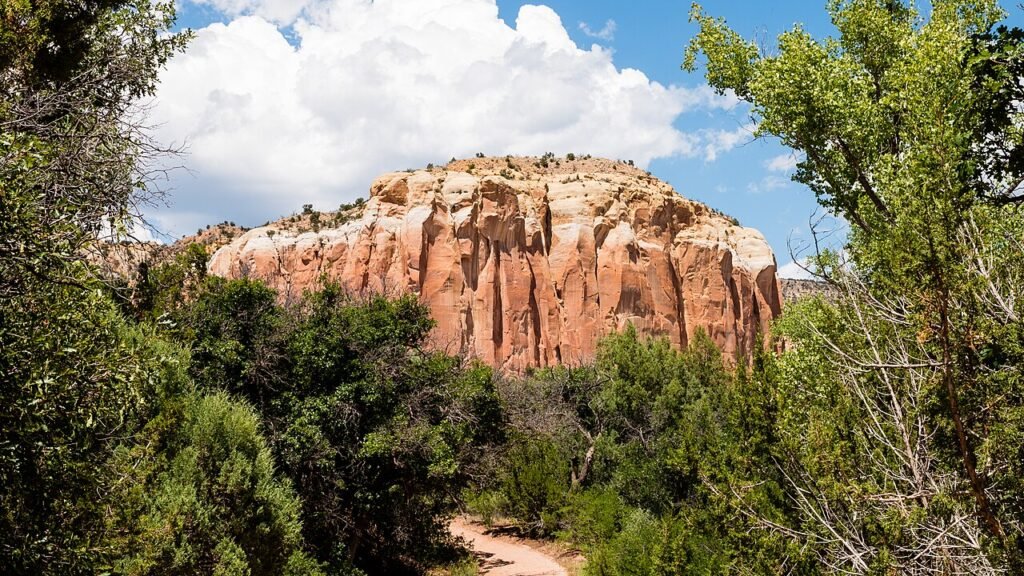
Landscape photograph: Ghost Ranch, New Mexico, July 20, 2017. NPS Photo/M. Reed, via Wikimedia Commons; public-domain U.S. federal government work. This is a photograph of the landscape, not a reproduction of an O’Keeffe painting.