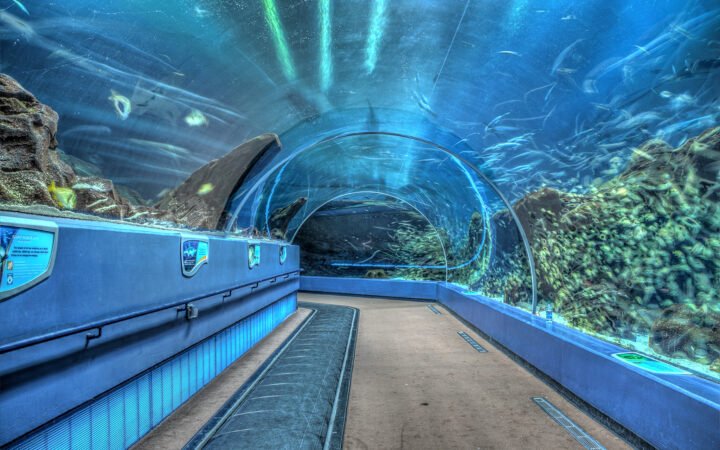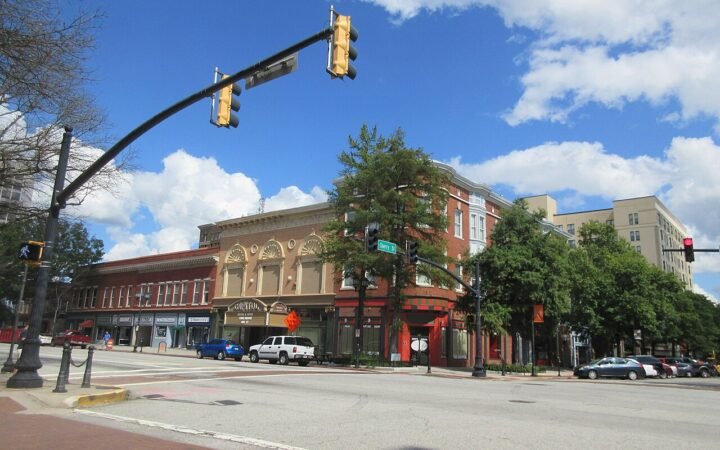
Georgia in the southeastern United States offers several different trips: an Atlanta city stay, a northern mountain break, or Savannah paired with the Atlantic coast. Trying to fit all three into a short visit usually means giving the road more time than the places you came to see.
City, mountains or coast: start with one
For a first trip to Georgia, the U.S. state, choose one region for a short break: Atlanta for city culture, northern towns for mountain outings, or Savannah and the coast for historic streets and beach time. With a longer stay, connect selected bases and count transfer days separately from full sightseeing days.
How to use this article: Compare the regional bases, choose a five-night route, or check when a car helps.
Planning sources checked November 18, 2026. Suggested night allocations are editorial starting points, not timed or personally tested itineraries.
1. Choose a region before choosing hotels
Three different starting points
| Base | Best fit | Planning tradeoff |
|---|---|---|
| Atlanta | Museums, civil-rights history, arts and neighborhoods | Cluster activities geographically rather than repeatedly crossing the metro area |
| A northern mountain town | Waterfalls, trails and small-town time | Choose one gateway near your outings, not a new cabin every night |
| Savannah or a coastal base | Historic streets, beach days and maritime landscapes | A city stay and an island stay have different access and transport needs |
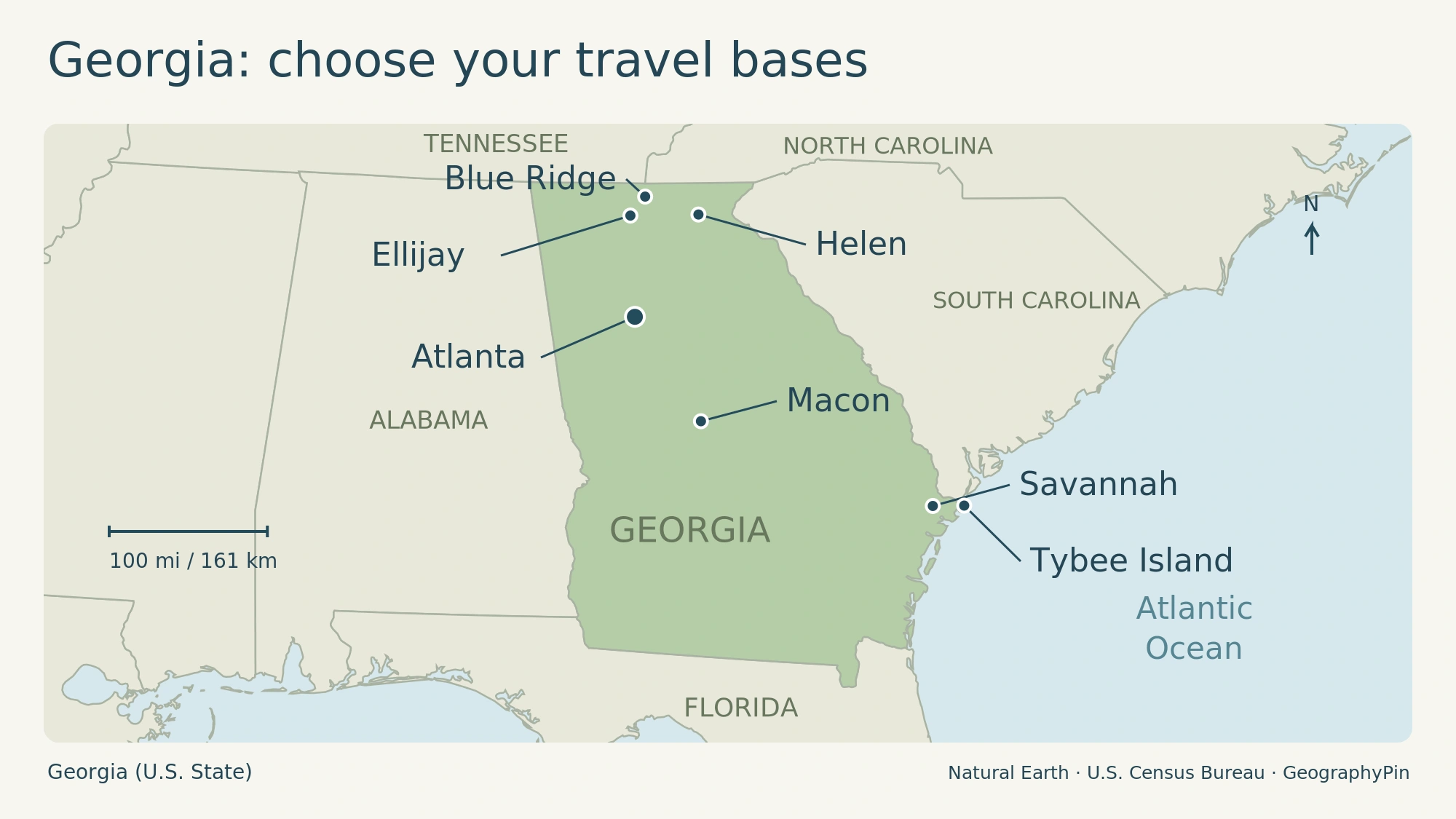
For the broader landscape and state background, see the Georgia (U.S. State) geography and facts profile.
Explore Georgia’s visitor regions are useful for orientation, not rules about how many stops a trip needs. Atlanta rewards urban interests; the north changes the emphasis to scenery and outdoor days. The coast combines Savannah with islands, while central Georgia adds music and cultural-history stops.
For a smaller city break centered on university grounds, live music and a separate garden or museum visit, consider Athens. Give it its own overnight plan rather than treating an evening concert as an extra stop after a mountain day.
Farther east, Augusta offers riverfront walking, museums and canal heritage. Treat it as a separate city stay, with downtown and the canal headgates planned as different outings, rather than adding it to an already full mountain-to-coast transfer.
For a western-Georgia stop, Columbus combines an Uptown riverfront day with a separately planned museum visit or guided river activity. Keep those choices in one local stay rather than treating whitewater as a quick addition to a long transfer day.
In the north, Helen, Ellijay and Blue Ridge offer different town experiences. Helen’s Bavarian-style center, Ellijay’s apple associations and Blue Ridge’s rail-and-outdoors setting are reasons to choose, not obligations to visit all three. Pick the town that best matches your main outings.
A downtown hotel suits evening walks and meals nearby; an outlying cabin suits quiet time but adds travel whenever you leave it. Compare the exact address with your planned activities before choosing the prettiest listing. This matters especially if you do not want to drive after dinner.
2. Build a route around nights, not a list of sights
Three nights: stay in one base. Choose Atlanta for a city break, Savannah for a historic-center stay with an optional coast outing, or one mountain town for two unhurried outdoor days. Do not add a second distant region just to say you visited it.
Five nights: pair places that belong together
Atlanta and the north: spend two nights in Atlanta, then three nights in one mountain base. Keep the transfer day lighter than a full hiking day. Choose Helen or another gateway according to your planned trails, and leave one day flexible for weather rather than booking an outdoor activity every morning.
Savannah and the coast: spend three nights in Savannah, then two nights at your chosen coastal base, or keep all five nights in Savannah if you prefer fewer moves. Tybee Island is the nearby beach option; staying there makes more sense when beach time is the priority rather than an occasional excursion.
These two five-night ideas are alternatives, not halves of a compressed single itinerary. A mountain-to-coast transfer is a substantial change of region. If both are essential, add nights or remove city days rather than assuming every transfer can happen after sightseeing.
Eight nights, Atlanta to Savannah: try three nights in Atlanta, one in Macon and four in Savannah. Macon sits at the I-75/I-16 junction, about 85 miles (137 kilometers) south of Atlanta, and its music heritage makes it more than a fuel stop. The overnight breaks the journey into two stages without adding a northern detour.
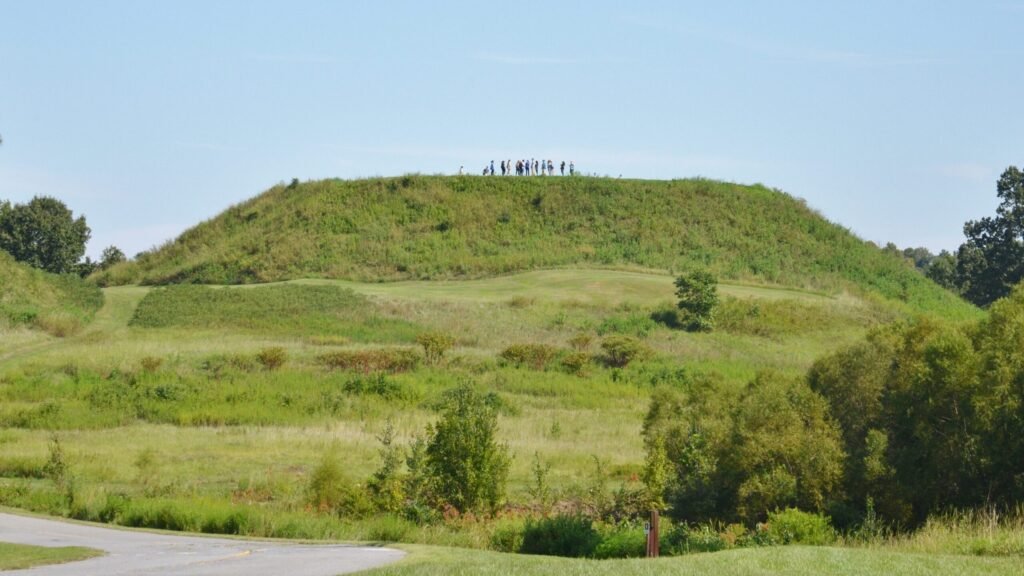
Give Macon enough daylight for a chosen visit. Ocmulgee Mounds National Historical Park preserves an Indigenous cultural landscape with Mississippian-period earthworks. Combine that interest with Macon’s music history only if opening arrangements and your arrival time allow; otherwise choose one well rather than rushing both.
For the longer route, compare arriving in Atlanta and departing from Savannah with returning to the same airport. Different-airport flights or a one-way car rental may cost more, but so does retracing the route. Price the whole journey, including any final overnight needed before an early flight.
3. Match the airport and transport to your route
Keep the car for the days that need it
An Atlanta-focused stay does not automatically require a rental car from arrival. MARTA’s Airport Station is inside the Domestic Terminal, with Red and Gold line service. International-terminal arrivals have a free shuttle connection to the Domestic Terminal. Check the current service hours and your accommodation’s final connection before relying on rail.
If your city activities work with transit and walking, compare collecting a car only when you leave Atlanta. For a mountain itinerary with scattered trailheads, plan a rental or specifically arranged transport; do not assume city transit will reach the countryside. A distant cabin is not made convenient by being inside the same county as a trail.
For a coast-focused stay, compare flights into Savannah/Hilton Head International rather than automatically routing through Atlanta. The airport lists rental cars, taxis and rideshare arrangements. Check the desk hours for your actual rental company if arriving late, and distinguish reaching Savannah from reaching an island accommodation.
Before each driving day, check current road conditions and navigation for the actual addresses. Budget stops, city traffic and check-in rather than treating a map’s fastest estimate as a promise. If you use an intercity bus or train instead, verify the dated service and the local trip from its station; a city-name destination is not a hotel drop-off.
4. Let the season shape the day
Spring and autumn: these are sensible starting points for walking-heavy Savannah plans. Fort Pulaski’s coastal weather guidance describes generally pleasant spring and autumn conditions, hot humid summers and possible winter cold snaps. It is regional context, not a forecast for your travel week.
Summer: put exposed walks early in the day and leave room for indoor stops, meals and rest. Beach time and mountain outings still need weather judgment; neither a paid activity nor a short trail makes thunderstorms irrelevant. For coastal travel, check tropical-weather alerts close to departure.
Fall in the mountains: use Georgia State Parks’ Leaf Watch for location-specific planning rather than assuming one statewide peak-color weekend. The park service encourages weekday visits and warns that full parking can limit access. Book the overnight base you want before building a crowded list of scenic stops around it.
Winter: favor a plan that remains enjoyable without swimming or a long exposed hike. City culture, town time and shorter outdoor visits can carry the trip, but check local conditions rather than assuming the entire state stays warm. Keep an indoor alternative for the day you care about most.
5. Book the experiences that control your schedule
Not every outdoor outing can be improvised after breakfast. At Tallulah Gorge State Park, rim overlooks and a descent to the gorge floor are different undertakings. The floor requires a permit and strenuous hiking; weather and water releases can restrict access. Choose the experience you can actually manage, not just the photograph you want.
Cumberland Island is a separate coastal commitment, reached by ferry or private boat rather than a road bridge. NPS recommends ferry reservations and warns that last-minute visitors can be placed on standby or turned away. Build that day around the confirmed boat arrangements instead of adding it casually to a Savannah sightseeing day.
Reserve the pieces that control the rest of your trip first: an essential ferry, a dated performance or a limited overnight stay. Then fit flexible walks and meals around them. Check cancellation terms for weather-sensitive activities, and do not assume buying transport also buys admission to the place it reaches.
The same principle applies to accessibility. Confirm the actual entrance, terrain, seating and transport handoff for the outing you choose. A scenic overlook, historic street and gorge-floor trail can have very different demands even when they appear together in one destination description.
What Did We Learn Today?
A good Georgia state trip begins with a few well-chosen bases. Keep short visits regional, use longer stays to connect places without sacrificing every transfer day, and match transport to the activities you actually want. Seasonal conditions and limited-access outings should shape the route before the hotel list becomes fixed.
Sources & Data Notes
View regional and practical planning sources
Checked November 18, 2026. Route combinations and night allocations are GeographyPin editorial suggestions, not measured driving schedules. Operator links govern current transport, trail and ferry arrangements; no fixed admission prices or guaranteed opening hours are quoted.
Photograph: Great Temple Mound, Ocmulgee Mounds, NPS Photo, public domain. The source records an August 2015 image; it is not a current access inspection.
- Explore Georgia: visitor regions
- Explore Georgia: northern mountain towns
- Explore Georgia: Macon location and cultural interests
- NPS: Ocmulgee Mounds
- MARTA: airport connections
- Savannah/Hilton Head Airport: ground transport
- NPS: Fort Pulaski coastal weather
- Georgia State Parks: Leaf Watch
- Georgia State Parks: Tallulah Gorge access
- NPS: Cumberland Island reservations
- Visit Savannah: Tybee Island
- Original travel locator: Natural Earth v5.1.1 boundaries and 2026 U.S. Census Gazetteer place points, public-domain data. Generalized geography; not a navigation map.