Savannah sits near the Atlantic coast of Georgia, the U.S. state. For visitors, the useful choice is not how many historic houses to collect, but how to balance the squares and park with a worthwhile museum visit, meals and the riverfront.
Squares, park and riverfront without rushing
Plan two full days in Savannah for the Historic District’s squares, Forsyth Park, River Street and one carefully chosen museum visit. Stay near the places you want to walk, leave room for heat and uneven surfaces, and treat Tybee Island as a separate coastal outing rather than another downtown stop.
How to use this article: Compare places to base yourself, use the shorter squares walk, or check riverfront level changes.
Practical sources checked November 18, 2026. The suggested days are flexible editorial itineraries, not guided tours or certified accessible routes.
1. Choose your nights and a base
One day: choose the Bull Street squares and park, with either a museum or a riverfront visit. Two full days: separate the main walk from a museum-centered day. Three or more: add a coast outing or more time for art and neighborhoods, rather than cramming everything into the same afternoon.
Where to stay for the days you want
| Area | Good fit | What to check |
|---|---|---|
| Central Historic District | Squares, museums and a walking-focused first visit | Exact entrance, stairs and parking arrangements |
| Near Forsyth Park | Park time and the southern end of the squares walk | The return journey after a riverfront evening |
| Bay Street or riverfront | Time beside the river and nearby dining | Which street level the entrance uses, plus room noise |
| Airport or an outlying location | Flight logistics or a driving-led trip | Total transport and parking costs, not just the room rate |
These are location tradeoffs, not hotel rankings. If an afternoon rest is important, a room near your main walk can be more useful than a larger room requiring another journey. For a historic inn, ask about the specific room’s access rather than assuming an attractive old building has an elevator.
A two-day stay does not require a car for every outing. Compare the cost of keeping a rental parked with arranging airport transport and collecting a car only for an excursion. Travelers combining regions can use the wider Georgia state travel routes to decide where Savannah belongs in the trip.
2. Walk the squares, then give the riverfront its own time
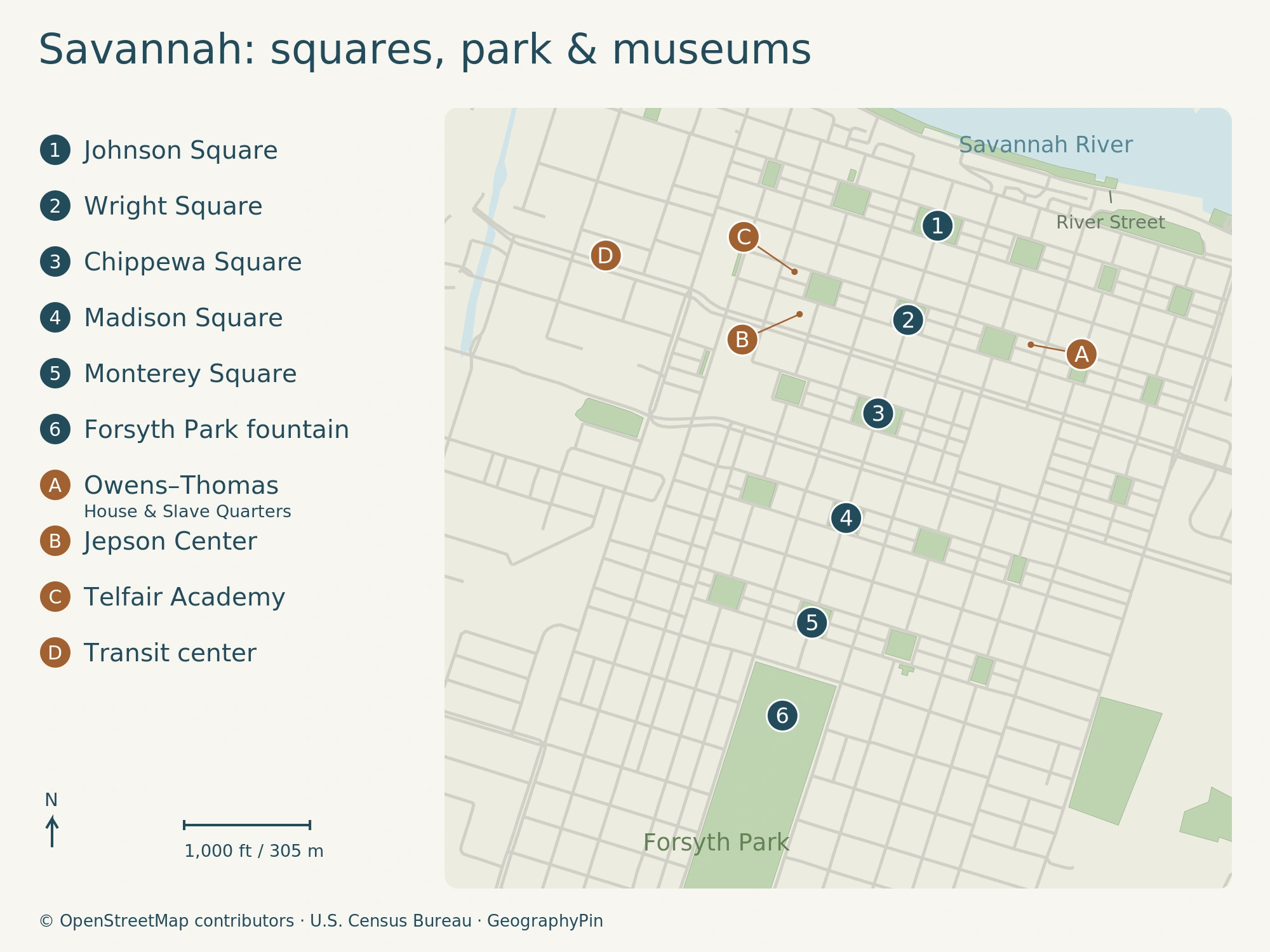
Day one, morning: start at Johnson Square and work south along the Bull Street corridor through Wright, Chippewa, Madison and Monterey squares. The visitor bureau’s square directory locates these public spaces along the same axis. Use marked crossings between blocks, and take time to sit rather than treating each square as a quick photograph.
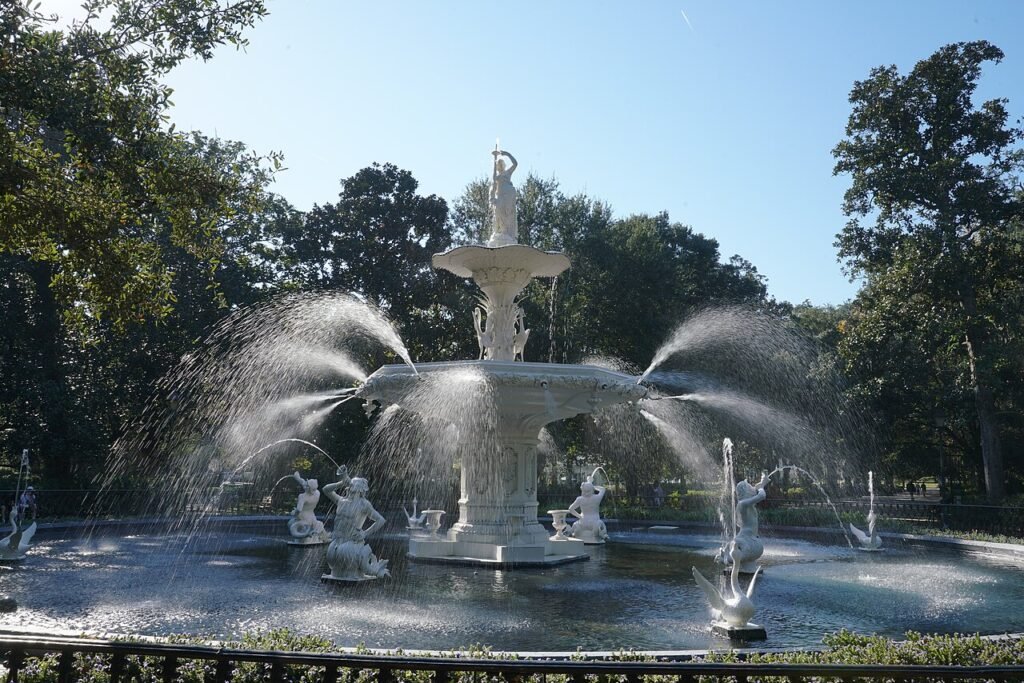
Continue to Forsyth Park, whose fountain stands at the north end. Its walking paths and open green space make a different kind of stop from the smaller squares. Allow time for a meal or rest afterward; the park need not be the start of another long sightseeing list.
Day one, later: return toward the river when you want a change of scene. River Street can be a separate outing rather than a compulsory walk back from the park. Keep dinner flexible enough to enjoy the waterfront instead of chasing a reservation at the opposite end of the district.
A smaller walk around three squares
With limited time or energy, keep Johnson, Wright and Chippewa squares and stop there. Have lunch nearby, then choose either one indoor visit or the riverfront. Forsyth Park can become a separate short visit by transport rather than the endpoint you must reach on foot.
Day two: build the morning around your chosen museum time, then leave the afternoon for the streets and squares nearby. Owens-Thomas sits by Oglethorpe Square; the Jepson Center and Telfair Academy cluster around Telfair Square. Pick the museum first so the surrounding walk supports it, rather than cutting a visit short to keep an arbitrary timetable.
Reverse the two days if a museum reservation or the weather makes that easier.
3. Pick one museum visit that adds meaning
The Owens-Thomas House & Slave Quarters is a strong choice when you want more than architectural admiration. Telfair interprets the household through slavery, including the lives of enslaved people who maintained the wealthier family’s home. Give that history the same attention as the rooms and decorative objects.
The operator offers advance selection of a tour day and time, subject to capacity, and requires onsite check-in even with a purchased ticket. Telfair describes guided visits as roughly 45–60 minutes and also lists late-afternoon self-guided audio entry. Confirm the format attached to your chosen time in the official booking details, and check the museum’s dated notices before traveling.
Access differs within the property: the Orientation Gallery and Slave Quarters have ramped entrances, while the mansion has stairs and no elevator. Contact the museum about the parts of the experience you can use before buying.
For an art-focused alternative, the Jepson Center at 207 West York Street combines art with the Telfair Children’s Art Museum. Look at the current exhibitions before choosing it, particularly if the visit is your main indoor activity rather than simply a rain shelter.
For the background behind the street plan and the wider city, see the Savannah city profile: map and history.
4. Arrive without turning every outing into a drive
Savannah/Hilton Head International Airport lists rental cars, taxis and rideshare options. Check your rental company’s desk hours for a late arrival, and confirm the final destination when arranging a ride. An airport transfer to Savannah is not automatically a transfer onward to Tybee Island.
For public transport, CAT’s Route 3 West Chatham links the airport with the Joe Murray Rivers, Jr. Intermodal Transit Center downtown. CAT explicitly describes it as a regular stopping route, not a direct airport shuttle. Check the dated timetable against your landing time and allow for reaching your accommodation from the transit center.
Within downtown, the fare-free DOT shuttle can reduce walking between parts of the district. Use the operator’s current map and service notices for the stops you need; it is not an all-night substitute for a return ride. This is particularly useful to consider before combining the park with a waterfront evening.
If you arrive by car, establish the hotel’s loading and parking arrangements before entering the historic streets. Compare overnight charges and re-entry rules, then leave the car in one place for a clustered walking day where practical. Moving it between adjacent squares adds work without adding much to the visit.
5. Plan around heat, surfaces and a separate coast day
Getting between Bay Street and River Street
The waterfront sits below the upper streets, with cobblestone ramps and stair connections. Savannah’s Waterfront lists a central public elevator between the Hyatt Regency and City Hall at Bull and Bay streets. Use that location when planning, but confirm it is operating if your visit depends on avoiding stairs.
The visitor bureau’s accessibility guidance identifies paved paths through Forsyth Park and accessible waterfront facilities, while noting that individual business entrances vary. A smooth path on one block does not establish an accessible route through the whole district. Ask about the entrance you will actually use, including any return uphill.
For walking-heavy days, spring and autumn are useful starting points. NPS guidance for nearby Fort Pulaski describes hot, humid summers and possible winter cold snaps. In summer, put the longer walk early, leave space for indoor breaks and check the local forecast before a coast outing. Shade is welcome but is not a substitute for shelter during a thunderstorm.
Tybee Island belongs on a separate day. The nearby beach destination is outside the downtown sightseeing circuit. Decide how you will travel both ways and leave room for a beach visit and a meal, rather than squeezing it between a timed house tour and dinner in Savannah.
If you have only two city days and no particular interest in the beach, keep them in Savannah. If the beach is the main reason for the trip, compare an island base with a city base instead of commuting by default. A shorter list of places often leaves more of the day for enjoying them.
What Did We Learn Today?
Savannah works well as a few connected experiences rather than a race between landmarks. Choose a base near your main interests, give the squares and park their own time, and select a museum that deepens the visit. Riverfront levels, transport hours and summer heat affect the day; an island excursion deserves separate space.
Sources & Data Notes
View visitor and operator sources
Checked November 18, 2026. Day plans and base comparisons are GeographyPin editorial suggestions, not measured walking schedules or accessibility inspections. Dated operator notices take precedence over generic hours; no admission price or fixed transit frequency is quoted.
Photograph: Fountain (Forsyth Park), jjmusgrove, November 7, 2023, CC BY 2.0, via Wikimedia Commons. Resized; this photograph predates the 2025 restoration.
Original GeographyPin map: © OpenStreetMap contributors, ODbL data retrieved November 18, 2026, with U.S. Census 2025 water geometry. Museum points mark sites, not verified entrances. The local map does not show the airport or Tybee Island.
- Visit Savannah: square locations
- City of Savannah: Forsyth Park
- Telfair: Owens-Thomas visits and access
- Telfair: Jepson Center
- Savannah’s Waterfront: access FAQ
- Visit Savannah: accessibility
- Savannah Airport: ground transport
- CAT: current schedules
- CAT: DOT shuttle
- NPS: coastal weather context
- Visit Savannah: Tybee Island