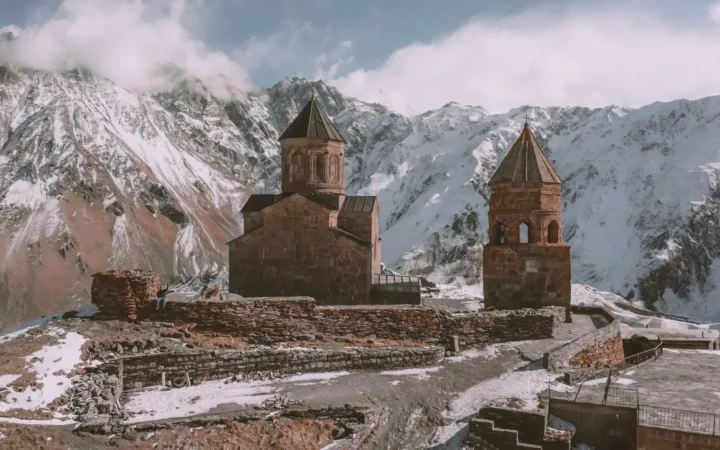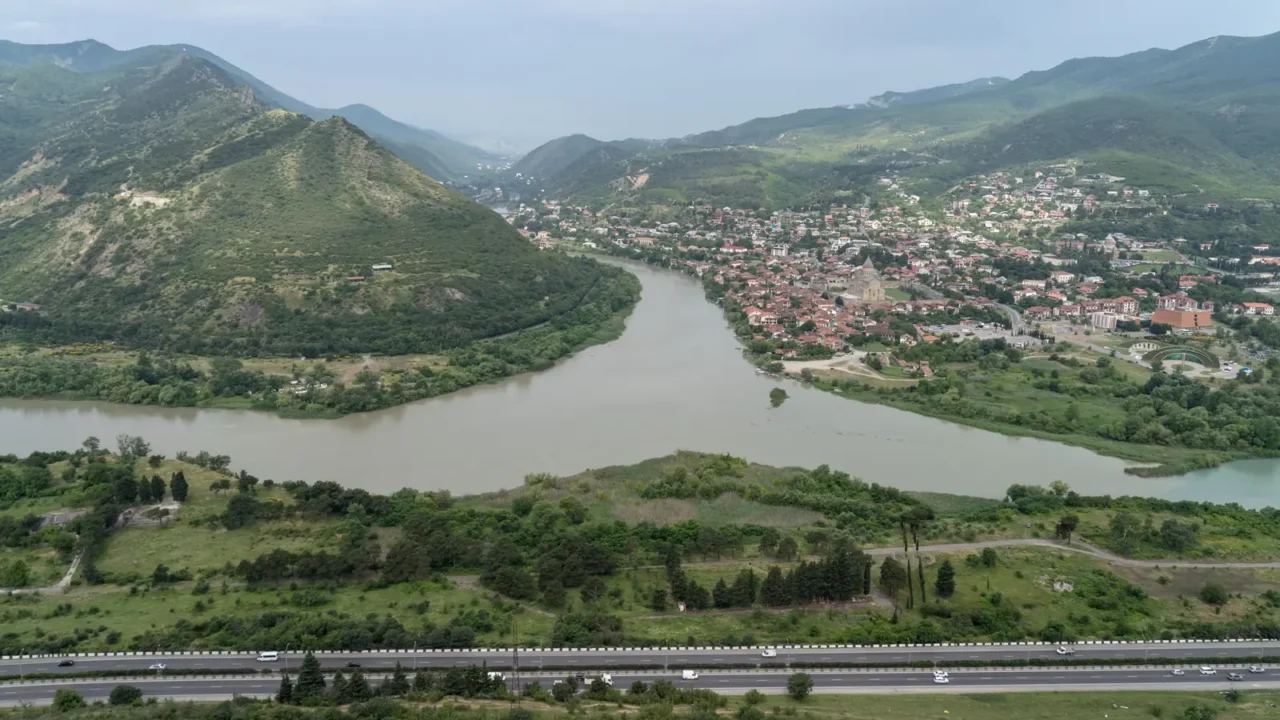
Mtskheta offers one of the most rewarding short trips from Tbilisi: a cathedral town, early medieval churches and a view of the Aragvi meeting the Mtkvari. The main planning mistake is to assume that everything fits into one town walk. Jvari Monastery stands separately on the hill and needs its own transport plan.
For a first Mtskheta trip, combine Svetitskhoveli Cathedral and Samtavro Monastery on foot, then visit Jvari with arranged transport. A half-day works with efficient transfers; a full day allows lunch and slower visits. Confirm the return journey before leaving Tbilisi or going up to Jvari.
How to use this article: Choose transport, explore Svetitskhoveli, plan Jvari, or follow the half-day route.
Plan the Town Walk and the Hilltop Separately
Mtskheta stands where the Aragvi joins the Mtkvari, about 20 km (12 mi) northwest of Tbilisi. It was a capital of the ancient kingdom of Kartli and remains a major center of Georgian religious life. The setting makes the history unusually easy to see: churches in the river valley and Jvari on the hill above.
Three monuments, two parts of the visit
The UNESCO property Historical Monuments of Mtskheta, inscribed in 1994, comprises Jvari Monastery, Svetitskhoveli Cathedral and Samtavro Monastery. It is a group of designated monuments, rather than a claim that every building in town is World Heritage-listed.
| Place | Why visit | How to include it |
|---|---|---|
| Svetitskhoveli Cathedral | The large medieval cathedral at the heart of town | Anchor the central walking route here |
| Samtavro Monastery | A monastic complex associated with Saint Nino and early Christian rulers | Combine with Svetitskhoveli on foot |
| Jvari Monastery | Early medieval architecture and the river-confluence panorama | Arrange a separate hilltop transfer |
A half-day can cover the main sights with efficient transport and a short break. A full day gives room for lunch, slower visits and time in the streets around the cathedral. Travelers using shared transport should leave more flexibility for connections, particularly if adding Jvari.
The distance from Tbilisi is not a door-to-door travel time. Your starting neighborhood, traffic and the route to the hilltop all matter. Keep a Mtskheta excursion separate from a tightly timed airport departure or evening booking.
Getting from Tbilisi to Mtskheta
Choose transport around Jvari
For the simplest first visit, book a driver or tour that explicitly includes Jvari and the town center. These are separate stops. A transfer described only as “Tbilisi to Mtskheta” may finish in town without taking you up to the monastery.
Before agreeing to a price, specify pickup, all stops, waiting time and the final drop-off. Ask whether the price is for the vehicle or per person and whether guiding is included. A driver gets you between places; a guide can explain the buildings, inscriptions and religious traditions.
If booking a tour, read the full route. Some combine Mtskheta with much more distant destinations, leaving only brief stops here. Choose a dedicated excursion if you want time inside the churches and an unhurried meal.
Shared transport: confirm the departure and return
Didube is the Tbilisi departure area to ask about for Mtskheta-bound minibuses and local services. Confirm the correct vehicle, fare, town-center drop-off and return stop before boarding. Show the Georgian place name, მცხეთა, if it helps. Do not rely on an old online departure interval or assume that every vehicle heading north stops where you want.
The municipality has published a Route 2 connection between the Mtskheta area and Didube, but its available notice describes a January 2024 trial. That is not reliable evidence for today’s timetable or fare. Ask locally about the current service rather than building a tight itinerary around that notice.
For current local help, Georgia Travel lists the Mtskheta Tourist Information Center at 3 Arsukidze Street, opposite Svetitskhoveli’s entrance. Check the return journey early in the visit, then arrange Jvari separately if it is part of your plan.
Arrange the return from Jvari before going up
When taking a taxi to Jvari, agree whether the driver will wait and where you will go afterward. A one-way ride does not include a return, and a ride-hailing car being available in Tbilisi does not guarantee an immediate pickup on the hill. Save the meeting point and contact details.
Drivers should check current road conditions, use legal parking and leave space for tour vehicles and pedestrians. With children, arrange suitable restraints when booking. Do not treat the hilltop approach as a casual extension of the town’s pedestrian walk.
Svetitskhoveli and the Streets Around It
Give the cathedral more than a photo stop
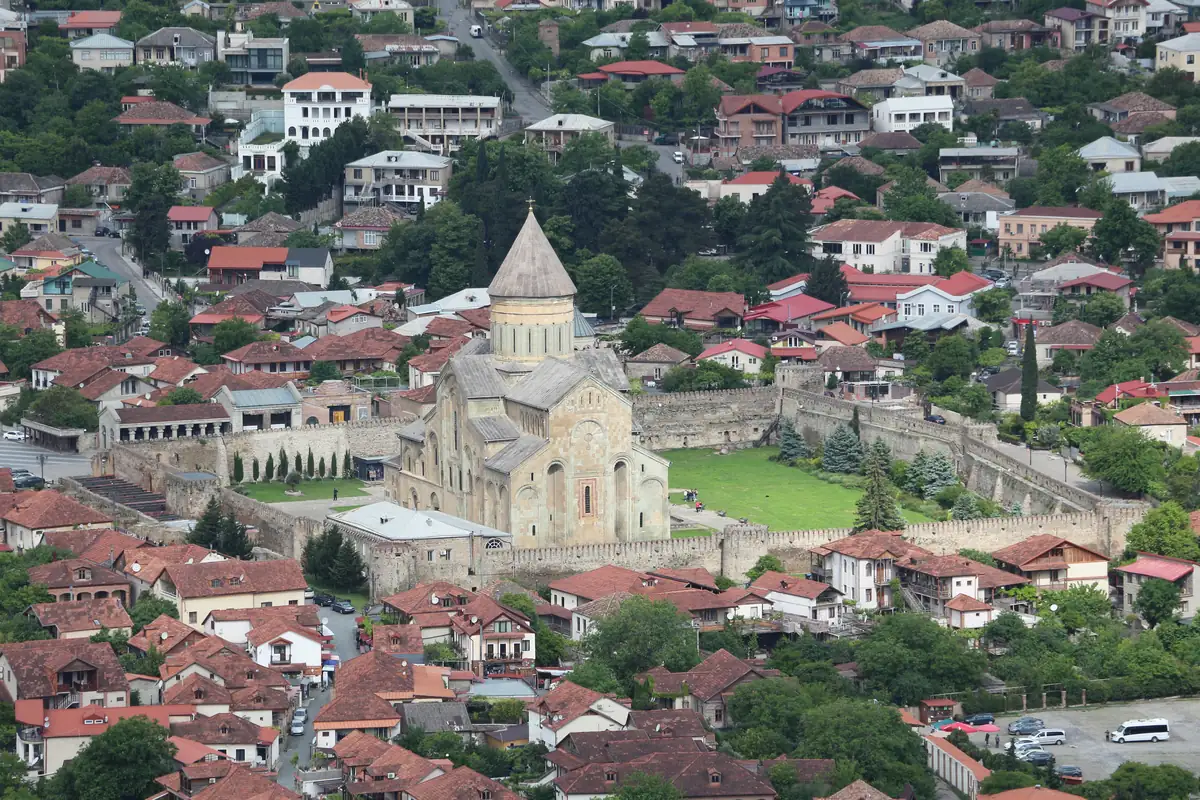
Svetitskhoveli Cathedral is the natural starting point in central Mtskheta. The present building dates to the 11th century and stands on a site associated with earlier churches. Its scale, carved stonework and surviving interior decoration reward a visit that is not rushed.
The cathedral is closely tied to the Georgian Christian tradition that Christ’s robe lies here. Its name is commonly translated as “life-giving pillar,” reflecting the religious story connected with the site. These traditions help explain its importance to worshippers; they should be understood as faith traditions rather than archaeological proof.
Look at the exterior before entering, then allow time for the interior where access is permitted. If a service or ceremony is taking place, keep clear of worshippers and follow instructions about movement and photography. A guide can add context, but the building should not be treated as a museum detached from religious life.
Leave time for the surrounding streets
The streets by the cathedral have souvenir stalls, food shops and places to eat. They are useful for a break between visits rather than a reason to rush through the monuments. Compare prices, ask what an item is made from and check ingredients in edible gifts.
Churchkhela, the grape-based sweet often made around a string of nuts, is a common purchase. Ask about allergens and packaging if taking it home. For lunch, choose somewhere that fits your available time and confirm the total bill, including any stated service charge.
Keep the walk comfortable: wear shoes with grip, carry drinking water and allow for uneven paving. If traveling with a wheelchair or stroller, check the actual entrance and route rather than assuming that a compact center is entirely step-free.
Samtavro: Another Part of Mtskheta’s Religious Story
Continue the town walk to the monastery
Samtavro Monastery is also in central Mtskheta and combines naturally with Svetitskhoveli. Its main church dates to the 11th century, while the complex has associations with Saint Nino and the introduction of Christianity to the kingdom of Kartli.
The tombs associated with King Mirian and Queen Nana are an important part of its religious significance. The grounds and smaller church give the visit a different scale from Svetitskhoveli. Samtavro is a living religious community, so respect areas set aside from visitor access.
Allow a separate stop rather than treating it as a church to photograph while passing. If you have limited time, Svetitskhoveli and Samtavro make a coherent town visit without requiring a countryside transfer.
There is no need to see every church in the region in one day. Understanding how these two central sites relate to Mtskheta’s history often makes a better visit than collecting a longer list of brief stops.
Jvari and the View of the Two Rivers
Look at the church as well as the panorama
Jvari Monastery stands on a rocky hill east of Mtskheta. Its principal church dates to the late 6th and early 7th centuries and is an important early example of Georgian cross-domed architecture. The name means “cross” and is associated with the tradition of Saint Nino placing a cross on this hill.
The view brings the town and its river setting together. The Aragvi meets the Mtkvari below; Kura is another widely used name for the Mtkvari, not a third river. Our Mtkvari and Kura river guide explains that naming and the river’s wider South Caucasus course.
Do not plan the stop only around a photograph of two sharply contrasting river colors. Water conditions, light and weather vary. Even when visibility is limited, the church itself is the reason this site belongs in a heritage visit.
Keep the hilltop visit flexible
Bring a layer for exposed conditions and take care on wet or icy surfaces. Stay within permitted visitor areas and do not climb beyond barriers for a better photograph. If conditions make the approach or viewpoint uncomfortable, give more time to the town instead.
For travelers with limited mobility, ask about the distance from the vehicle, ground surface, steps and church threshold before booking. A car reaching the site is not the same as guaranteed step-free access throughout it.
Once you have seen the view, enter quietly when permitted and look at the building’s compact proportions. A short but attentive visit can be more rewarding than a longer wait for a particular photograph.
A Half-Day or Full-Day Route That Works
Half a day: the three main monuments
With a driver, agree on Jvari as a distinct stop either before or after the town. In Mtskheta, visit Svetitskhoveli, walk to Samtavro and leave time for a drink or a short meal. The order can change with traffic, weather, services and your pickup location.
For planning, set aside roughly four to five hours from departure to return, and allow more if you want a leisurely lunch or detailed guided visits. This is suggested pacing, not a guaranteed journey duration. If shared transport or a late start reduces the time, focus on the town rather than forcing an uncertain Jvari connection.
A full day: slow down before adding more stops
Use the extra time for a longer cathedral visit, Samtavro, Jvari and lunch without watching the clock. Walk the central streets and leave a buffer before the return to Tbilisi. Spending more time at the main sites is a worthwhile use of a full day.
If another monastery is a priority and transport is arranged, consider Shio Mghvime, a separate excursion outside the central walking route. Its history reaches back to the 6th century and Saint Shio. Confirm access and the extra driving time with your driver before including it.
Shio Mghvime is not one of the three components of the UNESCO Mtskheta property. It also should not be advertised as a short walk from the cathedral. Adding it makes most sense when you have a full day and a particular interest in monastic history.
Should you stay overnight?
Most first-time visitors can visit from Tbilisi without changing accommodation. An overnight stay makes sense if you want an evening and morning in Mtskheta or are continuing a wider road trip. Check the property’s exact location, dinner options and onward transport before choosing it.
For a short city break, keeping your room in the capital avoids moving luggage for a single excursion. Plan the rest of that stay with our Tbilisi travel guide.
Clothing, Weather and Practical Checks
Prepare for working churches
Wear clothing that covers shoulders and knees, and carry a scarf or extra covering in case it is required. Follow each church’s posted instructions rather than assuming the rules are identical everywhere. Keep voices low, silence your phone and ask before photographing people or religious ceremonies.
Church access can change for services, special events or conservation work. Check locally if entering a particular interior is central to your trip. Do not confuse a website’s general attraction description with a confirmed opening calendar.
Choose a comfortable day and keep the budget clear
Spring and autumn are useful starting choices for a walking-focused trip. In summer, plan water and shade breaks; in colder months, check the hilltop approach and leave enough daylight for the return. A forecast for central Tbilisi does not tell you exactly how exposed Jvari will feel.
Budget for the return transport, any separate Jvari ride, food, guiding and optional purchases. Confirm current charges directly rather than assuming all services are included in a tour price. Carry some Georgian lari for small purchases and keep money aside for the return.
Check current Georgia travel safety advice before the wider trip. Use seatbelts, be careful at road crossings and follow local instructions at historic sites. No short excursion is a substitute for your normal travel insurance and entry checks.
What Did We Learn Today?
Mtskheta is a manageable trip from Tbilisi when its two parts are planned separately: Svetitskhoveli and Samtavro in the walkable center, and Jvari on its hill above the river confluence. Those three monuments form the UNESCO property. Arrange the hilltop return, leave time for living places of worship, and choose a relaxed main route before adding Shio Mghvime or other excursions.
Sources & Data Notes
Itinerary lengths are editorial planning suggestions, not transport schedules. Current fares, departure points, return services and church access require confirmation. The municipal transport notice is historical evidence of a trial route, not a current timetable. Religious traditions are identified as traditions, and UNESCO status follows the official property listing.
Featured photograph: Mtskheta and the Mtkvari–Aragvi river confluence seen from Jvari in June 2024. Photo: Alexey Komarov (Alexkom000) / Wikimedia Commons, CC BY 4.0. Resized and converted to WebP.