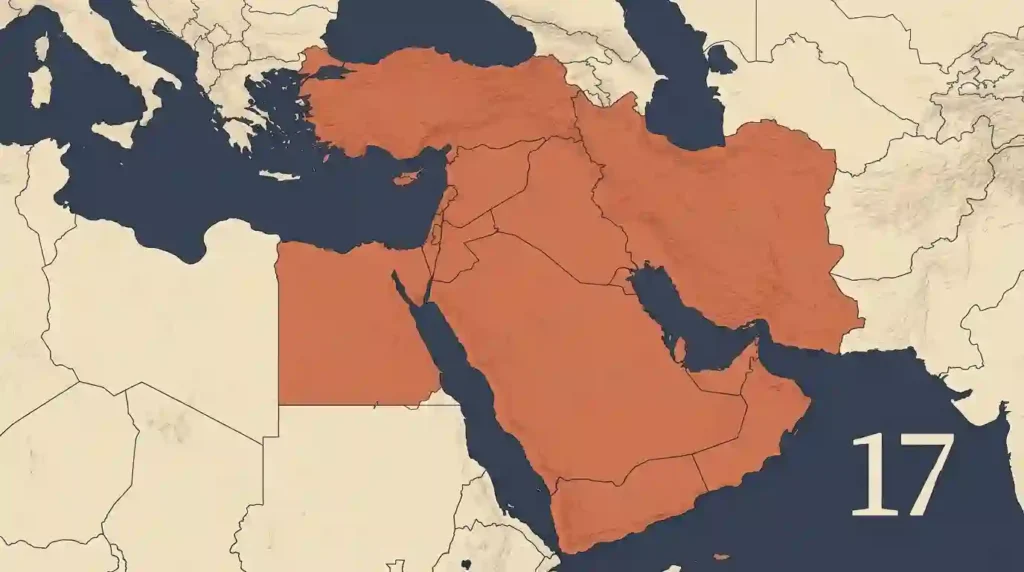
Seventeen countries are commonly included in a broad, practical definition of the Middle East. That count covers 16 United Nations member states plus the State of Palestine, and it includes Cyprus and Egypt. Because the Middle East has no universally fixed geographic boundary, narrower or institutional lists may produce a different total.
The 17 Middle East countries A–Z: Bahrain, Cyprus, Egypt, Iran, Iraq, Israel, Jordan, Kuwait, Lebanon, Oman, Qatar, Saudi Arabia, State of Palestine, Syria, Türkiye, United Arab Emirates, Yemen.
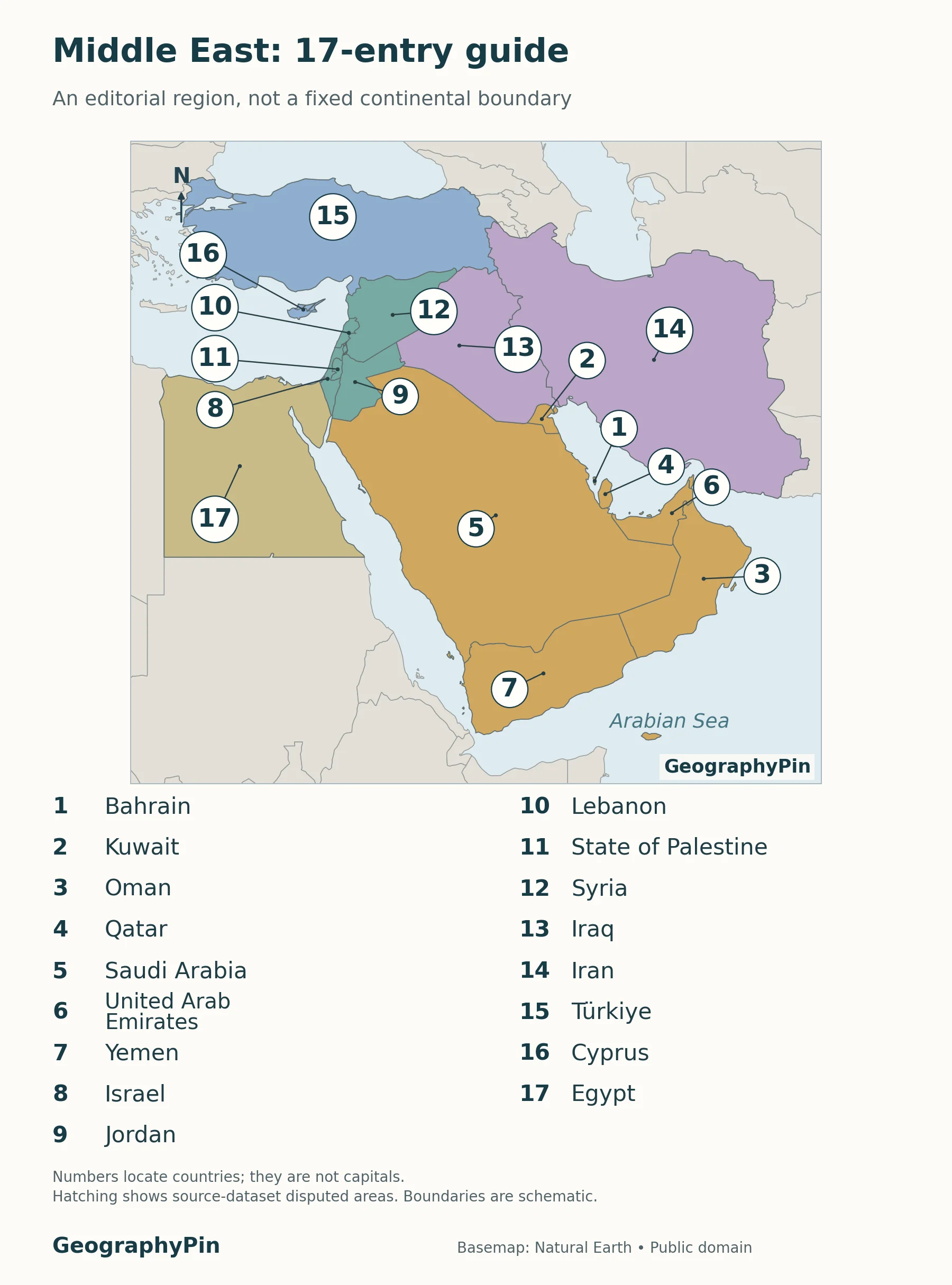
Middle East countries map: the 17-entry convention
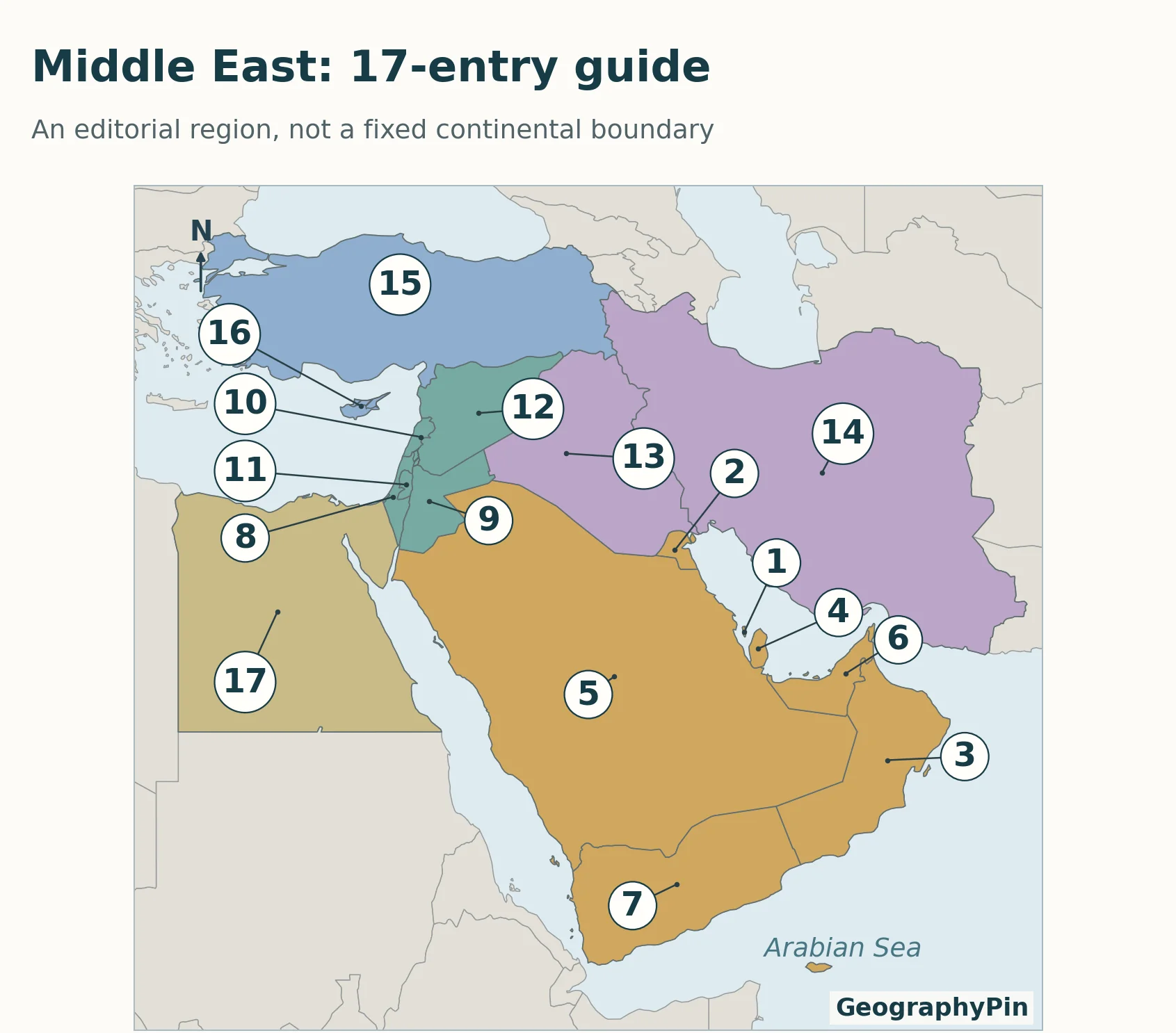
- Bahrain
- Kuwait
- Oman
- Qatar
- Saudi Arabia
- United Arab Emirates
- Yemen
- Israel
- Jordan
- Lebanon
- State of Palestine
- Syria
- Iraq
- Iran
- Türkiye
- Cyprus
- Egypt
Open the full-size map · Download the printable map
Our total includes 16 UN member states and the State of Palestine, a UN non-member observer state. Cyprus and Egypt are included under this page’s stated convention; Cyprus is counted once. A different regional definition can produce a different total.
Basemap: Natural Earth, public domain. Colors separate the editorial orientation groups, not measured data. Hatching marks the Golan Heights and Northern Cyprus from the source’s disputed-area layer and is not an exhaustive current-dispute inventory or a legal boundary determination.
How to use this article: See the grouped 17-country list, check the counting rule, compare it with UN Western Asia, or review the entries that shift other totals.
Which 17 Countries Are Included?
For general geography, a useful broad convention includes the Arabian Peninsula, the Levant, Iraq, Iran, Türkiye, Cyprus, and Egypt. It produces a practical list without treating a dependent territory or a breakaway administration as an additional country.
The 17-country list at a glance
The table groups the entries to make the map easier to read. These are editorial orientation groups, not an official set of subregions, and some countries connect more than one historical or physical zone.
| Practical grouping | Countries or states included | Count |
|---|---|---|
| Arabian Peninsula and Gulf | Bahrain, Kuwait, Oman, Qatar, Saudi Arabia, United Arab Emirates, Yemen | 7 |
| Levant | Israel, Jordan, Lebanon, State of Palestine, Syria | 5 |
| Mesopotamia | Iraq | 1 |
| Iranian Plateau | Iran | 1 |
| Anatolia and eastern Mediterranean | Türkiye (Turkey), Cyprus | 2 |
| Northeast Africa and Sinai | Egypt | 1 |
| Total | All entries above | 17 |
The counting rule used here
Sixteen entries are UN member states. The seventeenth is the State of Palestine, which the UN General Assembly granted non-member observer State status in 2012 (UN General Assembly, 2012). This follows the transparent country convention used in GeographyPin’s world capital cities reference: the observer-state basis is made explicit alongside the total.
Counting the State of Palestine does not imply that every government applies the same bilateral recognition policy, nor does it settle borders or final-status questions. For this geographic count, the West Bank and Gaza are not treated as two separate countries.
Why Does the Number Change?
The Middle East is a commonly used geographic and geopolitical region, not an administrative unit with a membership charter. National Geographic describes regions as areas assembled through shared physical or human features and uses the Middle East as an example spanning parts of Africa, Asia, and Europe. A region built this way can have a recognizable center without one compulsory outer line.
Cyprus, the State of Palestine, and Egypt shift many totals
Cyprus lies in the eastern Mediterranean and appears in the UN statistical subregion of Western Asia, yet it is also frequently grouped with Europe in political and institutional contexts. A broad Middle East list often includes it; a narrower list may leave it out.
The State of Palestine changes the arithmetic when one source follows the common 195-country convention and another limits its country total to UN members. Some references discuss the Palestinian territories but do not add a State of Palestine entry to their headline count. The difference is a counting convention, not a geographic discovery.
Egypt is centered in northeast Africa, while the Sinai Peninsula extends into Asia. Its historic, political, and geographic ties place it in most broad Middle East definitions, but a list restricted to Southwest Asia may exclude it. Türkiye creates a similar continental complication because most of its territory is in Asia while a smaller part is in Europe.
Territories do not add countries to this total
Cyprus is counted once. UN Security Council Resolution 541 treated the declaration of a separate state in northern Cyprus as legally invalid and called on states not to recognize a Cypriot state other than the Republic of Cyprus. The island’s continuing political division therefore does not create an extra country in this convention.
Akrotiri and Dhekelia are Sovereign Base Areas under United Kingdom sovereignty, not independent countries. They also do not increase the total. When another reference gives 18, the extra entry may instead come from a different regional scheme, an added territory, or another edge country; the list must be checked before the figures can be compared.
How the Middle East Differs From Other Regional Labels
Several familiar labels overlap the Middle East without describing the same set of places. Mixing them is the fastest way to produce a confident-looking but unexplained total.
Why the UN’s Western Asia list is different
The UN Statistics Division’s M49 system has a formal statistical subregion called Western Asia with 18 countries or areas. Compared with the 17-entry Middle East list used here, Western Asia removes Egypt and Iran, then adds Armenia, Azerbaijan, and Georgia. The arithmetic is therefore 17 minus 2 plus 3, which equals 18.
That does not make 18 an official UN answer to the Middle East question. M49 states that its assignments exist for statistical convenience and do not express a view about political affiliation. Western Asia is a defined data category; the Middle East is a broader conventional region.
| Label | What it describes | Scope or membership |
|---|---|---|
| Middle East | A conventional geographic and geopolitical region | 17 under the clearly stated convention used here |
| UN Western Asia | A statistical subregion in the M49 system | 18 countries or areas; a different list from the Middle East |
| Arab League | An intergovernmental organization | 22 members across the Middle East, North Africa, and nearby African regions |
| Gulf Cooperation Council | An intergovernmental organization of six Arab monarchies | Bahrain, Kuwait, Oman, Qatar, Saudi Arabia, and the United Arab Emirates |
| MENA and MENAAP | Middle East and North Africa; MENAAP also names Afghanistan and Pakistan | Broader than the Middle East; exact coverage depends on the institution |
Table downloads (2)
- The 17 entries used here, grouped for geographic orientation (8 × 3)View tableDownload CSV
- Related regional labels answer different questions (6 × 3)View tableDownload CSV
The Arab League has 22 members, while the Gulf Cooperation Council has six (European External Action Service; Gulf Cooperation Council). The World Bank’s MENAAP name explicitly joins the Middle East and North Africa with Afghanistan and Pakistan, showing why an institution’s regional portfolio should not be used as a stand-alone Middle East country count.
The Middle East is not the Arab world
Under the 17-entry convention used here, 13 are Arab League members. Four are not: Cyprus, Iran, Israel, and Türkiye. In the other direction, nine Arab League members sit outside this Middle East list: Algeria, Comoros, Djibouti, Libya, Mauritania, Morocco, Somalia, Sudan, and Tunisia. “Arab world” and “Middle East” therefore overlap, but neither is a substitute for the other.
The Gulf is a smaller subregion
“Gulf countries” can mean the six GCC members, the states bordering the Persian Gulf, or a looser political neighborhood. Those meanings differ as well. Iran and Iraq are Middle Eastern and closely tied to Gulf geography, but neither belongs to the GCC; the geography of the Strait of Hormuz shows why Iran and Oman remain central even when an organization’s membership is narrower.
Which Borderline Countries Are Usually Left Out?
Proximity, religion, language, and political involvement can all connect a country to the Middle East, but none alone creates a consistent boundary. This 17-entry convention keeps several neighboring groups separate unless a source explicitly chooses a broader frame.
The South Caucasus
Armenia, Azerbaijan, and Georgia belong to UN Western Asia, yet standard Middle East lists often treat them together as the South Caucasus. They may appear in wider historical, security, or energy discussions, especially because of their connections to Türkiye and Iran, but they are not included in the 17 used here.
Afghanistan and Pakistan
Both countries have strong links with Iran, the Persian Gulf, and Middle Eastern politics. The UN M49 system places them in Southern Asia, however, and general geographic usage normally treats them as South Asian countries. They appear in labels such as “Greater Middle East” or the World Bank’s MENAAP portfolio, not in this standard 17-entry answer.
North Africa beyond Egypt
Libya, Tunisia, Algeria, Morocco, Sudan, and Mauritania commonly appear in MENA or Arab-world material. A Middle East list may occasionally extend into some of them, but the usual dividing choice is to include Egypt and treat the rest separately as North Africa or, in Mauritania’s case, as both North and West African depending on the framework.
The contrast is useful: Arabic-speaking or Muslim-majority status is not the test. Iran, Israel, and Türkiye are in the broad Middle East list despite not being Arab League members, while several Arabic-speaking countries of North Africa remain outside it.
What Number Should You Use?
For an unsourced general-geography question, 17 is a defensible answer when the list includes Cyprus, Egypt, and the State of Palestine. The number becomes much stronger when the convention is stated in the same sentence.
For a quick reference or classroom answer
Use 17, then provide the country list if space allows. If a teacher, textbook, quiz, or organization supplies its own regional definition, follow that stated scope rather than mixing it with another list. A disagreement between 16, 17, and 18 is often a scope disagreement that can be resolved by comparing names.
For datasets and maps
Store the actual country or area codes, not just a field labeled “Middle East.” For a statistical comparison, name the institutional grouping and release used. For a visual, add a note explaining whether Cyprus and the State of Palestine are included and whether any territories are shown separately.
If you build a custom regional map with GeographyPin’s free map maker, the legend should identify the convention. A colored boundary cannot explain a political-status or classification decision by itself.
Recommended wording: “This page uses a 17-entry Middle East convention: 16 UN member states plus the State of Palestine, including Cyprus and Egypt.”
Frequently Asked Questions
Why do some lists count 16 Middle East countries instead of 17?
It depends on which entry the list leaves out. Dropping Cyprus from this guide’s list gives 16. Keeping Cyprus but counting only UN members also gives 16, because it leaves out the State of Palestine instead. The totals match, but the lists don’t.
Does the Middle East have a capital?
No. The Middle East is a region, not a country or a single governing organization, so it has no regional capital.
What Did We Learn Today?
A broad and clearly stated answer is 17 Middle Eastern countries or states: 16 UN members plus the State of Palestine, with Cyprus and Egypt included. The total varies because the Middle East has no mandatory boundary and is not the same as UN Western Asia, MENA, the Arab League, or the GCC. The most reliable practice is to state the convention and check the names behind any total.
Sources & Data Notes
The 17 entries reflect this guide’s editorial convention, not a universal boundary or an official UN Middle East total. M49 and the organization lists are separate comparisons. Map colors group the 17 entries for orientation; hatching shows selected areas from the map’s source data, not a current inventory of territorial disputes.
Sources and classification notes
- UN Statistics Division: M49 geographic groupings
- UN Dag Hammarskjöld Library: non-member observer states and Palestine resolutions
- UN Security Council Resolution 541 (1983) on Cyprus
- UK Ministry of Defence: Sovereign Base Areas in Cyprus
- National Geographic Society: how geographic regions are defined
- GCC Secretariat: charter and six member states
- League of Arab States mission: 22 member states
- World Bank: Middle East, North Africa, Afghanistan and Pakistan region
- Natural Earth: public-domain map data