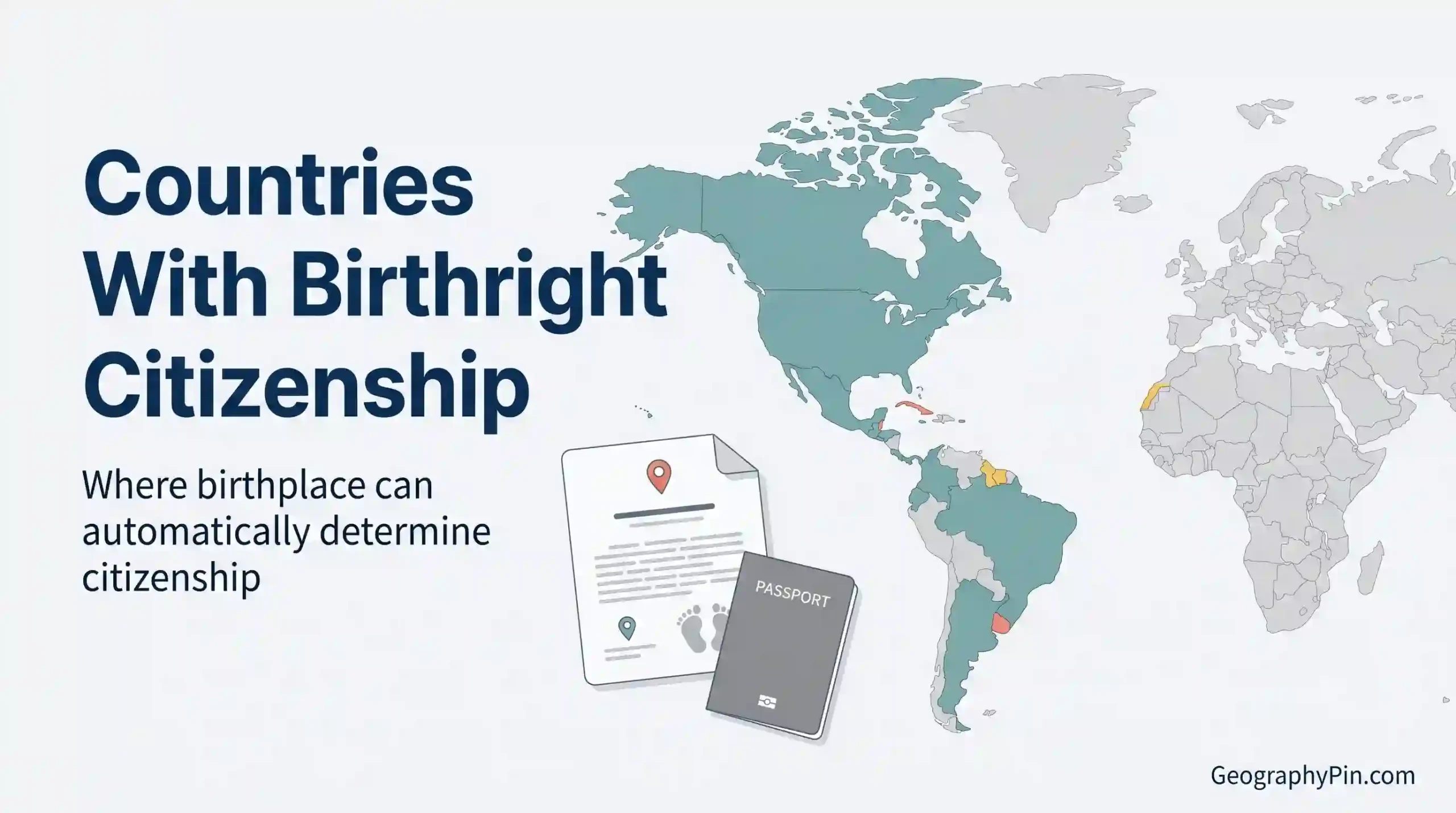
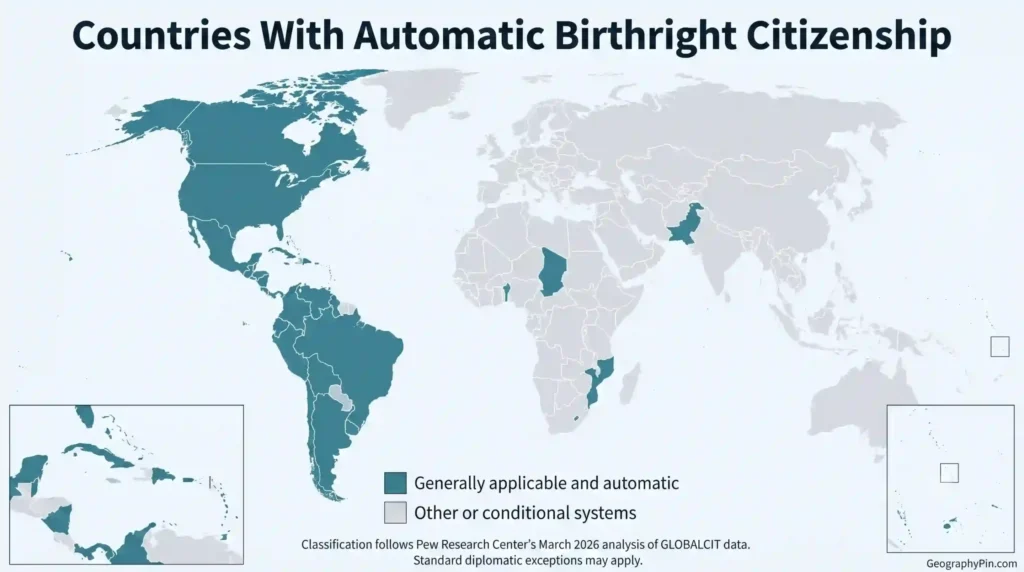
Thirty-three countries grant automatic, generally applicable citizenship to children born on their territory, regardless of their parents’ citizenship or immigration status. Most are in the Americas and Caribbean, while six are in Africa, Asia, or Oceania. Standard exceptions, especially for children of accredited foreign diplomats, still apply (Pew Research Center, 2026).
How to use this article: Start with what birthright citizenship means, jump to the complete automatic-citizenship list, compare conditional systems, or see what the child’s citizenship does for the parents.
What birthright citizenship actually means
In ordinary political discussion, birthright citizenship usually means jus soli, Latin for “right of the soil.” A child becomes a citizen because the child was born within a country’s territory, not because the parents were already citizens.
Birthplace, descent, and conditional citizenship
Nationality laws rarely follow only one principle. A country may combine territorial birthright citizenship with citizenship by descent, naturalization, adoption, marriage, or protection against statelessness.
| System | What normally determines citizenship | Key point |
|---|---|---|
| Jus soli | Place of birth | May be automatic or subject to conditions |
| Jus sanguinis | Citizenship of one or both parents | Can apply even when the child is born abroad |
| Second-generation jus soli | The child and a parent were born in the country | Birthplace alone is insufficient |
| Statelessness safeguard | The child would otherwise have no nationality | This is not general birthright citizenship |
Most countries primarily grant citizenship at birth through a citizen parent. In the 191-country dataset used for a 2026 comparison, 156 countries automatically recognized a child born in the country when at least one parent was already a citizen.
A birth certificate and citizenship are also different things. The certificate records where and to whom a child was born. It can provide essential evidence for a citizenship claim, but issuing a birth certificate does not automatically make the child a citizen under every nationality law.
The countries granting automatic birthright citizenship
The clearest current comparative category contains 33 countries where citizenship based on territorial birth is generally applicable and automatic, without requiring the parents to be citizens or legal residents. The category still allows narrow exclusions commonly found in nationality law, particularly for children of accredited diplomats.
The complete list by region
| Region | Countries |
|---|---|
| North and Central America | Belize, Canada, El Salvador, Guatemala, Honduras, Mexico, Nicaragua, Panama, United States |
| Caribbean | Antigua and Barbuda, Barbados, Cuba, Dominica, Grenada, Jamaica, St. Kitts and Nevis, St. Lucia, St. Vincent and the Grenadines, Trinidad and Tobago |
| South America | Argentina, Bolivia, Brazil, Ecuador, Guyana, Peru, Uruguay, Venezuela |
| Africa | Benin, Chad, Lesotho, Mozambique |
| Asia | Pakistan |
| Oceania | Tuvalu |
Why the diplomatic exception does not make the list “conditional”
Children of accredited foreign diplomats are commonly excluded because their parents have a special legal relationship with the host state. This narrow exception is treated differently from a rule requiring every foreign parent to hold permanent residence, lawful status, or a minimum period of residence.
The United States after the 2026 Supreme Court ruling
On June 30, 2026, in Trump v. Barbara, the U.S. Supreme Court held that children born in the United States to parents who are unlawfully or temporarily present are “subject to the jurisdiction” of the United States and are citizens at birth under the Fourteenth Amendment. The Court affirmed the lower court’s preliminary injunction against Executive Order 14160, preserving the country’s generally applicable territorial birthright rule.
Countries where birthplace is not enough by itself
About 50 other countries recognize more limited forms of territorial birthright citizenship, although the categories can overlap. Depending on the country, citizenship may require a parent with qualifying legal residence, another generation born in the country, membership in a defined group, or a registration or application process.
The most common conditions
| Type of rule | Examples | What may be required |
|---|---|---|
| Parental residence or legal status | Australia, Chile, Colombia, Germany, Ireland, New Zealand, United Kingdom | A parent must hold qualifying status or satisfy a residence rule |
| Second-generation birth | Belgium, France, Luxembourg, Netherlands, Portugal, Spain | A parent must also have been born in the country, sometimes with added conditions |
| Application or declaration | Costa Rica, Moldova, Paraguay | The child or parents must complete a legal process rather than receive citizenship automatically |
| Special group eligibility | Country-specific provisions in Guinea-Bissau, Haiti, Israel, Liberia, and Uganda | Eligibility may depend on ancestry, community, ethnicity, religion, or another defined connection |
Note: These categories are simplified examples, not mutually exclusive groups. Some countries provide more than one citizenship route or apply different rules to different children.
These differences explain why online lists can produce very different totals. One list may count only automatic and generally applicable jus soli, while another includes delayed acquisition, application-based rights, second-generation rules, or citizenship granted only to children who would otherwise be stateless.
Bangladesh and Tanzania show another difficulty. Their written laws can appear broad, but comparative citizenship researchers report that administrative practice requires at least one citizen parent. They are therefore excluded from the 33-country automatic group.
Why birthright citizenship is concentrated in the Americas
Twenty-seven of the 33 countries in the automatic category are in the Americas or Caribbean. This regional pattern reflects the history of settler societies, post-independence nation-building, immigration, slavery’s abolition, and efforts to create citizenship rules that did not depend entirely on European ancestry.
Many states in Europe, Asia, and Africa instead developed nationality systems centered more strongly on descent. Former British jurisdictions including the United Kingdom, Australia, New Zealand, and Ireland later restricted the broader territorial rules they once applied, replacing them with parental citizenship or residence conditions.
The divide is not absolute. Countries on both sides combine birthplace and descent, and many countries without general jus soli have safeguards for abandoned children, children of unknown parents, or children who would otherwise be stateless. Those safeguards serve an important purpose without granting citizenship to every child born in the territory.
What citizenship at birth means for the child and parents
Automatic citizenship can give the child the right to a passport, permanent residence in the country, access to rights associated with nationality, and political participation later in life. Documentation is still necessary to prove that status, and the exact rights and responsibilities depend on the country.
The child’s citizenship does not automatically legalize the parents
This is the most important practical correction. A citizen baby does not normally give foreign parents immediate citizenship, permanent residence, protection from removal, or an unrestricted right to remain in the country.
Some countries eventually offer immigration or naturalization routes to parents of citizen children. Those routes may depend on the child’s age, custody, family dependency, years of residence, financial support, or other legal conditions. They are separate from the child’s citizenship at birth.
Birthright citizenship is not the same as a passport
Citizenship may arise automatically under the law, but parents must still register the birth and obtain the documents required for a passport. Late registration, missing parental records, uncertain birthplace evidence, or differences between civil registries and immigration agencies can make a straightforward legal entitlement harder to prove.
A child may receive two citizenships
A child born in a jus soli country may also inherit a parent’s nationality through descent. That can create dual citizenship from birth. However, both countries’ laws matter: one may limit transmission to children born abroad, require consular registration, restrict dual nationality, or impose a later choice between citizenships.
Citizenship may also carry future obligations involving military service, passport use or, in a small number of systems, tax filing and financial reporting. Families should examine both national systems instead of assuming that a second citizenship brings only benefits.
How to check a country’s rule correctly
Citizenship law is too important to confirm through an undated list alone. Before making travel, childbirth, residence, or documentation decisions, check the rule that applies on the child’s expected date of birth.
Use this four-part check
- Confirm the legal basis: Look for the current constitution, citizenship act, nationality code, or official government guidance.
- Read the exceptions: Check rules for diplomats, foreign-government employees, temporary visitors, irregular residents, refugees, and births aboard ships or aircraft.
- Separate automatic status from a claim: Determine whether citizenship arises at birth or requires registration, a declaration, an application, or years of residence.
- Check the parents’ country too: Confirm citizenship by descent, dual-nationality rules, consular registration, and any future obligations.
Also remember that the legal right to citizenship does not create a right for the parents to enter a country for childbirth. Immigration admission, visas, medical costs, insurance, and proof of funds remain separate matters.
FAQ
How many countries have automatic birthright citizenship?
Thirty-three countries are classified as granting generally applicable automatic citizenship based on birth in the territory, regardless of the parents’ citizenship or immigration status. Narrow exceptions, especially for accredited diplomats, may still apply (Pew Research Center, 2026).
Does Europe have automatic birthright citizenship?
No European country appears in the current 33-country group with generally applicable automatic jus soli. Several European countries recognize conditional forms based on parental residence, legal status, a parent’s birthplace, or a later application.
Are babies born in Canada or Mexico automatically citizens?
Canada and Mexico are both included in the automatic territorial birthright category. As with other countries in this group, narrow legal exceptions can apply, particularly when a parent holds accredited diplomatic status.
Does a citizen baby make the parents citizens?
No. The child’s citizenship and the parents’ immigration status are separate legal questions. Parents may have access to a family-based route later, but citizenship for the child does not normally grant the parents immediate citizenship or permanent residence.
Is a birth certificate proof of citizenship?
It may be important evidence, particularly in a country with automatic jus soli, but a birth certificate primarily proves the facts of the birth. Its legal effect depends on the country’s nationality rules and the circumstances of the parents.
Why do some lists include more than 33 countries?
Broader lists may include conditional systems, second-generation birthright rules, application-based citizenship, special provisions for particular groups, and safeguards for children who would otherwise be stateless. They are counting more than generally applicable automatic jus soli.
Is birth in an embassy treated as birth in another country?
No. An embassy does not legally become the sovereign territory of the country it represents. Citizenship normally depends on the host country’s nationality law, although a diplomat’s child may fall under the diplomatic exception commonly found in territorial birthright rules.
What Did We Learn Today?
Automatic birthright citizenship is granted in 33 countries, with the strongest concentration in the Americas and Caribbean. Many other countries consider birthplace only when a parent has qualifying residence, another generation was born there, an application is completed, or the child would otherwise be stateless. Citizenship belongs to the child and does not automatically grant immigration status to the parents, so current nationality, immigration, registration, and dual-citizenship rules must all be checked separately.
Sources & Data Notes
The 33-country list follows Pew Research Center’s March 2026 analysis of the GLOBALCIT Citizenship Law Dataset, which compares citizenship rules across 191 countries. The United States update reflects the Supreme Court’s June 30, 2026 decision in Trump v. Barbara. Nationality laws often provide several overlapping routes, and administrative practice may differ from the apparent wording of a law, so the conditional examples are simplified for general comparison. The article was reviewed and updated by Zurab Koniashvili (Z.K. Atlas).