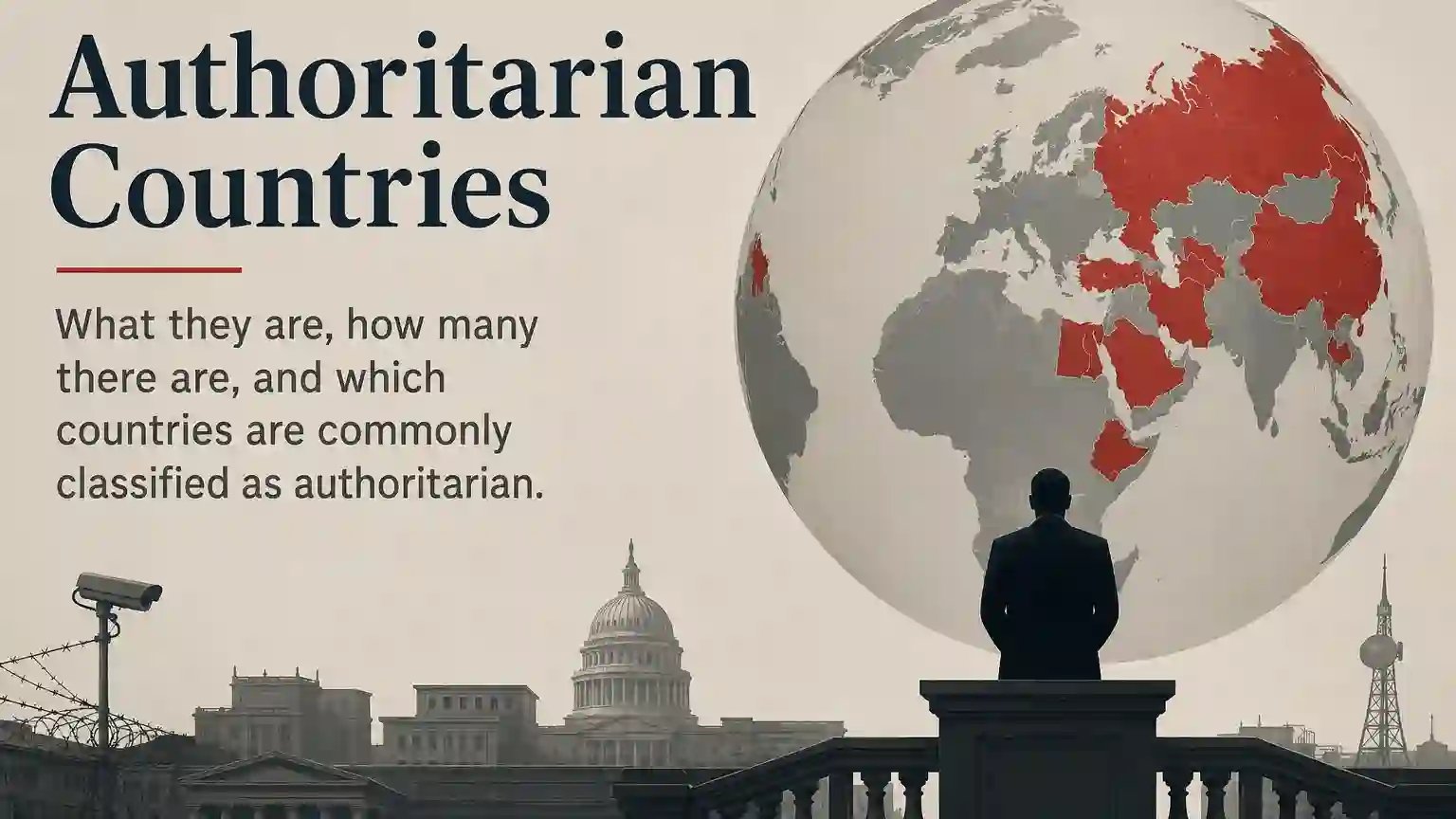
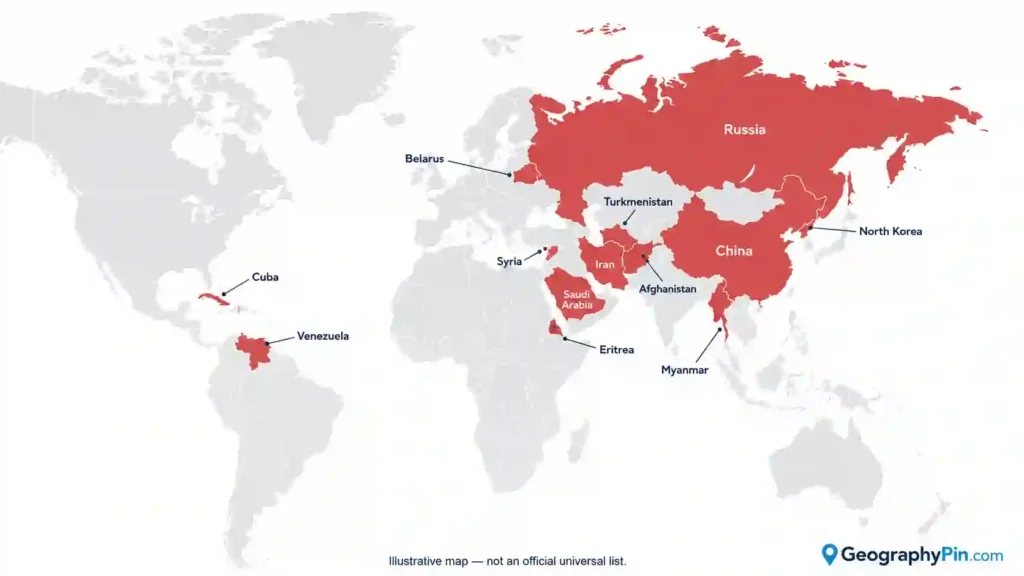
Authoritarian countries are countries where rulers limit real political competition, restrict civil liberties, control courts or media, and make it difficult for citizens to replace the government through free and fair elections. Common examples include China, Russia, North Korea, Iran, Saudi Arabia, Cuba, Belarus, Myanmar, Eritrea, and Turkmenistan.
How to use this article: For the fastest answer, jump to the quick signs of authoritarian rule, the number question, the common country examples, or the difference from dictatorship and hybrid regimes.
What Authoritarian Countries Means
An authoritarian country is not simply a country with strict rules, heavy policing, or a powerful leader. The core question is political accountability: can citizens freely criticize the government, organize opposition parties, access independent information, vote in fair elections, and peacefully replace the people in power?
In authoritarian systems, elections may be absent, delayed, tightly managed, or held under unfair conditions. Opposition parties may exist on paper but face arrests, bans, censorship, intimidation, disqualification, or media exclusion. Courts, election bodies, and security services often serve the ruling leader, party, military, monarchy, or elite network.
Quick signs of authoritarian rule
A country is more likely to be described as authoritarian when several of these signs appear together:
- Opposition parties cannot compete freely or safely.
- Independent media are censored, blocked, threatened, bought, or shut down.
- Courts and election bodies are controlled by the ruling authorities.
- Security forces are used against critics, protesters, journalists, or civil society groups.
- The same leader, family, party, or military network stays in power with weak accountability.
- Elections, if held, do not offer a realistic path for changing the government.
One sign alone does not prove that a country is authoritarian. The label becomes stronger when the political system blocks meaningful accountability across elections, courts, media, civil liberties, and public institutions.
| Feature | More democratic pattern | More authoritarian pattern |
|---|---|---|
| Elections | Competitive and credible | Controlled, unfair, or symbolic |
| Media | Independent outlets can criticize power | Censorship, pressure, or state control |
| Courts | Can rule against the government | Often politically loyal or pressured |
| Opposition | Can organize, campaign, and win | Restricted, banned, jailed, or weakened |
How Many Authoritarian Countries Are There?
There is no single official number of authoritarian countries because “authoritarian” is an analytical label, not a legal world category. The number changes depending on whether a source counts only closed autocracies, broader authoritarian regimes, “Not Free” countries, or hybrid systems with strong authoritarian features.
The number depends on the source
The Economist Intelligence Unit’s Democracy Index 2025 classified 61 of 167 covered countries and territories as authoritarian regimes, representing 39.2% of the population covered by the index.
Freedom House uses a different system. Instead of “authoritarian country” as its main label, it rates countries and territories as Free, Partly Free, or Not Free based on political rights and civil liberties. Its 2026 report said global freedom declined for the 20th consecutive year in 2025, with 54 countries declining and 35 improving during the year.
V-Dem separates political systems into categories such as closed autocracy, electoral autocracy, electoral democracy, and liberal democracy. Its 2026 Democracy Report said the number of closed autocracies increased from 22 in 2019 to 35 in 2025, showing that some systems moved from controlled elections toward even more closed rule.
Why different lists do not match
Lists differ because each source asks a slightly different question. One index may focus on election quality. Another may focus on civil liberties. Another may focus on whether the chief executive is chosen through meaningful multiparty competition. A country near the boundary between hybrid regime, electoral autocracy, and authoritarian regime can be classified differently by different sources.
That is why the safest wording is “commonly classified as authoritarian” or “classified as authoritarian by a specific index,” not “officially authoritarian.” The world has no single referee that permanently assigns every country to one regime category.
Authoritarian Countries List: Common Examples
The countries below are commonly discussed as authoritarian because major democracy, civil-liberties, or regime-type datasets consistently describe their political systems as highly restricted, autocratic, not free, or dominated by ruling elites. This is not a complete world list, and it is not an official UN classification.
Commonly cited authoritarian countries
| Country | Common authoritarian features | Typical regime pattern |
|---|---|---|
| North Korea | No meaningful political competition, dynastic rule, extreme state control | Closed one-party dictatorship |
| China | One-party rule, heavy censorship, restricted opposition politics | One-party authoritarian state |
| Russia | Managed elections, repression of critics, concentrated executive power | Electoral authoritarian system |
| Iran | Elected institutions exist, but unelected clerical bodies restrict political choice | Theocratic authoritarian system |
| Saudi Arabia | Monarchical rule, no national multiparty elections, restricted political dissent | Absolute monarchy |
| Cuba | One-party dominance and strict limits on organized political opposition | One-party authoritarian state |
| Belarus | Long-term rule, repression after disputed elections, weak political pluralism | Personalist authoritarian system |
| Venezuela | Opposition restrictions, institutional capture, disputed electoral conditions | Electoral authoritarian system |
| Myanmar | Military rule after a coup, severe limits on civilian politics | Military authoritarian regime |
| Afghanistan | Rule by the Taliban, no competitive democratic national system | Theocratic authoritarian rule |
| Eritrea | No regular competitive national elections and strong state control | Closed authoritarian state |
| Turkmenistan | Highly controlled politics, weak pluralism, state-dominated public life | Personalist authoritarian system |
| Syria | Severe political repression, conflict-linked state violence, limited political competition | Personalist authoritarian system |
Some countries are easier to classify than others. North Korea, Eritrea, and Turkmenistan are usually placed near the most closed end of the spectrum. Countries with elections, parties, and parliaments can still be authoritarian if those institutions do not create real accountability.
Authoritarian Countries by Region
Authoritarian countries are not limited to one continent, religion, ideology, or income level. They appear in different forms across Asia, Europe, the Middle East, Africa, Latin America, and Eurasia. Regional grouping helps readers see the pattern without pretending that every borderline case has one universally accepted label.
| Region | Common examples | Common pattern |
|---|---|---|
| East Asia | China, North Korea | One-party or closed authoritarian rule |
| Middle East | Iran, Saudi Arabia, Syria | Theocratic, monarchical, or personalist rule |
| Europe and Eurasia | Russia, Belarus, Turkmenistan | Managed elections or closed personalist rule |
| Southeast Asia | Myanmar | Military rule |
| Caribbean | Cuba | One-party rule |
| Latin America | Venezuela | Electoral authoritarianism |
| Africa | Eritrea | Closed authoritarian rule |
This regional view is selective. It is meant to show common examples, not to settle every disputed case. Some countries move between categories over time, and others sit in gray zones between authoritarianism and hybrid rule.
Authoritarian vs Dictatorship vs Hybrid Regime
These terms overlap, but they are not identical. “Authoritarian” is the broadest label. A dictatorship is usually a more direct form of authoritarian rule, often centered on one ruler, one military command, one ruling party, or one royal family. A hybrid regime sits between democracy and authoritarianism.
The simplest comparison
| Term | Meaning | Key idea |
|---|---|---|
| Authoritarian country | A country where political competition, rights, and accountability are heavily restricted | Broad category |
| Dictatorship | A system where power is held by one ruler or a narrow ruling group with little accountability | Direct concentration of power |
| Autocracy | A system where citizens lack meaningful power to choose or constrain rulers | Common dataset term |
| Hybrid regime | A system with elections and some democratic institutions, but also serious authoritarian practices | In-between category |
| Democracy | A system where citizens can choose leaders through meaningful, free, fair, and competitive elections | Accountable government |
Table downloads (4)
- Fast comparison: democratic vs authoritarian political features (5 × 3)View tableDownload CSV
- Common examples of authoritarian countries and why they are often classified that way (14 × 3)View tableDownload CSV
- Selected authoritarian country examples by region (8 × 3)View tableDownload CSV
- Authoritarian, dictatorship, autocracy, and hybrid regime compared (6 × 3)View tableDownload CSV
A country can hold elections and still be authoritarian. The key question is not whether ballots exist, but whether voters have real choice, opposition parties can compete safely, votes are counted fairly, media can report independently, and winners are allowed to govern.
Why Some Countries Are Hard to Classify
Some countries are difficult to classify because they mix democratic institutions with authoritarian practices. They may have elections, courts, parliaments, private media, and opposition parties, but those institutions may operate under heavy pressure from the ruling authorities.
These gray-zone systems are often called hybrid regimes, competitive authoritarian systems, electoral autocracies, or partly free states, depending on the source. One index may still treat a country as hybrid because opposition parties exist and sometimes win local races. Another may treat the same country as authoritarian because national elections are unfair, media access is unequal, courts are politicized, or opposition leaders face legal pressure.
Why the label matters
The term “authoritarian country” is not only a political insult. Used carefully, it helps compare how governments operate, how much freedom citizens have, how safe opposition activity is, and how predictable a country’s institutions may be.
For geography and geopolitics, authoritarian systems matter because they shape borders, alliances, migration, sanctions, wars, trade risk, censorship, internet access, and the flow of public information. A country’s regime type can affect how it reports data, how it responds to protests, how it handles minority groups, and how it behaves in international organizations.
The label should still be used with precision. Calling every strict government “authoritarian” weakens the meaning. The stronger question is whether citizens can organize, criticize leaders, access independent information, vote in fair competition, and replace the government without fear.
FAQ
How many authoritarian countries are there?
There is no single official number. The answer depends on the dataset and definition. The Economist Intelligence Unit classified 61 countries and territories as authoritarian regimes in its Democracy Index 2025, while Freedom House and V-Dem use different labels and methods.
Is an authoritarian country always a dictatorship?
Not always. Many dictatorships are authoritarian, but some authoritarian systems use elections, parties, courts, and parliaments in limited or controlled ways. That is why terms such as electoral authoritarianism and hybrid regime exist.
Can a country have elections and still be authoritarian?
Yes. Elections alone do not make a country democratic. If opposition candidates are jailed, media are controlled, courts are loyal to the ruling party, or vote counting is not credible, elections may exist without real democratic choice.
Are authoritarian countries the same as communist countries?
No. Some communist-ruled countries are authoritarian, but authoritarianism is broader than communism. Authoritarian countries can be monarchies, military regimes, theocracies, nationalist systems, one-party states, or personalist regimes.
Is there an official UN list of authoritarian countries?
No. The United Nations has member states, not an official list of authoritarian governments. Authoritarian classifications usually come from research institutes, democracy indexes, rights organizations, and political-science datasets.
Which countries are usually seen as the most authoritarian?
Countries such as North Korea, Eritrea, Turkmenistan, China, Syria, Afghanistan, and Saudi Arabia are often placed near the authoritarian end of major freedom and democracy classifications, though exact rankings depend on the source.
Can authoritarian countries become democratic?
Yes, but it depends on institutions, civil society, security forces, leadership splits, public pressure, elections, and international conditions. Some countries have moved from authoritarian rule to democracy, while others have moved in the opposite direction.
What Did We Learn Today?
Authoritarian countries are states where real political competition and public accountability are heavily restricted. There is no single official world list, because major datasets measure different things: elections, civil liberties, media freedom, executive power, and rule of law. The safest way to understand the topic is to look for patterns: controlled elections, weak opposition rights, censorship, politicized courts, and power concentrated in one party, ruler, family, military, monarchy, or elite network.
Sources & Data Notes
This article was written and reviewed by GeographyPin using major democracy and political-rights references, including Freedom House’s Freedom in the World, the Economist Intelligence Unit’s Democracy Index, V-Dem democracy classifications, Our World in Data political-regime datasets, and country-level reporting on political rights and civil liberties. Because “authoritarian” is not an official world category, country examples and figures are presented as careful classifications, not permanent labels. New elections, coups, conflicts, legal changes, or annual dataset updates may change some details after publication.