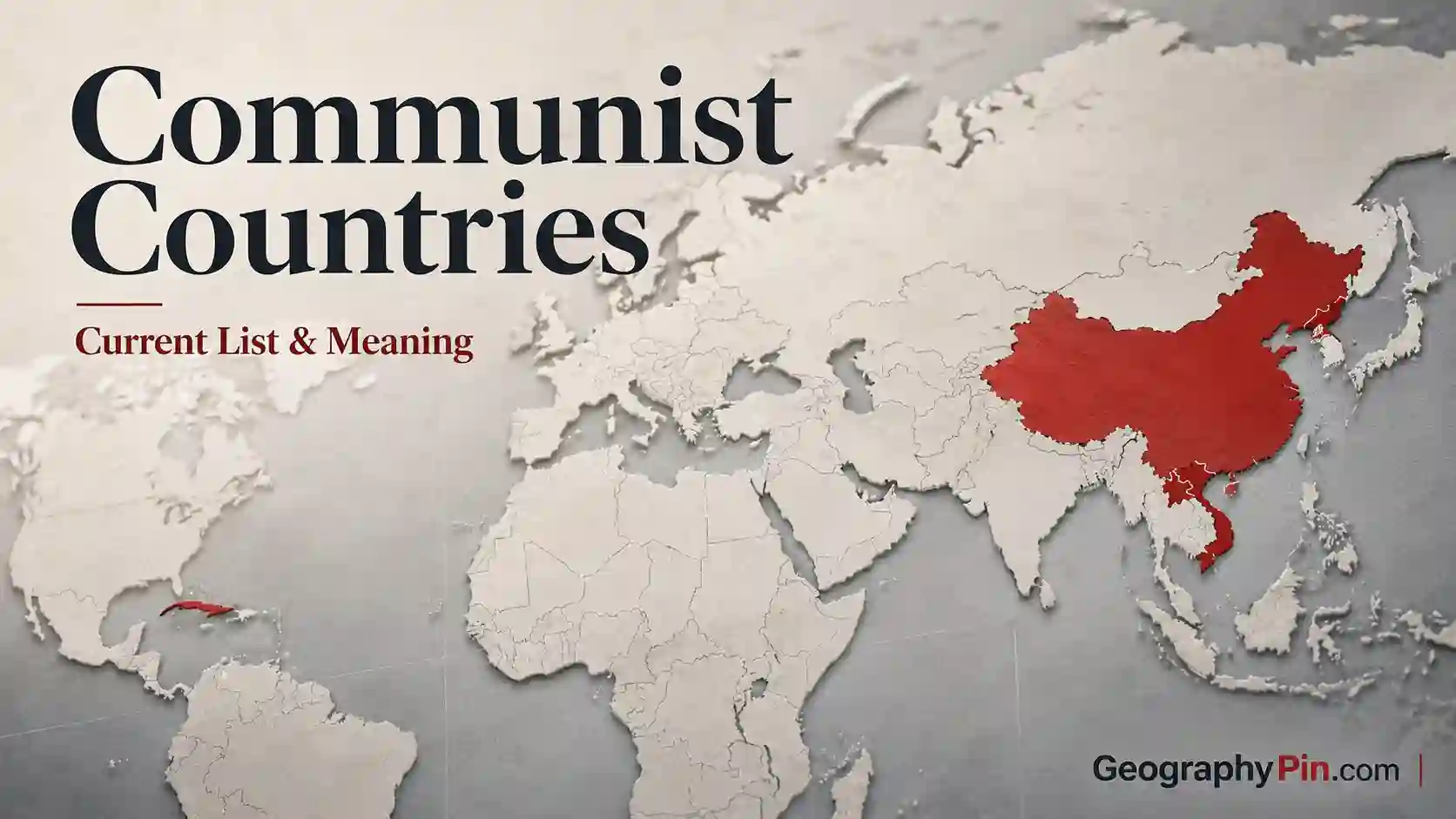
Communist countries usually means five present-day states: China, Cuba, Laos, Vietnam, and North Korea. The label refers mainly to communist-party rule and socialist constitutional systems, not to a fully classless, stateless communist society, which no modern country has achieved in practice.
How to use this article: For the fastest answer, jump to the current list; for the definition problem, use what counts; for the common confusion, see why counts vary; and for wording differences, check the comparison table.
What “Communist Countries” Usually Means
In political geography, “communist countries” is usually shorthand. It does not mean that a country has reached pure communism as a classless and stateless society. It means the state is governed by a communist party or a party system formally built around socialist or Marxist-Leninist ideology.
What counts as a communist country?
The practical test is political, not economic. A country is usually counted when the ruling party is communist in name or ideological origin, the party has a constitutionally protected leading role, and opposition parties either do not legally compete for national power or cannot realistically replace the ruling party.
Fast check: the practical rule
Use this rule: if a state is led by a communist party and describes its political order as socialist, it is commonly included. By that practical standard, the current list is China, Cuba, Laos, Vietnam, and North Korea.
Current Communist Countries List
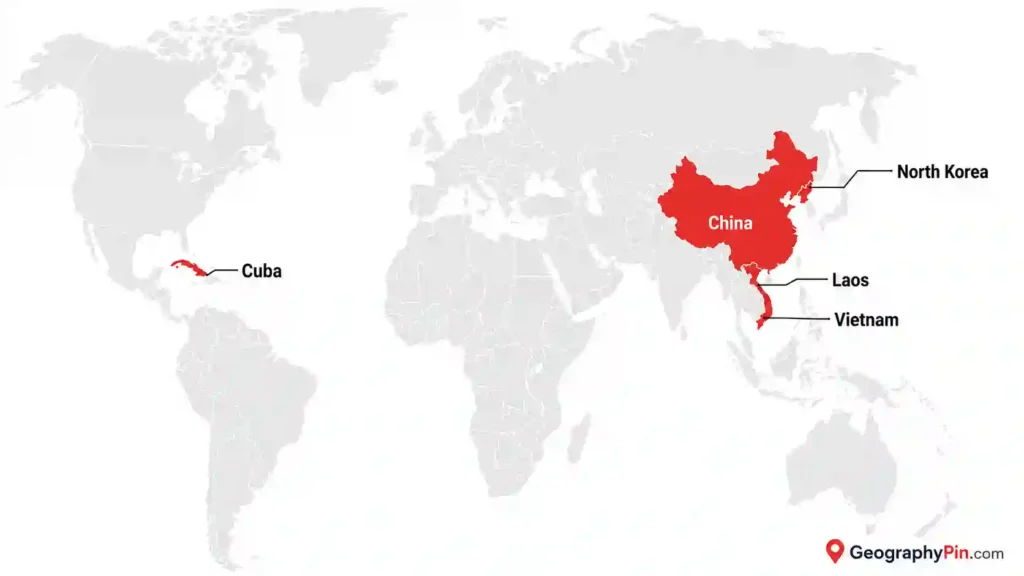
The widely used modern list has five countries. These are the countries most commonly described as communist today:
- China
- Cuba
- Laos
- Vietnam
- North Korea
The wording can differ by source. Some references say “communist country,” some say “socialist republic,” and others describe the system as one-party communist rule.
The current list at a glance
| Country | Ruling party or core party | Why it is included |
|---|---|---|
| China | Communist Party of China | The Communist Party has the central leading role in China’s socialist political system. |
| Cuba | Communist Party of Cuba | Cuba’s constitution gives the Communist Party the leading role in society and the state. |
| Laos | Lao People’s Revolutionary Party | Laos is a one-party socialist state led by a communist-derived revolutionary party. |
| Vietnam | Communist Party of Vietnam | Vietnam is a socialist republic where the Communist Party leads the state and society. |
| North Korea | Workers’ Party of Korea | North Korea is usually included because of one-party Workers’ Party rule, although Juche and dynastic leadership make it a special case. |
Why the Number Is Not as Simple as Five
Five is the clearest practical answer, but it is not the only possible answer. The count changes when people use “communist” to mean ideology, party rule, economic ownership, Cold War alignment, or official state language.
Why counts vary
Some lists count only states ruled by parties that explicitly call themselves communist. Other lists count socialist republics led by revolutionary parties even when the party name does not include the word “communist.” North Korea is the hardest case because it is rooted in communist-party rule but now presents itself through Juche, Kim family leadership, and a highly militarized state identity.
No country is fully communist in theory
Classical communist theory points toward a classless and stateless society with common ownership of the means of production. Existing “communist countries” are states with governments, armies, borders, ruling parties, money, and social hierarchy. That is why the phrase is best understood as a political label, not proof that pure communism exists anywhere.
Communist, Socialist, Marxist-Leninist, and One-Party: What’s the Difference?
These terms overlap, but they are not interchangeable. A country can call itself socialist without being ruled by a communist party. A communist party can run a market-heavy economy. A one-party state can be authoritarian without being communist.
The terms are related, not identical
| Term | Plain meaning | Why readers confuse it |
|---|---|---|
| Communist country | A state commonly ruled by a communist party or communist-derived party system. | People often treat the ruling party label as the whole economic system. |
| Socialist state | A state that defines itself as socialist or aims to build socialism. | Some socialist states are communist-party states; others are not. |
| Marxist-Leninist state | A state organized around a vanguard party, democratic centralism, and socialist construction. | It is often used as a more precise version of “communist state.” |
| One-party state | A state where one party dominates or legally controls national politics. | Not all one-party states are communist. |
| Social democracy | A democratic capitalist system with strong welfare policies and labor protections. | Countries such as Sweden or Denmark are sometimes wrongly called communist. |
Table downloads (2)
- Countries commonly described as communist today (6 × 3)View tableDownload CSV
- Common political terms and what they mean (6 × 3)View tableDownload CSV
Country-by-Country Notes
The five countries share communist-party dominance, but they are not identical. Their economies, histories, foreign policies, and constitutional language differ sharply.
China
China is the largest and most globally influential communist-party state. Its constitution describes the country as socialist and makes Communist Party leadership central to the system. Economically, China uses extensive state planning and party control alongside markets, private firms, exports, and global investment ties.
Cuba
Cuba is the main communist-party state in the Americas. The Communist Party of Cuba holds the constitutionally defined leading role, while the state has long maintained strong control over politics, media, and major institutions. Recent economic reforms have expanded space for private activity while the government continues to frame the system as socialist.
Laos
Laos is a landlocked Southeast Asian state governed through the Lao People’s Revolutionary Party. Its constitutional order gives the party the leading role in the political system. Laos has also pursued economic reforms, regional integration, hydropower development, tourism, and foreign investment while retaining one-party political control.
Vietnam
Vietnam is a communist-party state with one of the clearest examples of political continuity plus economic transformation. Since Đổi Mới reforms began in 1986, Vietnam has moved from a highly planned economy toward a more market-oriented model, helping turn the country into a middle-income economy in a single generation.
North Korea
North Korea is often included because it developed from a communist-party state and remains ruled by the Workers’ Party of Korea. It is also different from the others because Juche, military power, nuclear policy, and Kim family rule are central to the system. That is why some analysts describe it less as a conventional communist state and more as a dynastic, totalitarian, one-party dictatorship.
Are There Other Communist or Socialist Countries?
Several countries have socialist language in their constitutions, strong state sectors, ruling left-wing parties, or communist parties inside their political systems. That does not automatically make them communist countries in the usual geopolitical sense.
Commonly confused cases
India, Portugal, Sri Lanka, Bangladesh, Nepal, and Tanzania are examples that can confuse readers because they have socialist wording, socialist political history, or active left-wing parties. They are not normally counted as communist countries because communist parties do not monopolize national power in the same way as in China, Cuba, Laos, Vietnam, or North Korea.
Nordic countries are another frequent confusion. Denmark, Norway, Sweden, Finland, and Iceland are not communist countries. They are multiparty democracies with capitalist economies, private property, competitive elections, and large welfare systems.
How Communist Countries Changed Their Economies
The biggest mistake is assuming that all communist-party states operate the same type of economy. In practice, several have allowed markets, private firms, foreign investment, and export industries while keeping strict political control.
China’s model is often described as a socialist market economy. Vietnam uses the phrase socialist-oriented market economy. Laos has opened parts of its economy to investment and regional trade. Cuba has made periodic reforms allowing more private activity, though the pace and depth have changed over time. North Korea remains far more closed, with heavy state control and limited legal market activity.
This split between politics and economics is central. A country can be politically communist-party-led while economically mixed. That is why “communist country” is usually a statement about who controls the state, not a full description of how every shop, farm, bank, or factory operates.
FAQ
How many communist countries are there?
There are usually five countries counted as communist today: China, Cuba, Laos, Vietnam, and North Korea. The number can change only if the definition changes.
Is China still communist?
Politically, yes. China is ruled by the Communist Party of China, and party leadership is central to the constitutional system. Economically, China is not a pure planned economy; it combines state direction, party control, markets, private firms, and global trade.
Is Russia a communist country?
No. Russia was part of the Soviet Union, which was ruled by the Communist Party until 1991. The modern Russian Federation is not a communist country, even though communist parties still exist in Russian politics.
Is North Korea communist or something else?
For most practical country lists, yes, North Korea is included as a communist country because it is ruled by the Workers’ Party of Korea and developed from a communist-party state. It is also a special case because Juche ideology, militarization, and hereditary Kim family rule make it different from China, Cuba, Laos, and Vietnam.
Are socialist countries the same as communist countries?
No. Socialist is a broader term. Some countries use socialist language while still having multiparty elections, private property, and capitalist markets. Communist countries, in the common geopolitical sense, are usually one-party states led by communist or communist-derived ruling parties.
Are Nordic countries communist?
No. Nordic countries are democratic capitalist states with strong welfare systems. They have private ownership, competitive elections, independent political parties, and market economies.
What Did We Learn Today?
Communist Countries usually refers to five present-day states: China, Cuba, Laos, Vietnam, and North Korea. The label is mainly political because these countries are ruled by communist or communist-derived parties and describe their systems through socialist state language. It does not mean any of them has reached pure communism in the theoretical sense, and it also does not mean their economies all work the same way.
Sources & Data Notes
This article was written and reviewed using standard reference materials for political geography, including national constitutions, official government information, World Bank country notes, World Factbook-style references, and major reporting on recent policy changes. Political labels can vary by source, so the article uses the common practical meaning of “communist countries”: states led by communist or communist-derived ruling parties. Some descriptions are simplified for readability, and newer political or economic updates may change details after publication. AI tools helped with drafting and organization, with final editorial review by the author.