A ventifact is one of the clearest “signatures” of wind erosion: a rock face worn smooth, faceted, or pitted by airborne sand. They’re common in dry, open landscapes where strong winds can keep sand grains moving and where rocks stay exposed long enough to be shaped.
A ventifact is a rock shaped by abrasion from wind-driven particles. Facets, pits and grooves may record repeated impacts, especially in deserts and other sparsely vegetated environments. Its shape also depends on the original rock and local airflow; neither a shiny surface nor a particular number of faces identifies its history by itself.
How to use this article: For quick identification, jump to the fast check; for “what it isn’t” confusion, use common confusions; to compare look-alikes, go to the comparison table; for short answers, head to FAQ.
What is a ventifact?
A ventifact is a rock shaped by aeolian abrasion—abrasion caused by wind-blown particles. In simple terms, sand grains carried close to the ground strike exposed rock surfaces again and again, wearing their surfaces, carving pits or grooves, and sometimes developing flat faces (facets).
Ventifacts are usually discussed at the “hand sample” scale: individual stones, cobbles, or boulders you can walk up to and examine. That’s different from big wind-eroded landforms like yardangs (streamlined ridges) or dune fields (sand accumulations).
Many field guides use “ventifact” mainly for individual stones and boulders, but some authors also apply the term to wind-abraded bedrock or outcrops; usage varies by tradition.
Why deserts produce classic ventifacts
Deserts and other barren landscapes are ideal because they combine three ingredients: frequent winds, available sand-sized particles, and little vegetation to protect surfaces. When rocks remain exposed for long periods, the “sandblasting” effect has time to leave a visible mark.
What ventifacts look like up close
Compare textures and edges on different sides of the rock; gloss alone is not diagnostic. Some show multiple flat faces meeting at ridges, as if the rock has been planed down from different angles.
Fast check: how to recognize a ventifact
Ventifacts can be subtle until you know what to look for. This checklist focuses on features that are visible without tools and that don’t require guessing ages, wind speeds, or sand volumes.
Fast check in 60 seconds
- One dominant “worked” face: a smoother, cleaner surface compared with the rest of the rock.
- Facets and ridges: flat planes meeting at edges, sometimes forming a wedge-like profile.
- Pitting: tiny, closely spaced impact marks that look like peppering or stippling.
- Context: open ground, sparse plants, loose sand or grit nearby, and signs of wind action (ripples, sand drift).
Quick “touch test” and the caution that comes with it
Ventifact faces often feel smoother than surrounding surfaces, but don’t rely on smoothness alone. Water-worn cobbles, rock varnish, and even some chemical weathering can also create smooth textures. No single surface texture confirms wind abrasion; the surrounding geology and the rock’s different faces also matter.
A simple rule for “wind direction” claims
A common temptation is to treat a ventifact like a wind vane: “the facet points to the prevailing wind.” Sometimes that’s reasonable, but it’s not guaranteed. Rocks can roll, tilt, or be reworked as conditions change, and local turbulence can redirect sand flow. If you use ventifacts to infer wind direction, treat it as a clue—then confirm with landscape-scale signs like dune slipfaces, ripple orientations, or sand drift patterns.
How wind makes ventifacts
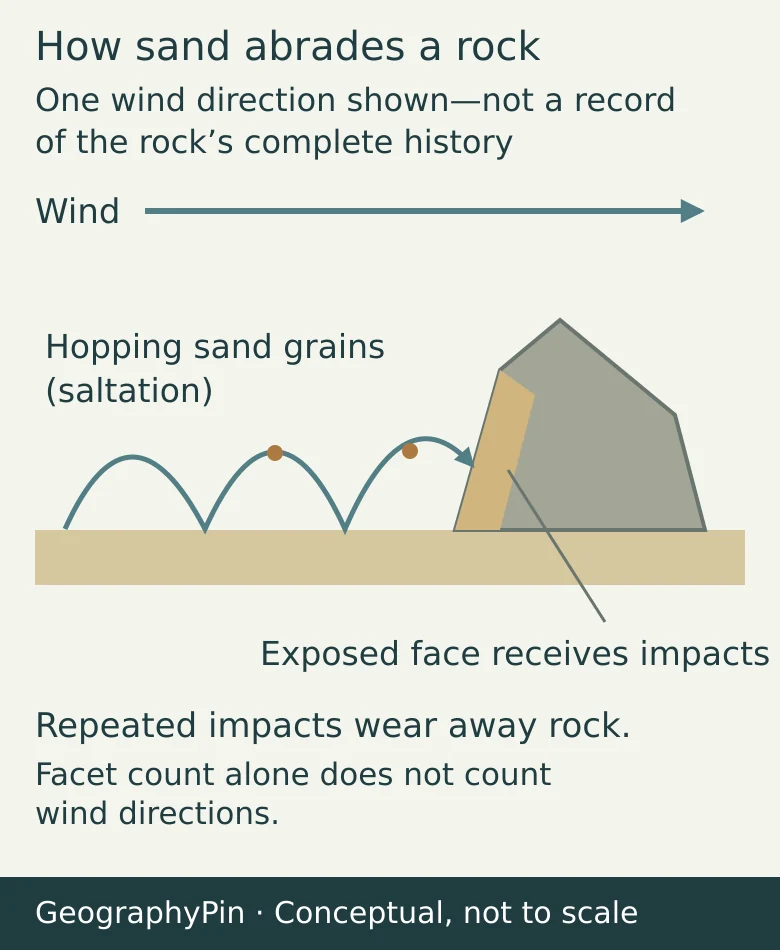
Wind alone doesn’t carve solid rock efficiently; the real work is done by particles carried by the wind. Sand grains moving close to the ground strike exposed surfaces repeatedly. Over time, those impacts abrade micro-highs, smooth irregularities, and can cut faces that become increasingly planar as abrasion “averages out” bumps and protrusions.
Abrasive delivery: why the near-ground zone matters
Hopping sand delivers repeated impacts near the surface. That’s why ventifact shaping often concentrates on the lower part of a rock, especially if sand supply is steady and vegetation is minimal. The height and angle of the “worked” zone can shift with changes in sand level, seasonal winds, or how a rock sits in the ground.
Facets, edges, and the “planing” effect
Abrasion can produce planar faces and grooves, but a rock’s initial shape and the way airflow carries grains around it also affect the result. If wind direction changes over long periods—or if a rock rotates—new facets can develop, creating a multi-faced ventifact.
Polish versus coating: two different “shines” that get confused
Gloss can come from coatings or later surface alteration, not simply abrasion. Sandblasting can even remove an existing gloss. Desert varnish and wind abrasion are different processes, although both may affect the same rock.
Types, terms, and common confusions
Ventifact terminology can be a little messy because different field traditions emphasize different shapes. The safest approach is to focus on observable features (facets, pitting, polish) and then use the special terms as optional labels rather than as strict categories.
Common shape terms you may see
- Einkanter and zweikanter: traditional shape terms whose usage varies; avoid treating them as universal facet-count categories.
- Dreikanter: Durand and Bourquin’s 2013 review defines the classic form by three ridges converging at an apex, not merely three faces.
These labels are descriptive, not a guarantee of a specific wind history. A rock can gain or lose facets as it shifts, gets buried by sand, or is re-exposed.
Common confusions: what a ventifact is not
Not a yardang: a yardang is a large ridge or streamlined hill carved by wind erosion; a ventifact is an individual rock shaped by abrasion. Not a dune: dunes are built by deposition of sand, not the sculpting of rock surfaces. Not glacial striations: glacial marks are typically linear scratches/grooves from rock dragged under ice, often aligned consistently across bedrock surfaces.
One more practical caution: some sharply edged ventifacts can resemble human-made stone tools at a glance, so context matters—especially near known archaeological areas where true artifacts may occur.
Comparison table: ventifacts versus look-alikes
| Feature | What you see | Main process | Typical setting |
|---|---|---|---|
| Ventifact | Facets, pits or grooves; surface appearance varies | Wind-driven abrasion by sand/dust | Deserts, polar deserts, windy barren plains, exposed rocky surfaces |
| Desert varnish | Thin dark coating; can look glossy; may not show facets | Surface coating chemistry and dust accumulation over time | Arid to semi-arid regions, exposed rock faces |
| Water-worn polish | Rounded edges, overall smoothness, fewer sharp planar facets | Flowing water rolling sediment against rock | Riverbeds, beaches, channels, flood zones |
| Glacial striations | Parallel scratches or grooves, often on bedrock surfaces | Abrasion by debris at the base of moving ice | Formerly glaciated terrain, valleys, uplands |
| Yardang | Large streamlined ridge/hill aligned with wind | Wind erosion of softer layers; abrasion and deflation at landscape scale | Arid basins with exposed sedimentary or weakly cemented deposits |
Where ventifacts form and what they can tell you
Ventifacts form where sand-sized particles can be mobilized and where rock surfaces stay exposed. That usually means dry, open landscapes with persistent winds, but “dry” can include cold deserts as well as hot ones. You may also see ventifact-like abrasion features discussed in planetary geology, especially for wind-shaped rocks on Mars.
Environments that favor ventifacts
- Sand sources nearby: dunes, sandy washes, deflated basins, or loose granular surfaces.
- Exposure time: stable ground surfaces where rocks aren’t quickly buried or covered by plants.
- Wind corridors: gaps, basins, or open plains that focus wind and keep grains moving.
Ventifacts can occur on desert pavements, but those stone-covered surfaces have more than one origin. Wind removal can leave a coarse lag, while some pavements develop as windblown dust accumulates beneath surface stones. A pavement is not, by itself, proof of deflation.
What a ventifact can (and can’t) reveal
Can reveal: that wind-driven abrasion has been active, and that sand-sized particles were available to do the cutting. In some settings, a consistent facet orientation can support a prevailing-wind interpretation when it matches other wind indicators in the landscape.
Can’t reliably reveal by itself: a precise wind direction history, a time span, or a wind speed. Without dating and broader context, a ventifact is best treated as qualitative evidence: “wind abrasion happened here.”
Field-friendly photo tips (useful for documentation)
For a clear record, photograph the rock from three angles: (1) the best-exposed worked face straight-on, (2) a side view that shows the ridge between facets, and (3) a wide shot showing the ground surface and any nearby sand features. If possible, include a scale object and note whether the rock looks embedded (stable) or loose (easily moved).
FAQ
Are ventifacts only found in hot deserts?
No. They’re most associated with hot deserts because the settings are obvious and widespread, but similar wind abrasion can happen in cold, dry, sparsely vegetated regions where sand or grit is available and surfaces stay exposed.
What’s the difference between a ventifact and a yardang?
A ventifact is an individual rock shaped by wind-blown particles. A yardang is a landscape-scale ridge or hill carved and streamlined by wind erosion, often in layered or weakly cemented deposits.
Do ventifacts always have three faces?
No. Shapes vary with the initial rock, abrasion, movement and exposure. Counting faces alone cannot reconstruct how many wind directions shaped a specimen.
Can you use a ventifact to tell the prevailing wind direction?
Sometimes, but cautiously. A facet can align with a dominant sand-blasting direction, yet rocks can move and local turbulence can redirect sand. Use ventifacts as supporting evidence and cross-check with dunes, ripples, or other wind-shaped features nearby.
Is a shiny rock in the desert automatically a ventifact?
No. Shine may reflect a coating or other surface change. Identification needs more than gloss.
Are ventifacts found on Mars?
Yes. NASA’s Curiosity mission described ventifacts near the rover during sols 3417–3418, and research on Spirit observations documents wind-abraded rocks at Gusev crater. These observations do not imply identical conditions or erosion rates on Earth and Mars.
What Did We Learn Today?
A ventifact records wind-driven abrasion of rock. Facets, pits and grooves need to be interpreted alongside the surrounding geology, not used as a stand-alone test. Surface gloss may have a different origin, and neither a traditional shape name nor a face count supplies a complete wind history.
Sources & Data Notes
- Durand and Bourquin (2013), Criteria for the identification of ventifacts in the geological record: A review and new insights: limits of surface-texture diagnosis and the ridge-based dreikanter definition.
- Greeley and colleagues (2006), Gusev crater: Wind-related features and processes observed by the Mars Exploration Rover Spirit: observed wind-abraded rocks, facets and possible contributing processes.
- NASA, Sols 3417–3418: A View Filled With Ventifacts: a Curiosity mission observation, not an Earth–Mars erosion-rate comparison.
- Lancaster (2009), Monitoring Aeolian Features and Processes, hosted by the National Park Service: wind-driven sediment transport and dust accumulation beneath desert pavement.
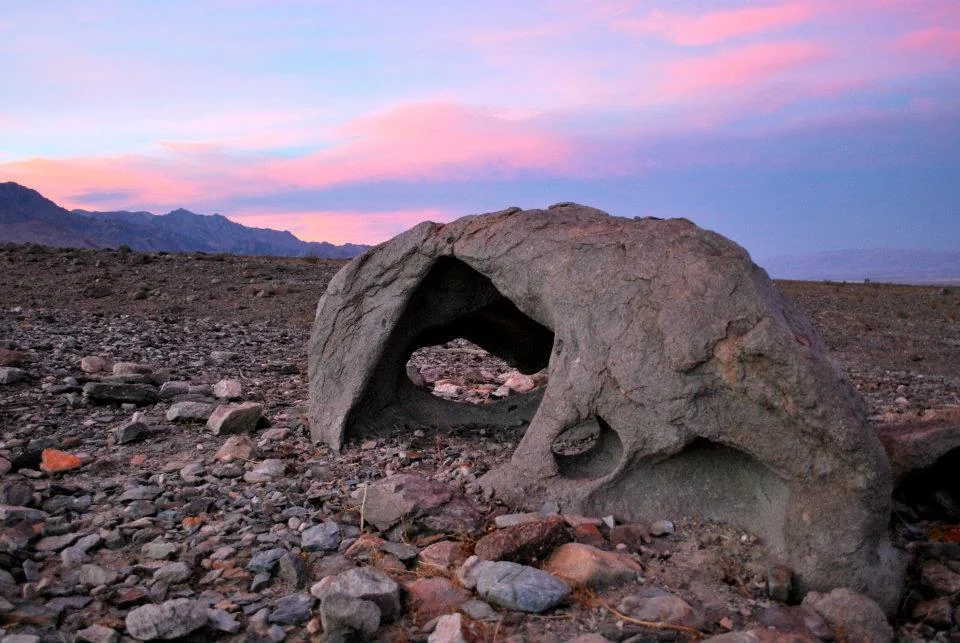
- National Park Service: Aeolian Landforms: source of the Death Valley ventifact photograph. NPS photograph, converted to WebP; no claim to original U.S. Government works.
The schematic is conceptual and has no measurement scale. The photograph shows a real NPS-identified example, but does not establish that every visible cavity has a single cause.