The distinction matters because a country can mention socialism while retaining competitive multiparty politics, private ownership, and a mixed economy.
As of 2026, five countries are commonly grouped as current socialist states: China, Cuba, Vietnam, Laos, and North Korea. This is a political-constitutional convention, not a universal economic test: each is governed by a communist or revolutionary workers’ party and formally pursues socialism, but their constitutional wording and use of markets differ.
How to use this article: Start with the three-category definition, check the five-state comparison, read the North Korea 2026 update, or compare constitutional references elsewhere.
What Do We Mean by “Socialist Countries”?
Socialism is a broad family of political and economic ideas emphasizing social ownership, collective control, or strong public direction of productive resources. It does not describe one fixed constitution, party system, or economic model.
For a present-day country list, the clearest approach is to examine constitutional identity, the position of the ruling party, and the state’s declared political direction together. Readers looking specifically for the ruling-party label may also find GeographyPin’s guide to communist countries and what that term means useful.
Three Useful Buckets
- Party-led socialist states: China, Cuba, Vietnam, Laos, and North Korea are governed by communist or revolutionary workers’ parties whose political systems formally pursue socialism.
- Democratic constitutions with socialist language: India, Nepal, Sri Lanka, Bangladesh, Portugal, and other countries use socialist wording without granting one socialist or communist party permanent control.
- Governments with socialist or social-democratic programs: elected parties may expand public ownership, welfare programs, or labor protections, but those policies can change after an election and do not redefine the state by themselves.
How the Current List Became Five
The number of states commonly described as socialist was much larger during the Cold War. Political transitions between 1989 and 1991 reduced the list sharply, leaving the five current cases with different national versions of party-led socialist government.
| Period | Milestone |
|---|---|
| 1917–1991 | The Soviet Union and aligned party-states shape the international meaning of a socialist state. Most Central and Eastern European socialist regimes end between 1989 and 1991, followed by the Soviet Union’s dissolution. |
| 1949 | The People’s Republic of China is founded under Communist Party leadership. |
| 1959–1961 | The Cuban Revolution succeeds in 1959, and the government declares its socialist character in 1961. |
| 1975–1976 | The Lao People’s Democratic Republic is established in 1975, and the reunified Socialist Republic of Vietnam is formally created in 1976. |
| 2019–2026 | Cuba adopts its 2019 Constitution, Laos promulgates a revised constitution in 2025, Vietnam amends specified constitutional provisions in 2025, and North Korea revises its constitution in March 2026. |
Socialist Countries Today (2026): The Five Party-Led States
The commonly used current list contains China, Cuba, Vietnam, Laos, and North Korea. They are grouped together because socialism remains part of their formal state direction and a communist or revolutionary workers’ party controls national political power.
“Party-led” is more accurate than treating all five as institutionally identical one-party states. China officially recognizes several subordinate parties within a system led by the Communist Party, while North Korea also retains satellite parties. Neither arrangement permits competitive opposition to replace the ruling party.
The Current Five at a Glance
The shared classification is mainly political and constitutional. Their economies range from extensive market use in China and Vietnam to much tighter state control in North Korea.
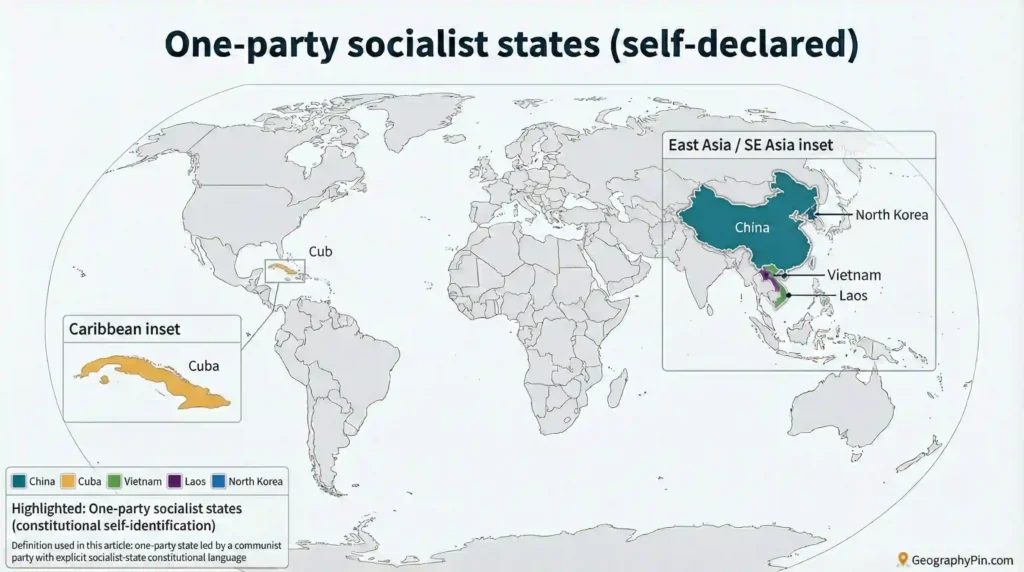
China (People’s Republic of China)
China’s Constitution defines the country as a socialist state in Article 1 and identifies Communist Party of China leadership as a defining feature of socialism with Chinese characteristics. Article 15 states that China practices a socialist market economy (Constitution of the PRC, amended 2018).
Why counted: explicit socialist-state identity, constitutionally central Communist Party leadership, and an official socialist market-economy model.
Cuba
Cuba’s 2019 Constitution defines Cuba as a socialist state in Article 1. Article 5 gives the Communist Party of Cuba the leading role in society and the state, while Article 18 establishes a socialist economic system based primarily on public ownership and planning. The constitution also recognizes private and mixed property under state regulation.
Why counted: explicit socialist-state identity, constitutionally protected Communist Party leadership, and a formally socialist economic system.
Vietnam (Socialist Republic of Vietnam)
Vietnam’s Constitution describes the state as socialist in Article 2, places the Communist Party of Vietnam in the leading position under Article 4, and defines the economy as a socialist-oriented market economy in Article 51.
A 2025 constitutional amendment revised the Vietnam Fatherland Front, trade-union, legislative-initiative, and local-government provisions. It did not replace Articles 2, 4, or 51.
Why counted: socialist constitutional identity, Communist Party leadership, and an official socialist-oriented market economy.
Laos (Lao People’s Democratic Republic)
The 2025 Constitution of Laos identifies the Lao People’s Revolutionary Party as the political system’s leading core in Article 3. Article 13 defines the national economy as a socialist-oriented market economy with multiple sectors and forms of ownership.
Why counted: constitutionally established revolutionary-party leadership and a formal socialist-oriented political and economic path.
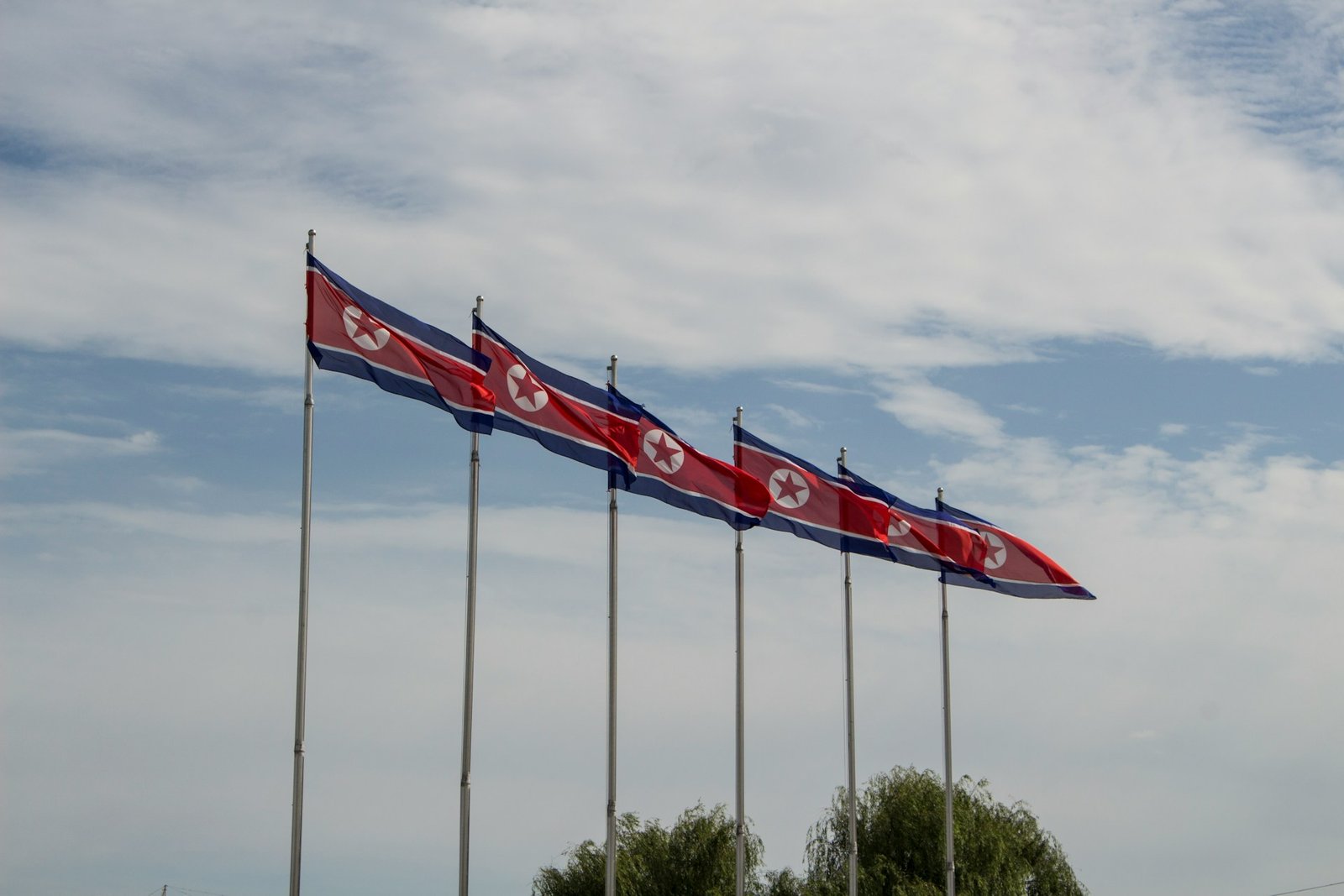
North Korea (Democratic People’s Republic of Korea)
North Korea requires a 2026 qualification. Its March 2026 constitutional revision changed Article 1 from an explicit socialist-state definition to a statement of the country’s official name. However, the revised preamble still describes a people-centered socialist state, Article 9 places state activity under Workers’ Party of Korea leadership, and Articles 16–17 retain socialist production relations and state or cooperative ownership.
The revision and its territorial changes were disclosed through South Korea’s Ministry of Unification and examined in May 2026 reporting. A public English translation of the 2026 text reflects the new article structure.
Why counted: continuing socialist language in the constitutional preamble and economy provisions, combined with the constitutionally protected leadership of the Workers’ Party. North Korea remains the list’s most qualified case.
| Country | Current constitutional anchor | Leading party | Official economic framing |
|---|---|---|---|
| China | Articles 1 and 15 of the Constitution amended in 2018 | Communist Party of China | Socialist market economy |
| Cuba | Articles 1, 5, and 18 of the 2019 Constitution | Communist Party of Cuba | Socialist system with planning and multiple recognized property forms |
| Vietnam | Articles 2, 4, and 51 of the 2013 Constitution, as amended in 2025 | Communist Party of Vietnam | Socialist-oriented market economy |
| Laos | Articles 3 and 13 of the 2025 Constitution | Lao People’s Revolutionary Party | Socialist-oriented market economy |
| North Korea | 2026 preamble and Articles 9, 16, and 17 | Workers’ Party of Korea | Socialist production relations with state and cooperative ownership |
The five-state total is therefore best understood as a transparent classification convention. It is not an official list maintained by the United Nations or another international authority.
Countries That Mention “Socialism” but Are Not Party-Led Socialist States
Several democratic constitutions use socialist language to express commitments to equality, social justice, welfare, or economic development. An official name or constitutional aspiration does not place a country in the same political category as the five states above.
The decisive difference is that these constitutions do not grant a communist or revolutionary workers’ party a protected right to control national political power.
Constitutional References Compared
| Country | Socialist wording | Why it is classified differently |
|---|---|---|
| India | The Preamble describes India as a sovereign, socialist, secular, democratic republic. “Socialist” was added by the 42nd Amendment in 1976. | India has a competitive multiparty parliamentary system and a mixed economy. The adjective expresses constitutional goals rather than permanent rule by a socialist party. |
| Nepal | Article 4 defines Nepal as a socialism-oriented federal democratic republican state. | The same constitution commits Nepal to competitive multiparty democratic government, civil liberties, periodic elections, and an independent judiciary. |
| Sri Lanka | Article 1 names the country the Democratic Socialist Republic of Sri Lanka. | The official name exists within an electoral constitutional order and does not establish permanent control by a socialist or communist party. |
| Bangladesh | The official constitutional text lists nationalism, socialism, democracy, and secularism as fundamental principles of state policy. | The constitutional wording links socialism to a democratic process and does not give one socialist party exclusive national authority. |
| Portugal | The constitutional preamble retains a historical aim of opening a path toward a socialist society. | Portugal’s operative constitutional structure is a democratic state based on the rule of law, representative government, and political pluralism. |
Table downloads (3)
- Selected milestones behind the current five-state list (6 × 2)View tableDownload CSV
- Constitutional and political comparison of the five commonly listed states (6 × 4)View tableDownload CSV
- Selected constitutional references that do not create party-led socialist states (6 × 3)View tableDownload CSV
Why the Wording Does Not Settle the Classification
Constitutional adjectives may record historical compromises, national goals, or principles of social justice. Official country names can also survive major changes in economic policy and government.
The examples above are representative rather than an exhaustive list of every constitution containing socialist language. Their shared distinction is the absence of a constitutionally protected communist or revolutionary party monopoly comparable to the five-state group.
Why Do Definitions Get Confused?
Socialism Is Broader Than One State Model
Social ownership can take the form of national ownership, local public ownership, cooperatives, worker ownership, or other collective arrangements. Political traditions using the socialist label also disagree about markets, elections, private property, planning, and the role of the state.
That is why the word may describe both an authoritarian party-state and a democratic political movement without making the two systems equivalent.
Using Markets Does Not Decide the Question
China, Vietnam, and Laos formally describe their economies as socialist or socialist-oriented market economies. Cuba recognizes private and mixed property within a state-directed socialist system. These arrangements differ, but market activity alone does not remove a country from the party-led socialist category.
The reverse is also true: extensive welfare programs, public healthcare, or state-owned companies do not automatically make a multiparty market democracy a socialist state. Nordic welfare states are a common example of this confusion.
A Practical Constitution-and-Party-System Test
For a defensible classification, ask four questions:
- Does the current constitution identify the state, political direction, or economy as socialist?
- Does it give a communist or revolutionary workers’ party a protected leading role?
- Can opposition parties legally compete for and replace the national ruling party?
- How does the state formally describe ownership, planning, and market activity?
The common five-country answer comes from considering these questions together. A keyword search for “socialist” cannot distinguish India’s preamble from China’s constitutional party system or account for North Korea’s revised 2026 wording.
Frequently Asked Questions
How many socialist countries are there today?
Five countries are commonly listed in 2026: China, Cuba, Vietnam, Laos, and North Korea. Five is a practical political-constitutional count, not an official universal total.
Are communist countries and socialist states the same thing?
No. “Communist country” usually describes rule by a communist or communist-derived party, while “socialist state” refers to a state’s declared political direction. The terms overlap in the current five-country list but are not universal synonyms.
Do China and Vietnam use markets?
Yes. Both use markets, private businesses, investment, and multiple forms of ownership while retaining Communist Party leadership. China calls its system a socialist market economy; Vietnam uses socialist-oriented market economy.
Why does India’s Constitution say “socialist”?
The word was added to India’s Preamble in 1976 and expresses constitutional commitments to social and economic justice. India remains a competitive multiparty parliamentary republic with a mixed economy.
Is Sri Lanka socialist because of its official name?
No. “Democratic Socialist Republic of Sri Lanka” is the constitutional name, but Sri Lanka does not give a socialist or communist party permanent control of the state.
Is North Korea still counted after its 2026 constitutional revision?
It is still commonly included. Although Article 1 no longer explicitly defines the country as a socialist state, the revised preamble, Workers’ Party leadership clause, and economic provisions continue to place socialism within the constitutional order.
What Did We Learn Today?
The defensible 2026 answer is five commonly grouped party-led socialist states: China, Cuba, Vietnam, Laos, and North Korea. The total depends on constitutional identity and ruling-party control rather than a single economic test. Democratic references in India, Nepal, Sri Lanka, Bangladesh, and Portugal belong to a different category, while North Korea remains included despite its revised Article 1.
Sources & Data Notes
Principal materials consulted for this update included constitutional texts and amendment records published by or through China’s State Council and National People’s Congress, Cuba and Laos texts hosted by FAOLEX, Vietnam’s constitutional and National Assembly records, and constitutional publications from the relevant national authorities in India, Nepal, Sri Lanka, Bangladesh, and Portugal. The North Korea update used the 2026 text released through South Korea’s Ministry of Unification, a public English translation, and reporting or analysis from Reuters, 38 North, and the Korea Economic Institute of America. The five-country total is a political-constitutional convention rather than an official international classification. This article was prepared and editorially reviewed by Z.K. Atlas, who completed the final factual checks and publication approval. AI tools may have assisted during the editorial process, including with language refinement and the creation or editing of visual materials.