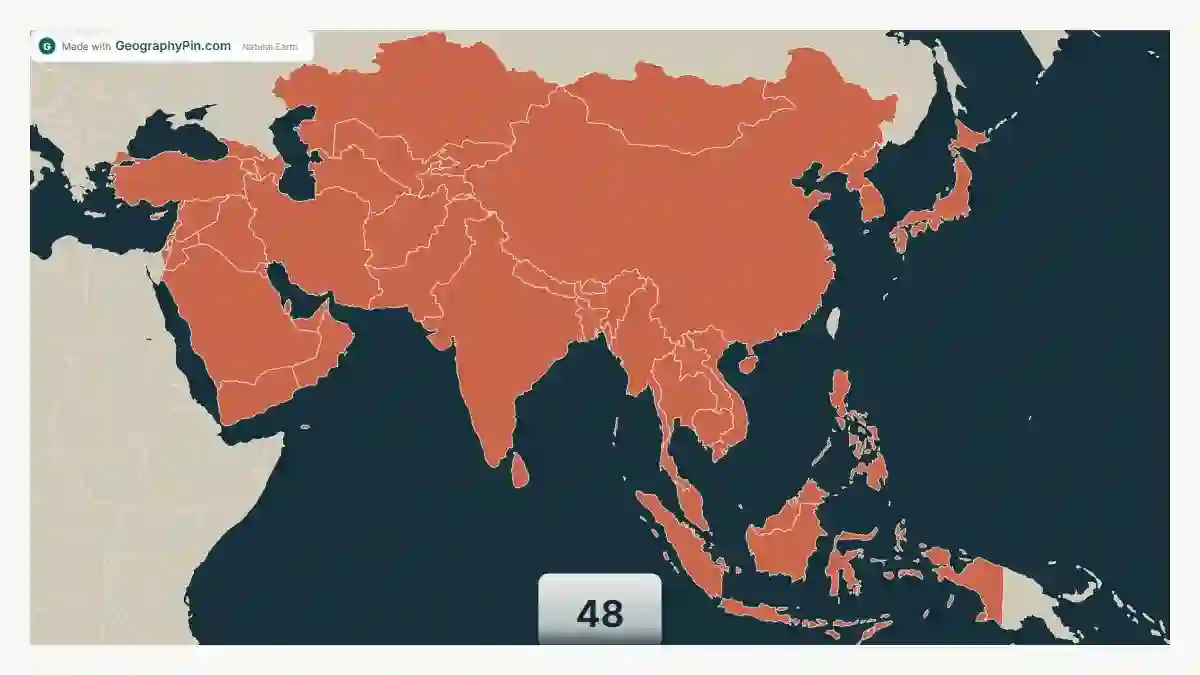
Asia has 48 countries under the convention used here: the UN M49 Asia grouping, with Hong Kong and Macao counted within China rather than as separate countries. The list includes the State of Palestine and excludes Russia, which M49 assigns to Eastern Europe.
How to use this article: Go straight to the full country-capital table, check how the count reaches 48, or review the capitals that need extra context.
How the Count Reaches 48
The counting convention used here
The count follows the United Nations Statistics Division’s M49 standard, which divides Asia into Central, Eastern, South-eastern, Southern, and Western Asia. M49 is a statistical framework; the UN states that these regional assignments do not express a position on political affiliation.
M49 contains 50 Asian “countries or areas” because Hong Kong and Macao are listed separately for statistical purposes. Counting both special administrative regions within China produces 48 state entries: 47 UN member states plus the State of Palestine, which has UN non-member observer state status.
Why Russia is not included
Russia is physically transcontinental, with territory in both Europe and Asia. M49 assigns the Russian Federation to Eastern Europe, so it is not part of this 48-country table. The same framework places Armenia, Azerbaijan, Cyprus, Georgia, and Türkiye in Western Asia, and Kazakhstan in Central Asia.
What is not counted separately
Hong Kong and Macao are statistical areas within the M49 system but are not separate countries. Taiwan is not a separate M49 entry and is not added under this UN-based convention. Lists using different geographic or recognition rules may therefore produce a different total.
List of 48 Countries in Asia and Their Capitals
The table uses familiar English country names, with current official forms added where useful. An asterisk or dagger points to a note where the capital answer requires clarification.
Country and capital table
| Country | Capital |
|---|---|
| Afghanistan | Kabul |
| Armenia | Yerevan |
| Azerbaijan | Baku |
| Bahrain | Manama |
| Bangladesh | Dhaka |
| Bhutan | Thimphu |
| Brunei | Bandar Seri Begawan |
| Cambodia | Phnom Penh |
| China | Beijing |
| Cyprus | Nicosia |
| Georgia | Tbilisi |
| India | New Delhi |
| Indonesia | Jakarta* |
| Iran | Tehran |
| Iraq | Baghdad |
| Israel | Jerusalem† |
| Japan | Tokyo |
| Jordan | Amman |
| Kazakhstan | Astana |
| Kuwait | Kuwait City |
| Kyrgyzstan | Bishkek |
| Laos | Vientiane |
| Lebanon | Beirut |
| Malaysia | Kuala Lumpur* |
| Maldives | Malé |
| Mongolia | Ulaanbaatar |
| Myanmar | Nay Pyi Taw (Naypyidaw) |
| Nepal | Kathmandu |
| North Korea | Pyongyang |
| Oman | Muscat |
| Pakistan | Islamabad |
| Philippines | Manila |
| Qatar | Doha |
| Saudi Arabia | Riyadh |
| Singapore | Singapore |
| South Korea | Seoul |
| Sri Lanka | Sri Jayawardenepura Kotte* |
| State of Palestine | East Jerusalem† |
| Syria | Damascus |
| Tajikistan | Dushanbe |
| Thailand | Bangkok |
| Timor-Leste | Dili |
| Türkiye (Turkey) | Ankara |
| Turkmenistan | Ashgabat |
| United Arab Emirates | Abu Dhabi |
| Uzbekistan | Tashkent |
| Vietnam | Hanoi |
| Yemen | Sana’a* |
Capital Cities That Need Extra Context
Most country-capital pairs are straightforward. The following cases involve a restored city name, a separate government seat, an unfinished transfer, conflict, or disputed political status.
Notes for the marked and commonly confused entries
- Kazakhstan: Astana is the current name of the capital; Nur-Sultan is obsolete. The Government of Kazakhstan identifies Astana as the national capital.
- Indonesia: Jakarta remains the legal capital while Nusantara is being developed. In June 2026, Indonesia’s Constitutional Court noted that the presidential transfer decree had not been issued, so the move had not occurred.
- Malaysia: Kuala Lumpur remains the national capital, while Putrajaya is the federal government’s administrative center.
- Sri Lanka: Sri Jayawardenepura Kotte is the administrative capital and seat of Parliament. Colombo remains the country’s main commercial center and hosts major national institutions.
- Israel and the State of Palestine: Israel designates Jerusalem as its capital, while the State of Palestine designates East Jerusalem as its capital; Palestinian administration is centered mainly in Ramallah. Jerusalem’s final status remains unresolved, and the UN position is that it should be settled through negotiations.
- Yemen: Sana’a is the national capital, while Aden has served as the temporary seat of the internationally recognized government during the conflict.
Related Country and Capital Lists
Continue with the corresponding GeographyPin reference lists:
Frequently Asked Questions
Are there exactly 48 countries in Asia?
There are 48 under the convention used here. Asia has no universally binding country count because sources handle transcontinental states, recognition questions, and statistical areas differently.
How many UN member states are in this list?
The table contains 47 UN member states and the State of Palestine, which is a UN non-member observer state.
Why are Cyprus and Türkiye included while Russia is excluded?
UN M49 places Cyprus and Türkiye in Western Asia but assigns the Russian Federation to Eastern Europe. This is a statistical classification rather than a denial that Russia has extensive territory in Asia.
Why do some Asian capital lists give different city names?
A formal capital and the working seat of government may be in different cities, a capital transfer may be unfinished, or a city’s political status may be disputed. Malaysia, Sri Lanka, Indonesia, Yemen, Israel, and the State of Palestine illustrate these distinctions.
What Did We Learn Today?
The 48-country total is a consistent UN-based convention, not the only imaginable geographic count. It pairs 47 UN members and the State of Palestine with their capitals, excludes Russia under M49, and identifies cases where a capital, government seat, planned transfer, or disputed status requires more explanation.
Sources & Data Notes
Classification and country status were checked against the United Nations Statistics Division’s M49 standard and UN membership resources. Capital names and exceptional cases were checked against UN geographical-names material, UN Data, the Government of Kazakhstan, Indonesia’s Constitutional Court, Putrajaya Corporation, Sri Lankan government and parliamentary sources, and United Nations material on Jerusalem and Yemen; Indonesia’s legal-capital note was current through July 24, 2026. This article was prepared and editorially reviewed by Zurab Koniashvili (Z.K. Atlas), who completed the final factual checks and publication approval. AI tools may have assisted during the editorial process, including with language refinement and the creation or editing of visual materials.