A calm pond beside an old mill can look like a natural feature. Its shape and connections may instead record an engineered system for collecting water, controlling its movement and turning that movement into work.
A mill pond is water impounded or stored to supply a water-powered mill. It helps provide controlled flow to a wheel or turbine, often through a millrace, with water returning downstream afterward. The name describes a purpose, not a fixed size, and surviving mill ponds may outlast the industry they served.
How to use this article: Follow the water’s route, distinguish head from flow, or examine the Yates Mill example.
1. A Pond Defined by Its Function
“Mill pond,” also written “millpond,” identifies a water body by its role in supplying a mill. It is not a separate category determined by a universal minimum depth or surface area.
A natural pond can occupy a hollow without having been created for industry. A mill pond belongs to a deliberately arranged water-power system, even if its surroundings later look natural or its original machinery has disappeared.
The broader pond definition explains natural and constructed basins. The lake explanation covers why pond, lake and reservoir names do not follow one worldwide size rule. Here, the distinguishing question is what the stored water was intended to do.
2. How the Water-Power System Works
Follow the supply, then the return flow
The National Park Service’s Brandywine Valley account describes dammed ponds feeding mills through headraces, with tailraces returning water to the stream.
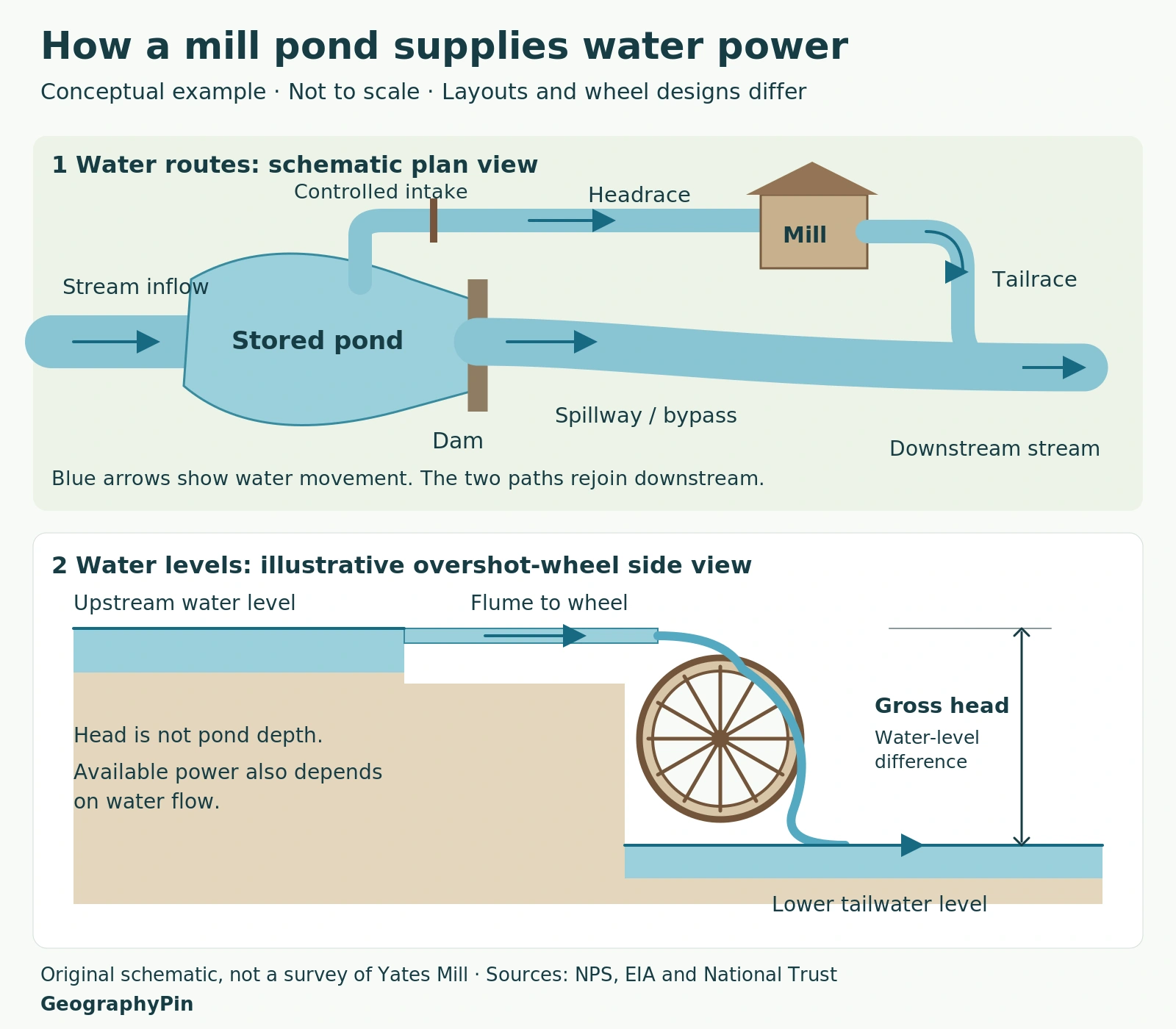
| Part | Function |
|---|---|
| Pond | Holds water for the mill’s supply. |
| Dam or weir | Raises or diverts water. |
| Headrace | Carries water toward the mill. |
| Wheel or turbine | Transfers water’s energy to machinery. |
| Tailrace | Carries used water back downstream. |
The illustration separates the water-supply system from the mill building. It is a conceptual arrangement, not a reconstruction of every mill or a survey of the photographed example.
Head is a height difference, not pond depth
Head is the water-level or elevation difference available to drive the machinery; flow is how much water passes through over time. The U.S. Energy Information Administration identifies both as fundamental to available water power.
A deep pond does not automatically provide a large usable fall at the wheel. Storage can help manage when water is released, but cannot create a continuing supply during drought. The useful questions are how much water arrives, how it is controlled and how far it can fall.
Historically, water power often drove mill machinery directly rather than generating electricity. The water leaving the wheel still belongs to the drainage system; the mill extracts energy, not the entire stream itself.
3. A Millrace Is Not the Same as a Mill Pond
A race is primarily a conveyance channel; a pond provides a body of stored water. They can be closely connected without being identical features.
At Patterson’s Spade Mill in Northern Ireland, a river diversion fed a headrace that widened into a pond before supplying a turbine. This off-channel example shows why not every mill pond lies directly behind a dam across the main stream.
Some supply channels were extensive. According to the National Park Service’s Amana account, colonists built a 7-mile (11-kilometer) canal in Iowa between 1865 and 1869. It diverted Iowa River water to two textile mills and a flour mill before returning toward the river through Price Creek.
The Amana example shows a water-power landscape larger than one pond beside one building. Mapping only the mill would omit the channel that made its location useful.
4. A Documented Example: Yates Mill
Steep Hill Creek, Raleigh, North Carolina
Yates Mill stands on Steep Hill Creek in the Raleigh area of Wake County, North Carolina. The city’s historic designation report documents the site and its former commercial milling, which ended in 1953.
Yates Mill Associates’ history records a land survey for Samuel Pearson in 1756 and a land grant in 1761. Those dates document the property history; neither should be presented automatically as a precisely established construction date.
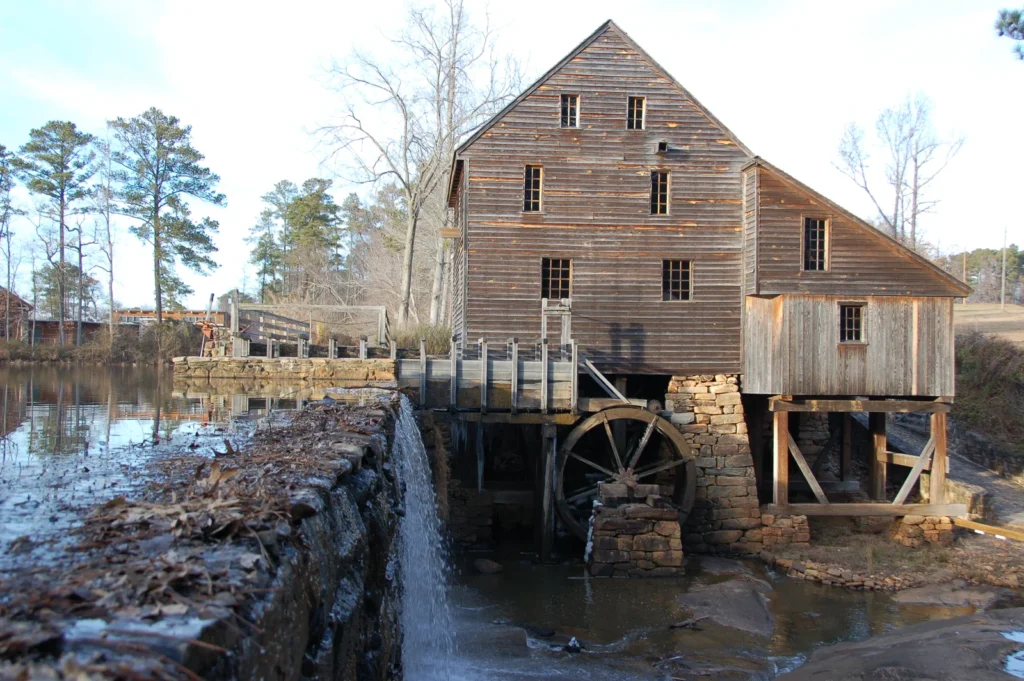
The pond supplied an overshot wheel, with water delivered near the wheel’s top. Flooding during Hurricane Fran in 1996 breached the dam. Restoration of the dam, flume and machinery allowed corn grinding to resume in 2001.
This sequence illustrates the pond’s connection to a working system: storing water was only one part of a chain that also depended on the retaining structure, delivery channel and mill equipment. The featured photograph records the site in 2011, not an assurance that every component remains unchanged.
5. Sediment and the Changing Landscape
Impounding water changes the flow conditions in a stream reach. Whether it also produces a thick sediment deposit depends on the material arriving and how water moves through the impoundment.
The Bureau of Reclamation’s December 2017 sediment guidelines explain that storage, operations and sediment characteristics affect trapping. Some low-head impoundments contain little accumulated material. It is therefore misleading to describe every old mill pond as a deep basin of trapped mud.
Where substantial sediment has accumulated, a dam breach or removal can expose or release it. The amount and downstream response require site-specific assessment, not a universal prediction that removal will either cause severe damage or have no effect.
Maintenance could itself shape the landscape. At Amana, the historical millrace was dredged annually before a change to electrical generation in the 1920s altered operations. That is a documented local history, not a recommendation that all mill ponds need annual dredging.
A surviving place-name is only a starting clue. To understand a particular “Mill Pond,” look for records of its dam, race, mill and later alterations rather than assuming that the present water body still performs its original function.
Frequently Asked Questions
Were mill ponds used only for grinding grain?
No. Water-powered mills also processed materials such as timber, paper and textiles. The pond supplied power-related water storage; the machinery inside the mill determined the work performed.
Does all the water have to pass through the mill?
No. A spillway or other bypass can return surplus water without sending it through the machinery. The diagram shows the controlled supply and bypass as separate paths.
What Did We Learn Today?
A mill pond makes sense as part of a connected water-power landscape, not simply as a pool beside a building. Pond storage, the race, available head and machinery perform different roles. Historical examples also show that changes in operations, structures and sediment can leave a landscape quite different from the one its name first described.
Sources & Data Notes
The diagram is conceptual, not a survey of Yates Mill. Dates refer to documented property history, construction of the Amana race and specific restoration events. Sediment behavior is conditional; the December 2017 technical guidance is not a measurement of either named site.
- NPS: Industry in the Brandywine Valley
- EIA: Hydropower Explained
- National Trust: Patterson’s Spade Mill pond
- Yates Mill Associates: site history
- NPS: Amana Mill Race
- Bureau of Reclamation: Dam Removal Analysis Guidelines for Sediment, December 2017
- City of Raleigh: Yates Mill landmark report
Photograph: Yates Mill, its pond and spillway in Raleigh, North Carolina, January 16, 2011. Photo: Mark Turner, public domain via Wikimedia Commons.
