Scotland has a parliament, and French Polynesia has significant autonomy. Neither example tells you by itself whether the country is a federation. The distinction is where regional authority comes from and how it can be changed.
A unitary state has one national constitutional order rather than a federal division of powers among governments. It can still give elected regional legislatures substantial powers. Scotland and Wales have different powers under UK devolution, and France’s overseas arrangements also vary without making France a federation.
How to use this article: Check what makes a system unitary, see where devolved lawmaking differs in the UK, or compare two French overseas arrangements.
Unitary does not mean everything is run from the capital
Distinguish the source of power from its day-to-day use
Constitutional examples checked November 20, 2026. A unitary system has one national constitutional order rather than a federation-wide division of authority between the center and constituent governments. That does not require national officials to make every decision. Regional institutions can run services, adopt rules or even make primary laws in specific fields. The International IDEA constitutional design brief distinguishes federal and nonfederal ways to accommodate territorial autonomy.
Three questions help: Who gives the regional body its powers? What kind of rules can it make? What legal process changes the arrangement? Electing a legislature answers none of those questions on its own. Conversely, a constitutional guarantee of local self-government need not turn a unitary state into a federation.
How UK devolution actually works
Three legislatures, but no equivalent for all of England
The UK Parliament dates the first transfers to July 1, 1999 for Scotland and Wales and December 2, 1999 for Northern Ireland. Subsequent laws broadened and changed the powers. Today the Scottish Parliament, the Welsh Parliament (Senedd Cymru) and the Northern Ireland Assembly can each make primary laws within their devolved fields. The fields are not identical.
| Part of the UK | Lawmaking institution or arrangement | Key distinction |
|---|---|---|
| Scotland | Scottish Parliament | Scotland Act 1998, section 28 allows Acts of the Scottish Parliament within competence and preserves the UK Parliament’s power to make laws for Scotland. |
| Wales | Senedd Cymru | Government of Wales Act 2006, section 107 provides for Welsh legislation and retains UK Parliament’s power to make laws for Wales. |
| Northern Ireland | Northern Ireland Assembly | Northern Ireland Act 1998, section 5 provides for Assembly legislation and retains UK Parliament’s power. The settlement distinguishes transferred, reserved and excepted matters. |
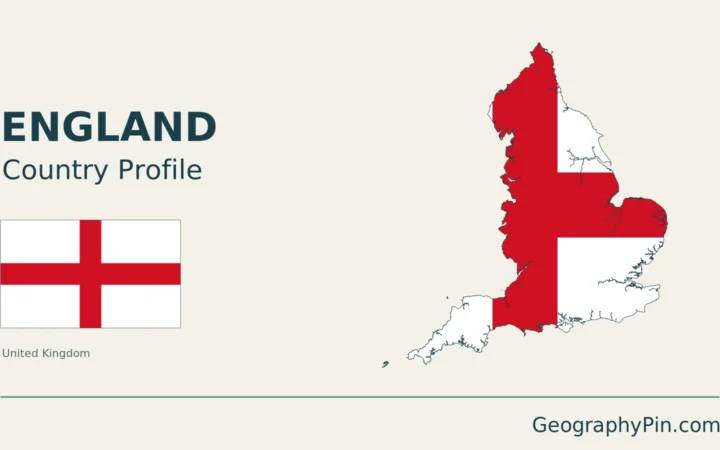
| England | No separate England-wide legislature of this kind | The UK Parliament makes primary laws for England. London and some other areas have local or mayoral powers; those bodies are not equivalent to the three devolved legislatures. |
One practical contrast is policing. The Scottish Parliament treats justice and policing as devolved subject areas, within limits. The Welsh schedule of reserved matters lists policing under reservations, also subject to exceptions. The House of Commons Library describes this variation across the UK as asymmetric devolution.
A political convention is not a legal veto
In these statutory settlements, Westminster retains the legal power to legislate in devolved fields. That is not a claim that it normally chooses to do so. Under the Sewel Convention it normally seeks consent before legislating on devolved matters. Scotland and Wales have statutory recognition of that convention.
In Miller, paragraphs 136–151 (2017), the UK Supreme Court treated Sewel as a political convention rather than a rule the courts can enforce. Losing a consent vote is not the same as a legal veto. The point is specifically about this convention and the UK devolution settlements; it is not a claim that every UK authority can act without legal limits.
Decentralization in France is not one rule for every place
Guadeloupe and French Polynesia do not have the same status
The French Constitution describes the Republic as indivisible and its organization as decentralized. The 2003 constitutional reform added the explicit decentralization wording to Article 1. Article 72 provides for territorial communities to govern themselves through elected councils under statutory conditions and to make regulations within their responsibilities.
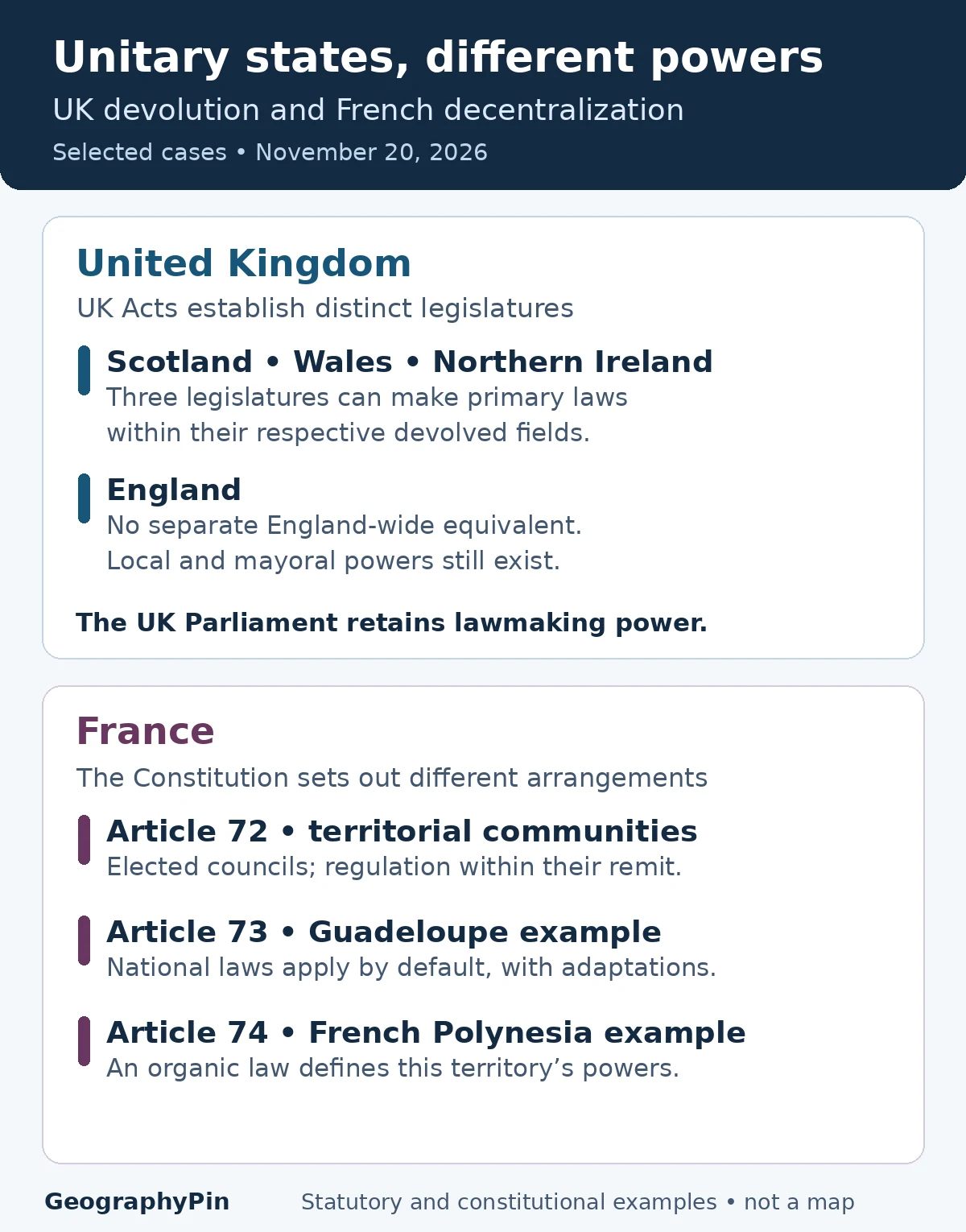
Guadeloupe illustrates Article 73. National laws and regulations apply by default, but can be adapted to local circumstances. France’s official legislative drafting guide describes this regime and its exceptions.
French Polynesia illustrates a different arrangement under Article 74. Its own organic autonomy law sets out the division: Article 13 gives its authorities power in areas not assigned to the French state or to local communes under the applicable rules. This is not a description of all overseas France. Other territories can have different statutes or constitutional provisions.
How to compare devolution with federal powers
Compare fields and the legal basis, not the name of the elected office. In Canada, for example, section 92 of the Constitution Act, 1867 sets out fields for provincial legislatures. The UK examples above start with the relevant Act of the UK Parliament. France provides constitutional recognition for territorial self-government and different overseas arrangements without making ordinary regions equal partners in a federation.
Maps can locate the places affected, but cannot tell you whether a particular law applies there. Check the instrument’s territorial extent, where its provisions actually apply, and the date the relevant change took effect. The same boundary can remain on a map after powers change.
Frequently Asked Questions
Can a national government have local offices without devolving power?
Yes. A local office can carry out national policy while remaining part of the national government. That differs from giving a separately elected body power to choose policy or legislate in a field.
Does a unitary state have to be a republic?
No. Unitary and federal describe where governing power sits geographically, not whether the head of state is a president or a monarch. The UK has a monarch, while France’s constitution describes a republic.
Can regional laws be reviewed by courts even when the Sewel Convention is not enforceable?
Yes. A court can examine whether a devolved law is within legal competence. The Scottish Parliament’s description of devolved and reserved matters concerns the legal scope of its powers, separate from whether Westminster sought consent under Sewel.
Can a French overseas community change from one constitutional regime to the other automatically?
No. Article 72-4 requires the affected voters’ prior consent before a change between the Article 73 and Article 74 regimes for the relevant territory; an organic law decides the change.
What Did We Learn Today?
Unitary states can have elected legislatures and substantial territorial autonomy. The UK and France show different arrangements within the same national constitutional order. To see what a region can actually do, check the source and limits of its authority, not just whether it has a parliament or appears on a distinct part of a map.
Sources & Data Notes
International IDEA provides the constitutional framing. The current UK statute texts, UK and Scottish parliamentary explainers and the UK Supreme Court judgment establish what is legally assigned and what remains a political convention. The French Constitution and organic legislation distinguish territorial councils and the two overseas examples. The diagram shows selected institutions and places, not every form of local government.
Featured image: Scottish Parliament Debating Chamber 1, © User:Colin / Wikimedia Commons, November 2, 2013, CC BY-SA 4.0. Cropped, resized and converted to WebP; the adaptation remains under CC BY-SA 4.0. The original comparison illustration draws on the constitutional and parliamentary sources linked in the text; it is not a map of sovereign boundaries.