Where is Batumi? On the Black Sea coast of southwest Georgia, the country in the South Caucasus. It is Adjara’s capital.
Is it worth visiting? Yes for a city-and-coast break with food, architecture, nightlife, and nature nearby; less so for a reliably dry, sandy-beach vacation.
How many days do you need? Two days cover the main city; three allow one well-chosen excursion.
When is the best time to go? May–June or September often balance outdoor plans and crowds; July–August best suits a beach-led trip but is busier and more humid.
Are the beaches sandy? No. Batumi and most nearby shores are predominantly pebble or shingle.
Do you need a car? No for central Batumi. Use buses, bicycles, or app-booked taxis for outer sights; arrange transport for some mountain trips.
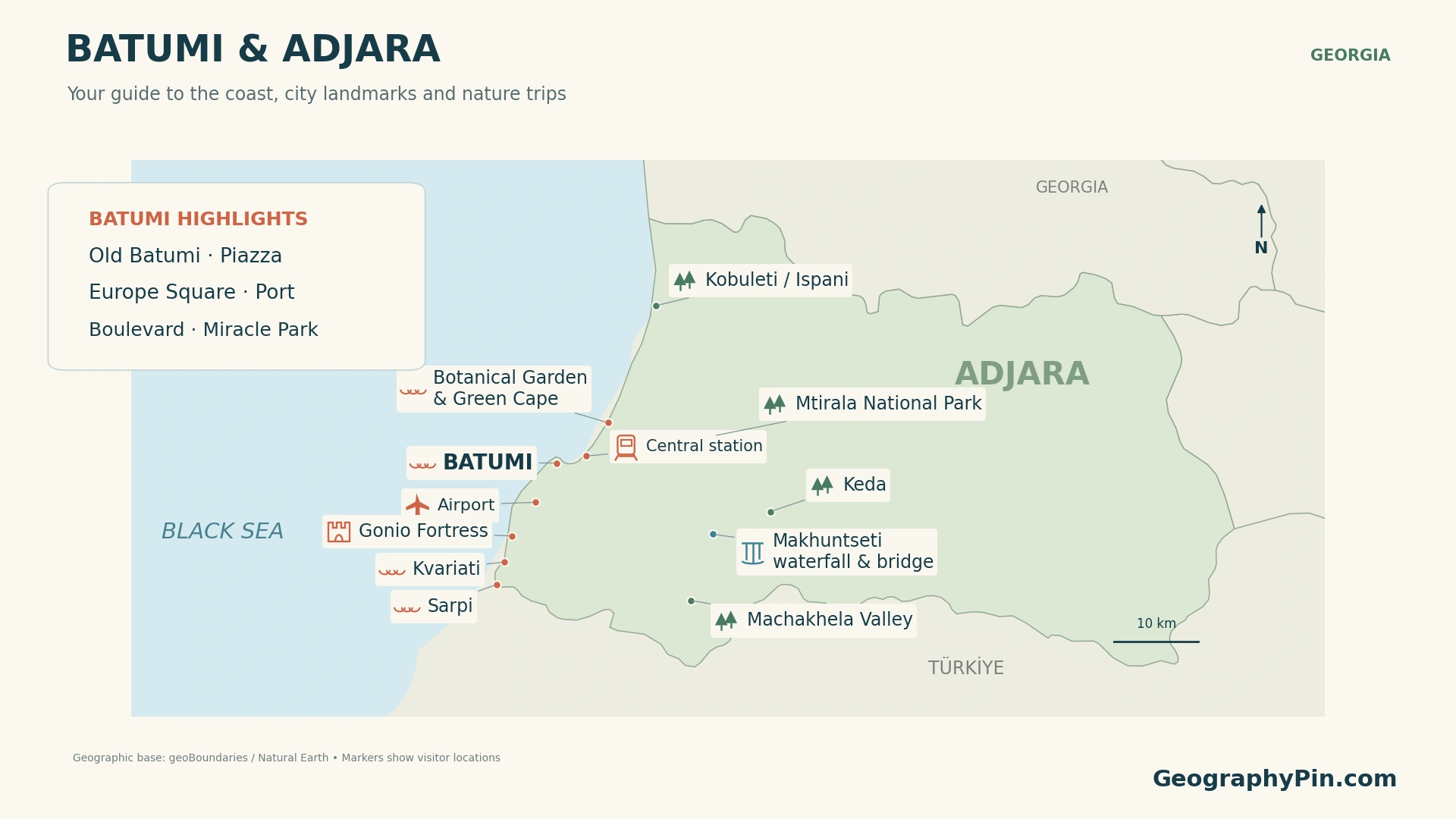
Batumi’s historic center and original boulevard occupy the northern-central waterfront, while New Boulevard extends south toward the airport; the railway station and Botanical Garden lie north of the main visitor area.
How to use this article: Jump to arrival options, areas to stay, timing by trip goal, or the three-day route.
Where Batumi Is and How the City Fits Together
Batumi sits on the eastern Black Sea, close to Georgia’s border with Türkiye. Adjara—also rendered Ajara—is an autonomous republic within Georgia the country, not a separate country. This is not the U.S. state of Georgia.
The core visitor geography is simple once the transport hubs are placed correctly. Old Batumi, the port, Miracle Park, and the older Boulevard occupy the northern-central waterfront. The promenade continues south through the high-rise Khimshiashvili/New Boulevard district. Batumi Airport is southwest of the center; Batumi Central railway station is north of the main tourist area despite its name. Green Cape and the Botanical Garden are farther north, while Gonio, Kvariati, and Sarpi run south toward Türkiye. Mountainous Adjara lies inland.
| Fact | Visitor information |
|---|---|
| Country | Georgia |
| Autonomous region | Autonomous Republic of Adjara, also called Ajara |
| Water body | Black Sea |
| Approximate coordinates | 41.65° N, 41.64° E |
| Time zone | Georgia Standard Time, UTC+4 |
| Currency | Georgian lari, code GEL |
| Official language | Georgian |
| Airport code | BUS, Batumi International Airport |
| Railway station | Batumi Central |
| Emergency number | 112 |
| Beach type | Predominantly pebble or shingle |
| Suggested first trip | Two to three full days |
Is Batumi Right for You?
Batumi works best as a mixed city, coast, and nature stop—not as a conventional dry-weather resort. Use the tradeoffs below rather than judging it by a long attraction count.
| Interest | Fit | Reality check |
|---|---|---|
| Waterfront walking | Strong | The Boulevard is long; bicycles or transport help with the southern reaches. |
| Architecture | Good | Late-19th- and early-20th-century streets meet conspicuous modern towers. |
| Food | Strong | Regional dishes are a genuine reason to visit without needing a restaurant checklist. |
| Nightlife | Good for interested visitors | Summer activity can mean noise around central streets and tower districts. |
| Beach holiday | Mixed | Expect stones, urban waterfront, humidity, rain, and peak-summer crowds. |
| Family visit | Good | Parks and waterfront attractions help, but individual rides and venues need live checks. |
| Nature excursions | Strong base | Mountain weather, road conditions, and transport determine what is realistic. |
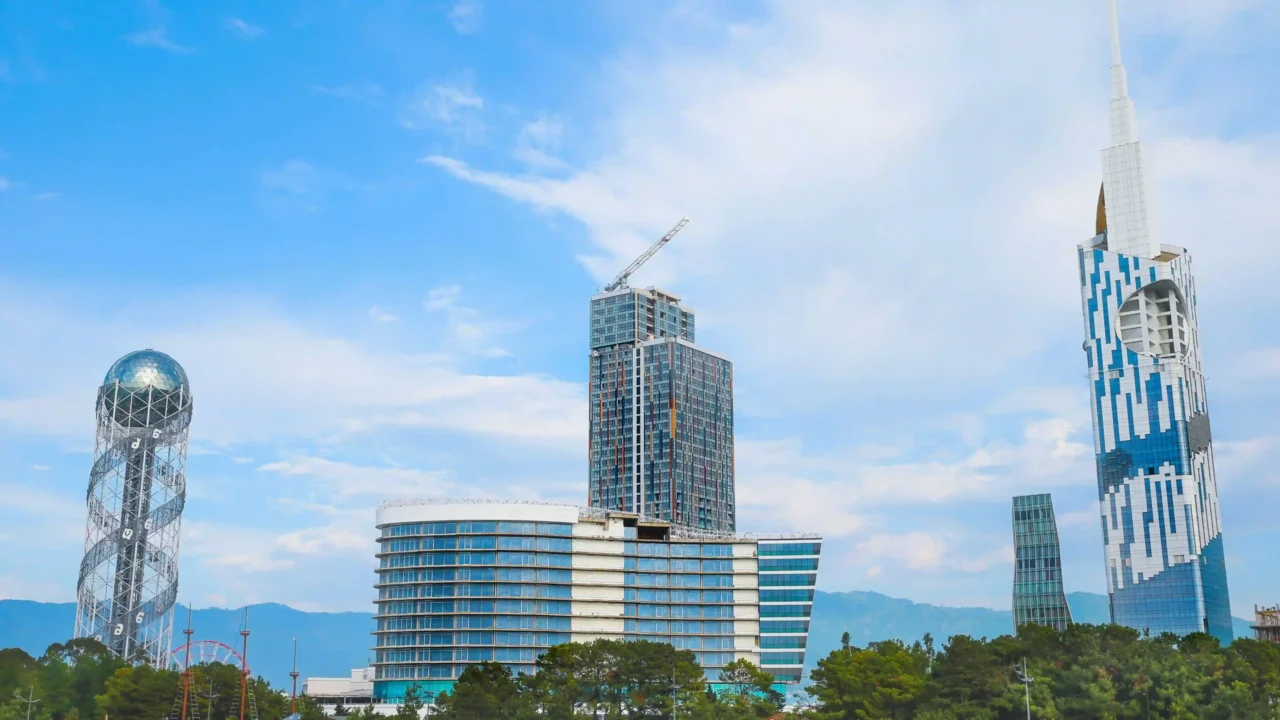
Extensive modern development is part of Batumi’s present-day character. It creates more apartment and entertainment choices, but construction views and noise can change block by block.
Entry Rules and Travel Insurance
Georgia’s visa rules depend on nationality, travel document, and sometimes a qualifying foreign visa or residence permit. Check your exact situation with the official GeoConsul visa checker. Eligible travelers who require a short-stay visa can apply through Georgia’s official e-Visa portal while outside Georgia.
Do not assume that every nationality receives one year visa-free, or apply one passport-validity formula to every entry category. Verify the rules for the passport you will actually present, and recheck them shortly before departure.
Since January 1, 2026, incoming tourists generally must carry health and accident insurance for their complete stay, including arrival and departure dates. The policy must provide at least GEL 30,000 in coverage, may be issued by a Georgian or foreign insurer legally authorized in its country to provide health and accident insurance, and may be shown electronically or on paper in Georgian or English. Keep it accessible at the border; see the official Georgian MFA insurance notice. Visa-free status does not itself remove this requirement.
How to Get to and Around Batumi
Compare the main arrival options
Choose by origin and final arrival point, not by a timetable copied months in advance. Batumi’s flights, rail capacity, road traffic, and border queues all vary.
| Route | Arrival and journey type | Best use case | Check live |
|---|---|---|---|
| Direct flight to Batumi | BUS airport, southwest of the center; flight plus short bus or taxi transfer | A direct flight operates on your dates | Airline schedule, seasonal operation, baggage, and onward transport |
| Train from Tbilisi | Batumi Central, north of the tourist core; intercity rail plus a final city transfer | Comfort and avoiding road traffic | Georgian Railway schedule, seats, and final bus or taxi |
| Coach from Tbilisi | Road coach; terminal or operator stop can vary | Budget or departure-time flexibility | Operator, terminal, duration, baggage rules, and traffic |
| Transfer from Kutaisi Airport | Airport coach to Batumi, or shuttle to the nearby rail station and a suitable train | Flights arriving at Kutaisi | Airport-listed transfer providers, the current Batumi connection, rail connection, and whether the chosen train stops |
| Road through Sarpi from Türkiye | Land-border crossing south of Batumi, followed by road transport | Combining Türkiye with coastal Georgia | Check the official customs-point overview, Revenue Service contacts, required documents, queues, and onward transport. |
Direct flights can be highly seasonal, and an airport route map that includes scheduled and unscheduled services does not prove a route operates on your date. Batumi Airport’s official page identifies municipal bus 10 to the city center, but its detailed bus page still displays an obsolete fare. The official municipal resolution, effective February 3, 2026, set the fare for one standard municipal-bus ride paid with a transport plastic card at GEL 0.70. Confirm the current fare and whether any other payment method is accepted before boarding.
Kutaisi Airport’s railway station is about 1.1 miles (1.8 kilometers) from the terminal and has a dedicated shuttle for rail passengers, but not every train necessarily fits a flight arrival. Airport coach desks do not imply continuous departures. Compare both options live.
Getting around without a car
Old Batumi, the port, and the northern waterfront are walkable, but the Boulevard is long. The airport, railway station, Botanical Garden, Green Cape, and southern beaches require a bus, bicycle, or taxi for most visitors.
Batumi Transport operates municipal services, but verify routes in a current journey-planning app and confirm payment locally because official online route and payment information can lag. BatumVelo can suit level waterfront trips. For taxis, book through an app or arrange one through a trusted provider, verify the vehicle and fare shown, and check that working seatbelts are available.
Where to Stay in Batumi
Choose an area, not a hotel list
These labels are practical visitor areas rather than exact administrative neighborhoods. Check the precise block, recent noise reports, and walking route before booking.
| Area | Best for | Tradeoff |
|---|---|---|
| Old Batumi | Architecture, restaurants, and a first visit | Nightlife and street noise are possible. |
| Old Boulevard/Rustaveli area | Waterfront access and established hotels | Demand and prices rise in high summer. |
| Khimshiashvili/New Boulevard | Modern towers, apartments, and nightlife | Farther from the historic core; construction noise varies. |
| Makhinjauri/Green Cape | A quieter coast and Botanical Garden access | Less convenient for repeated central sightseeing. |
Best Time to Visit and How Long to Stay
Batumi has a humid subtropical climate shaped by the Black Sea and western Georgia’s mountains. Summer is warm and humid, but this is not a reliably dry Mediterranean-style resort: rain can interrupt plans throughout the year. Use Georgia’s National Environmental Agency weather portal and its warnings page for urgent conditions.
Best period by trip goal
| Period | Best for | Main limitation |
|---|---|---|
| May–June | Green scenery, sightseeing, and outdoor excursions | Swimming conditions still vary, especially earlier. |
| July–August | Warmest beach period and fullest seasonal services | Busiest, humid, and generally most expensive; rain remains possible. |
| September | Often-suitable swimming conditions and potentially lighter crowds | Substantial rain remains possible. |
| October–April | Quieter city travel, food, and museums | Wetter spells, shorter days, and reduced seasonal operations. |
How many days to allow
| Time | Realistic plan |
|---|---|
| One day | Historic center, port, and waterfront overview |
| Two days | Main city sights plus the Botanical Garden or another half-day attraction |
| Three days | The strongest first-visit plan, including one nearby excursion |
| Four or more days | Slower beach time and deeper exploration of Adjara, with weather flexibility |
Best Things to Do in Batumi
Priorities matter more than volume. Times below are planning estimates, not opening hours.
| Place | Allow | Setting | What to check live |
|---|---|---|---|
| Old Batumi, Piazza, and Europe Square | 2–3 hours | Mostly outdoors | No general ticket; check individual venues and events. |
| Batumi Boulevard and Miracle Park | 2–3 hours | Outdoors | Weather and any paid ride, tower, or event |
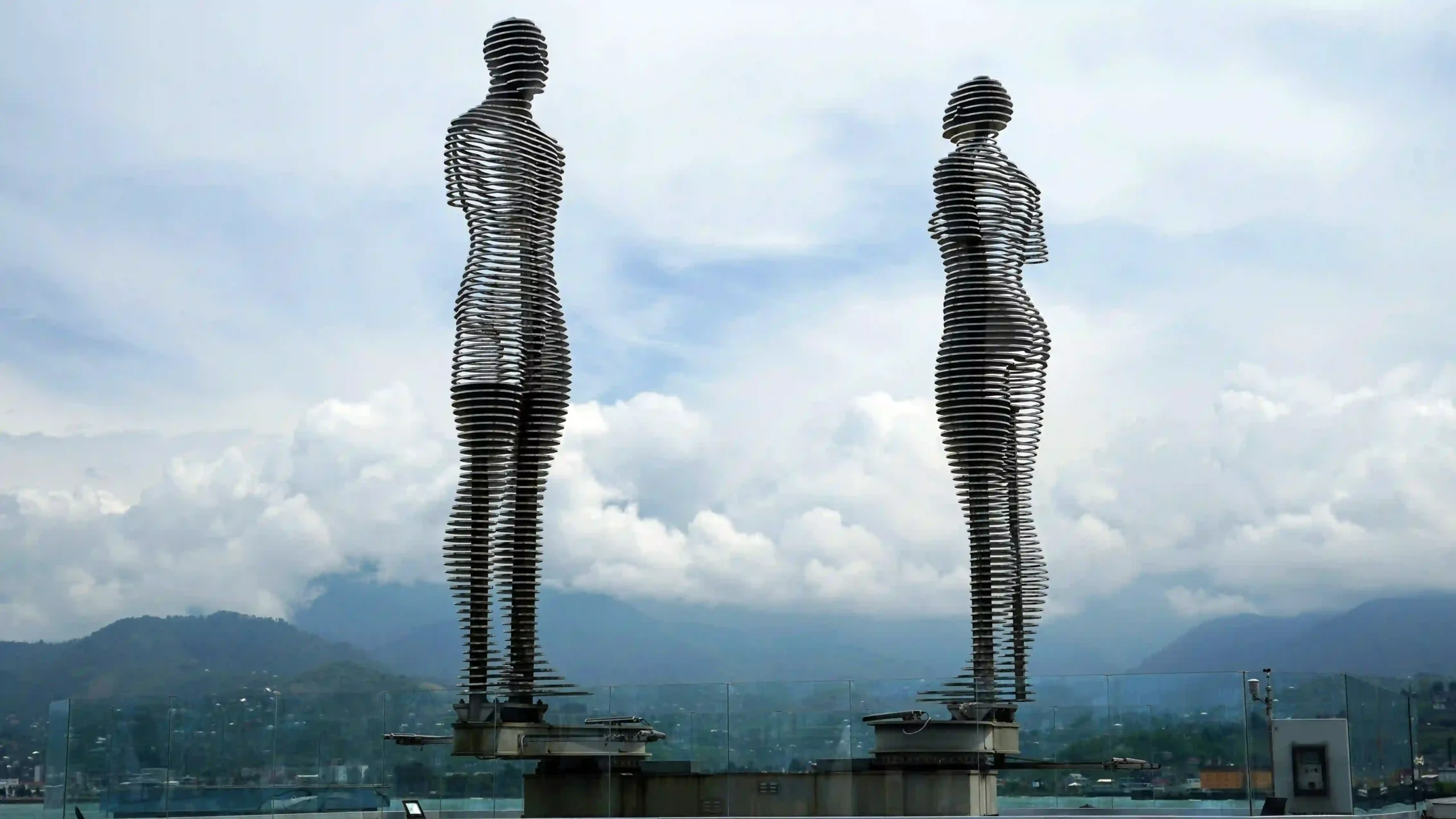
| Ali and Nino sculpture | 15–30 minutes | Outdoors | Maintenance; do not assume it will be moving |
| Batumi Beach | 1–3 hours | Outdoors | Weather, sea state, flags, and lifeguard instructions |
| Batumi Botanical Garden | About 2–3 hours | Outdoors, sloped | Hours, admission, internal transport, and access |
| Argo Cable Car | 1–2 hours | Mixed | Operation, weather, queue, and tickets |
| Archaeological Museum or Ajara Art Museum | 1–2 hours | Indoors | Hours, exhibitions, and tickets |
| 6 May Park and family attractions | 1–2 hours | Mixed | Each attraction’s separate hours and admission |
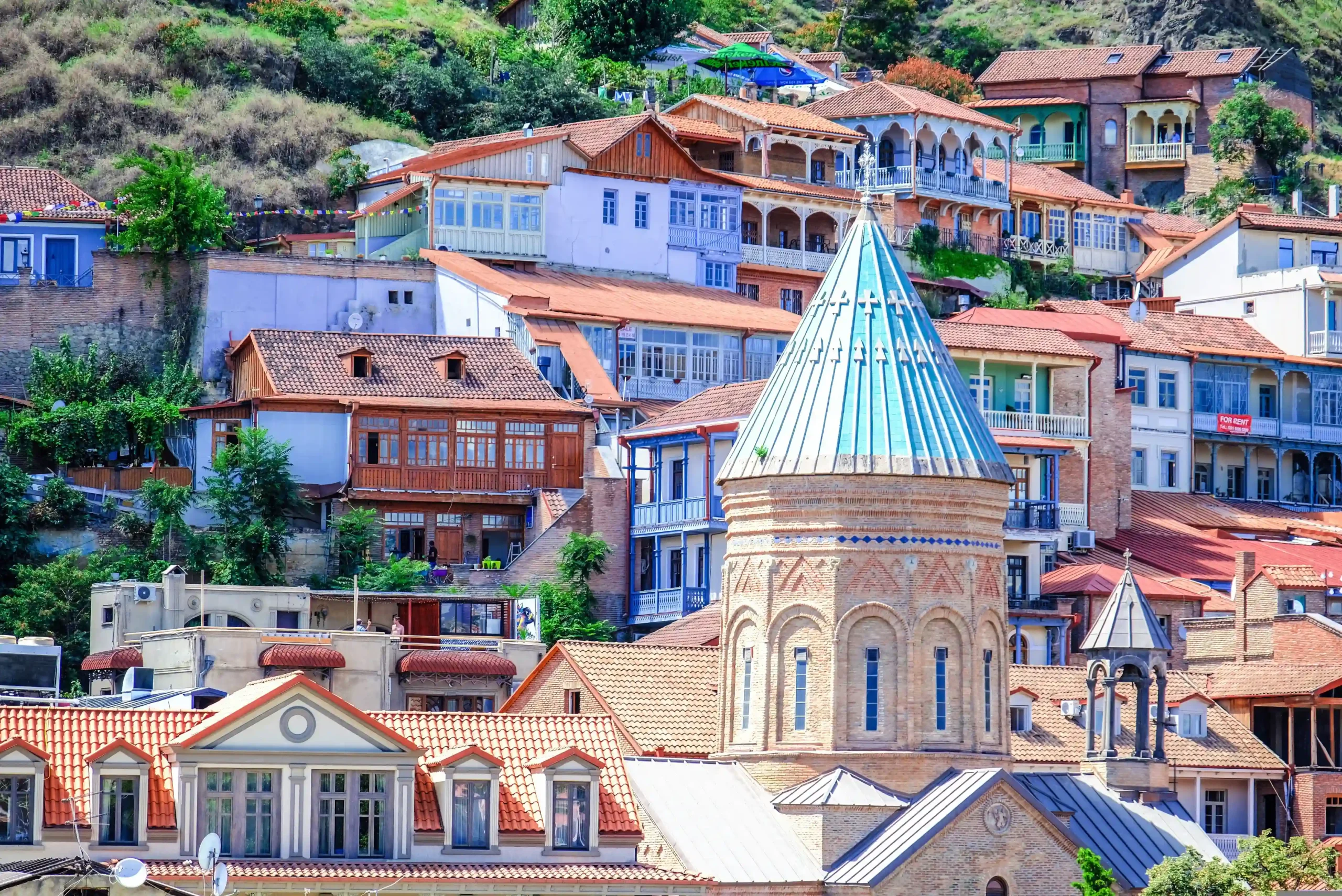
Old Batumi is historic, but it is not a preserved medieval town. The official Old Batumi overview places much of its recognizable architecture in the expansion driven by port and trade development during the late nineteenth and early twentieth centuries. Piazza is a much newer urban set piece. Together with Europe Square, these streets work best as an architectural walk rather than a search for a single “old town” monument.
Follow that walk through the port to Miracle Park and the Boulevard. Ali and Nino is a kinetic sculpture, but maintenance can interrupt its movement. On a clear day, Argo offers an elevated city-and-sea view; in rain, substitute an archaeology or art museum rather than forcing an outdoor checklist.
What Are Batumi’s Beaches Really Like?
Batumi’s main shore is predominantly smooth pebble or shingle, not sand. Water shoes can make entering and leaving the sea more comfortable, but they are a useful option rather than a compulsory purchase. A padded mat also works better than a thin towel on the stones.
Central Batumi Beach is urban: the Boulevard, roads, hotels, and city activity sit close behind it. The New Boulevard coast extends the waterfront south with more spread-out modern development. Green Cape and Makhinjauri lie to the north; Gonio and Kvariati offer alternatives south of the city. Most visitors based in central Batumi will use transport to reach them.
You can swim in the Black Sea when conditions permit, but neither water quality nor sea safety is permanent. Conditions change by location, weather, runoff, and date. Follow the beach flags and lifeguard instructions displayed that day, and stay out when rough-water warnings are in force. Avoid claims that one beach is always the cleanest or safest.
A Realistic Three-Day Batumi Itinerary
The three-day route at a glance
This plan keeps the city compact on the first two days and reserves the third for one coherent excursion. Reverse outdoor and indoor periods when rain dictates.
Day 1: Old Batumi and the waterfront
Walk Old Batumi, Piazza, and Europe Square, then continue toward the port and Miracle Park. Follow the waterfront for sunset rather than trying to walk the Boulevard’s entire length.
Day 2: Garden, beach, and a weather choice
Give the Botanical Garden the morning or early afternoon, including transport time. Back in the city, choose a beach or Boulevard interval. Finish with a museum in wet weather or the Argo Cable Car if visibility and operation are favorable.
Day 3: Southern coast or inland Adjara
Choose Gonio-Apsaros Fortress with Gonio or Kvariati for archaeology and coast. Alternatively, devote the day to one inland route such as Mtirala National Park or the Makhuntseti–Keda corridor. Do not attempt both the southern coast and a full mountain excursion in one rushed day.
Best Day Trips from Batumi
Pick one by interest, mobility, and the day’s forecast. Travel times and access can change with traffic, road works, rain, and landslides.
| Excursion | Best for | Time | Plan before leaving |
|---|---|---|---|
| Botanical Garden and Green Cape | Gardens, views, and an easy northern outing | Half day | Opening, transport, slopes, and return connection |
| Gonio-Apsaros with Gonio or Kvariati | Archaeology plus the southern coast | Half to full day | Fortress hours, sea conditions, and return transport |
| Mtirala National Park | Rainforest landscapes and hiking | Full day | Trail, vehicle access, footwear, weather, and daylight |
| Makhuntseti, an historic arched bridge, and Keda | Waterfall, valley scenery, and mountain Adjara | Long half or full day | Road and weather conditions; do not rely on unsupported bridge legends |
| Machakhela | Forest and cultural landscapes | Full day | Route, guide or driver, access, and weather |
| Kobuleti/Ispani wetlands | Wetlands and birding | Half to full day | Visitor access, seasonal conditions, and transport |
Table downloads (8)
- Batumi travel facts (13 × 2)View tableDownload CSV
- Batumi trip-fit matrix (8 × 3)View tableDownload CSV
- How to get to Batumi (6 × 4)View tableDownload CSV
- Practical areas to stay in Batumi (5 × 3)View tableDownload CSV
- When to visit Batumi by travel goal (5 × 3)View tableDownload CSV
- Realistic Batumi trip lengths (5 × 2)View tableDownload CSV
- Prioritized Batumi sights for a first visit (9 × 4)View tableDownload CSV
- Choose a Batumi excursion by interest (7 × 4)View tableDownload CSV
Gonio-Apsaros is a Roman-era archaeological and defensive complex south of Batumi; keep the visit focused and use GeographyPin’s Gonio Fortress guide for the fuller history.
Protected land within Mtirala National Park forms part of the serial UNESCO World Heritage property Colchic Rainforests and Wetlands. Mtirala is not independently inscribed as a separate World Heritage Site. Likewise, describe the stone bridge near Makhuntseti simply as an historic arched bridge, often called Tamar’s Bridge; do not claim that Queen Tamar personally built it.

What to Eat in Batumi
Adjara’s food is rich in dairy, dough, eggs, and butter, but the dishes are not interchangeable. The official Ajarian cuisine guide is a useful starting point:
- Adjarian or Ajarian khachapuri: boat-shaped cheese bread finished with egg and butter. The popular boat-and-sun explanation is culinary folklore, not established origin history.
- Borano: a particularly rich combination of Ajarian cheese and melted or clarified butter.
- Sinori: thin baked dough sheets cut or rolled and served with a dairy, butter, and often garlic mixture; recipes vary.
- Achma: layers of thin dough with cheese and butter.
- Chirbuli: an Ajarian egg dish with recipes that vary, including Kobuleti-style egg-and-vegetable versions.
- Batumi coffee: coffee traditionally prepared by heating the pot in hot sand.
Order selectively: several of these are substantial dishes. A short regional tasting tells the reader more about Adjara than an exhaustive restaurant directory that ages quickly.
Money, Connectivity, Packing, and Accessibility
The Georgian lari is the legal payment currency. Cards are common at many central businesses, but carry some lari for small outlets, markets, transport contingencies, and rural stops. Use established bank ATMs, read the withdrawal screen carefully, and do not plan around a fixed exchange rate.
Prepaid SIM and eSIM options are available from Georgian mobile providers; compare current coverage, activation requirements, and data packages for the places you will visit. Mountain coverage can differ from central Batumi.
Pack light rain protection even in summer, sun protection, and footwear that can handle wet streets and uneven paving. Water shoes are useful for the pebble coast but optional. Traffic can be assertive, so use marked crossings where available and remain alert even when you have priority.
Accessibility reality check
Central Batumi is comparatively flat, and much of the waterfront is level. Barriers remain: pebble beaches, uneven curbs and pavements, older buildings, traffic crossings, and the Botanical Garden’s slopes. Verify step-free entrances, elevators, accessible toilets, beach access, and vehicle accommodation with each attraction or operator rather than assuming.
Is Batumi Safe?
Official advice does not designate Batumi as a no-travel area. The U.S. Department of State advisory dated March 13, 2025 still listed Georgia at Level 1—exercise normal precautions—when checked, while its Level 4 warnings applied to Abkhazia and South Ossetia, not Batumi. The UK safety guidance describes crime levels as low but identifies several practical risks. Read your own government’s current advice before departure.
- Call 112 for police, fire/rescue, or urgent medical help.
- Use normal precautions with phones, wallets, and bags. In nightlife settings, keep drinks in sight; official advice reports drink-spiking incidents in Georgia.
- Use an app-booked or prearranged taxi, verify the vehicle, and check that working seatbelts are available.
- Avoid demonstrations and large political gatherings. They can occur outside Tbilisi and disrupt transport.
- Check forecasts before rural excursions. Heavy rain can trigger flooding, road disruption, and landslides.
- At the beach, obey current flags and lifeguards and stay out in rough water.
- LGBT+ visitors may face discrimination or harassment. Same-sex sexual activity is legal, but UK guidance says same-sex relationships are not widely accepted and homophobic harassment and assault occur.
Frequently Asked Questions
Is Batumi worth visiting?
Yes if you want a walkable historic core, a long waterfront, regional food, nightlife, and access to coastal or mountain nature. It is a weaker fit if your priority is a quiet, reliably sunny sandy-beach resort.
How many days are enough for Batumi?
Two full days cover the main city sights and one substantial outer attraction. Three days are better because they allow one southern-coast or inland-Adjara excursion without rushing.
What is the best month to visit Batumi?
There is no guaranteed best month. June often suits green scenery and sightseeing; September can still suit swimming and may bring lighter post-peak crowds. Rain is possible in both. Choose July or August for the fullest beach season, accepting heat, humidity, demand, and crowds.
Does Batumi have sandy beaches?
Batumi’s main urban beach is predominantly pebble or shingle, as are most nearby shores. Do not plan for a broad sandy-resort beach.
Can you swim in the Black Sea at Batumi?
Yes, when the day’s sea conditions and beach guidance permit. Check flags and lifeguard instructions, use caution in rough water, and remember that water quality can change after weather events.
Is Batumi safe?
Official advisories do not single out Batumi as a no-travel destination. Use normal city precautions, protect drinks and belongings, use app-booked taxis with seatbelts, avoid demonstrations, and check sea and mountain weather.
Is Batumi expensive?
It depends strongly on season and travel style. Accommodation demand and prices generally rise in July and August, while central waterfront venues can cost more than neighborhood alternatives. Compare current quotes in GEL rather than relying on an old daily budget or exchange rate.
Is Batumi better than Tbilisi?
Neither is universally better. Batumi is the stronger choice for the Black Sea, Boulevard, and nearby subtropical nature; Tbilisi offers the larger capital-city experience and a different architectural and cultural setting. Many first trips combine both.
How long does the Tbilisi–Batumi journey take?
Allow roughly five to six hours for a direct train, plus the transfer from Batumi Central to your accommodation. Exact journey times, engineering work, added services, and road traffic change, so verify your date through Georgian Railway or the chosen coach operator.
Can you visit Batumi without a car?
Yes. Central Batumi is walkable, and buses, bicycles, and app-booked taxis cover wider urban distances. Some inland nature trips are easier with a driver, organized transfer, or carefully checked public connection.
Do you need a visa for Georgia?
That depends on nationality, travel document, and sometimes other visas or residence permits. Use the official GeoConsul checker; do not assume another traveler’s visa-free period applies to you.
Is Batumi in Europe or Asia?
Batumi is in Georgia, on the Black Sea coast of the South Caucasus. Whether Georgia is grouped with Europe, Asia, or both depends on the geographic or institutional convention; see Is Georgia in Europe or Asia? for the distinction.
What Did We Learn Today?
Batumi is best approached as a compact historic center attached to a very long urban waterfront, with newer districts extending south and key transport and nature sites outside the walkable core. Two or three days work well when plans account for pebble beaches, humid and changeable weather, one carefully chosen excursion, and live checks for entry, transport, attraction, and safety information.
Sources & Data Notes
Stable geographic information is separated from practical details checked on September 8, 2026. Visa rules, insurance, fares, transport, border operations, attraction hours, prices, forecasts, beach conditions, and advisories can change and should be rechecked before booking and again before the 2027 summer season. Attraction times are editorial planning estimates, not operating hours; map coordinates and district boundaries are approximate.
- GeoConsul visa checker and Georgia e-Visa portal
- Georgian Ministry of Foreign Affairs: mandatory insurance for tourists
- Batumi International Airport: transport to and from the airport, Georgian Railway booking portal, and Kutaisi Airport bus transfers and railway connection
- Batumi City Council Resolution No. 9 on municipal bus fares and Georgia customs-point overview
- Visit Batumi: Old Batumi, weather and climate, and Batumi Beach
- Batumi Botanical Garden, Argo Cable Car, and Adjara Museums
- UNESCO World Heritage Centre: Colchic Rainforests and Wetlands and Agency of Protected Areas: Mtirala National Park
- Georgian National Tourism Administration: Ajarian Dishes
- Georgia National Environmental Agency weather portal
- U.S. Department of State Georgia Travel Advisory and UK safety and security guidance for Georgia