The United Arab Emirates left OPEC and OPEC+ on the same date in 2026. A later statement named only seven producers, but that was a separate group discussing voluntary adjustments. The UAE’s departure changed both lists; the seven-country statement did not.
The November 2026 EIA roster lists 11 OPEC members, including Saudi Arabia, Iraq and Venezuela. OPEC Plus also includes non-OPEC participants such as Russia and Oman. The UAE left both on May 1, 2026, and the seven countries named in a later production meeting were a subgroup, not the complete roster.
How to use this article: Use the dated roster, then distinguish OPEC from its wider framework, check when the UAE left and compare the seven-country subgroup.
Which countries are in OPEC?
Read the member list after the UAE’s departure
The November 2026 U.S. Energy Information Administration roster lists 11 OPEC members and 10 other countries in the wider OPEC+ cooperation framework. The separate voluntary-adjustment group includes some countries from each list. Its seven countries are not the OPEC+ total.

| Category | Countries | What it counts |
|---|---|---|
| OPEC members after the UAE exit | Algeria, Republic of the Congo, Equatorial Guinea, Gabon, Iran, Iraq, Kuwait, Libya, Nigeria, Saudi Arabia and Venezuela | Formal OPEC membership, not which countries have production targets |
| Non-OPEC participants in the wider cooperation framework | Azerbaijan, Bahrain, Brunei, Kazakhstan, Malaysia, Mexico, Oman, Russia, South Sudan and Sudan | Nonmembers listed by the U.S. Energy Information Administration for OPEC+; no implication of identical quota treatment |
| November 1, 2026 voluntary-adjustment meeting | Algeria, Iraq, Kazakhstan, Kuwait, Oman, Russia and Saudi Arabia | Seven named participants in a particular arrangement, not another list of all OPEC+ countries |
| Former member and former participant | United Arab Emirates | Left OPEC and OPEC+ effective May 1, 2026 |
Why OPEC Plus is not another name for OPEC
Distinguish the organization from its cooperation framework
Iran, Iraq, Kuwait, Saudi Arabia and Venezuela founded OPEC in 1960. The wider framework dates to the Declaration of Cooperation signed December 10, 2016, when OPEC and producers outside it agreed to cooperate on the oil market. Russia’s position is the simplest test: it participates through the declaration, but it is not an OPEC member.
Membership and production commitments are different even for OPEC itself. In the November 2026 outlook, the U.S. Energy Information Administration counts Iran, Libya and Venezuela as OPEC members but excludes them from its production aggregate for members subject to OPEC+ agreements. A membership map and a production-target table therefore need not assign the same group to every country.
Why some pages still show 12 OPEC members
Use the effective exit date, not an undated roster
The United Arab Emirates announced on April 28, 2026, that it was leaving OPEC and OPEC+, effective May 1, 2026. The Emirates News Agency reported the withdrawal and the EIA subsequently incorporated it. OPEC’s general member page still displays the UAE and a total of 12, but the dated announcement and November EIA table support the post-exit classification used here.
Older maps can also reflect earlier memberships. Qatar withdrew effective January 1, 2019, Ecuador effective January 1, 2020, and Angola withdrew in January 2024. An earlier roster is not necessarily wrong for the year it describes; use the effective date before applying it to a current map.
Why a seven-country OPEC Plus statement is not the full roster
Compare a specific meeting with the wider participant list
OPEC’s November 1, 2026, release names seven producers that had previously announced additional voluntary adjustments. It covers those seven, including some OPEC members and some participants outside the organization. It does not erase the wider Declaration of Cooperation list. OPEC’s June 2026 ministerial statement covered the broader framework and set the next full ministerial meeting for November 29.
There is also a separate Charter of Cooperation. Brazil’s 2025 national energy council resolution distinguished its participation in that dialogue from the Declaration of Cooperation and from commitments to control oil output. A report that says Brazil joined an OPEC-related forum does not put it on the OPEC member list or in this declaration-based map category.
What a map of members does not measure
No, not every major oil exporter is an OPEC member. The United States and Canada are substantial producers outside the declaration group shown here. Conversely, membership on this map is not a ranking of output, reserves, exports or influence on oil prices.
Changing the countries in a calculation does not change how much oil they actually produced in the past. The EIA estimated that 2025 OPEC members, including the UAE, produced roughly 35% of the world’s crude oil. Counting the same year without the UAE would put that share near 31%. That comparison isolates the effect of the roster; it does not show a sudden drop in worldwide output on the day the UAE left.
Frequently Asked Questions
Was OPEC founded in Vienna?
No. The five original members established OPEC in Baghdad, Iraq, in 1960. Its secretariat was first in Geneva and moved to Vienna in 1965.
Which Congo appears on the OPEC list?
It is the Republic of the Congo, often called Congo-Brazzaville. The Democratic Republic of the Congo, or Congo-Kinshasa, is a different country and is not on this roster.
Does OPEC directly set the price at a gas station?
No. Coordinating crude production can affect the crude market, but pump prices also reflect refining, distribution, taxes and other factors. A production decision does not set a retail price.
What Did We Learn Today?
OPEC membership, participation in the wider declaration and a voluntary production arrangement are three different measures. The UAE’s effective withdrawal date changes the roster, while agreeing to discuss oil markets or attending a subgroup meeting does not establish OPEC membership.
Sources & Data Notes
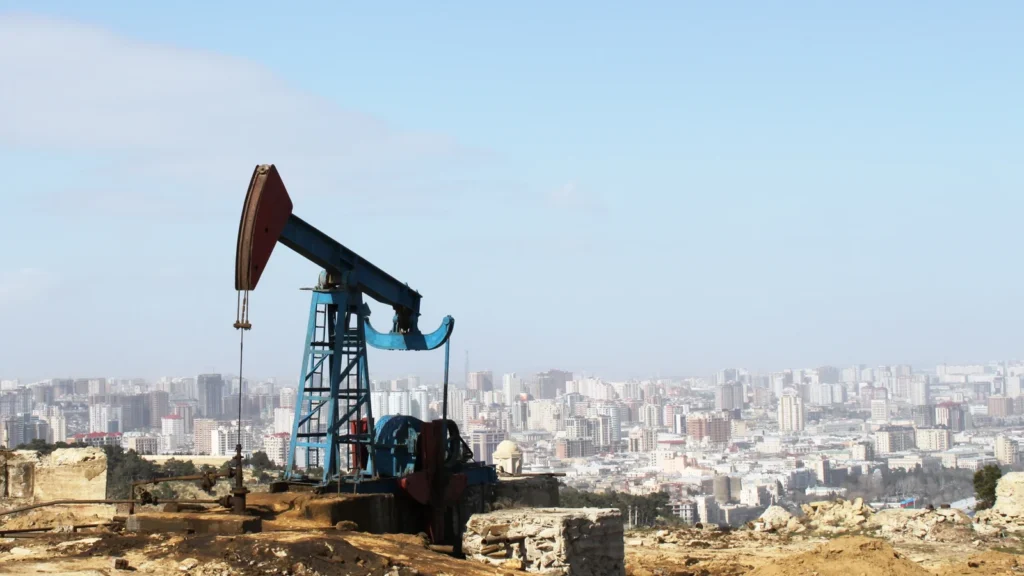
Featured image: Oil pump in Baku, Gulustan, March 29, 2010, CC BY-SA 3.0. Cropped, resized and converted to WebP; adapted image remains CC BY-SA 3.0. The photograph does not describe current operations. Country categories and production-aggregate scope come from the EIA’s archived November 2026 Short-Term Energy Outlook, Table 3d notes. The Emirates News Agency exit notice and EIA June 23 post-exit analysis supersede the UAE inclusion in OPEC’s general overview for this dated comparison. The EIA’s 2025 shares are rounded and use the same world output in both cases. See OPEC’s Declaration of Cooperation history, June 2026 full ministerial statement and November 1 voluntary-group statement. Separate sources support Brazil’s Charter status, Qatar’s exit, Ecuador’s exit, Angola’s exit and OPEC history and the EIA’s retail fuel explanation. This is a dated classification, not a current production forecast. The original GeographyPin map uses Natural Earth public-domain cartographic data and does not adjudicate boundaries. Prepared for final factual and editorial review by Zurab Koniashvili (Z.K. Atlas).