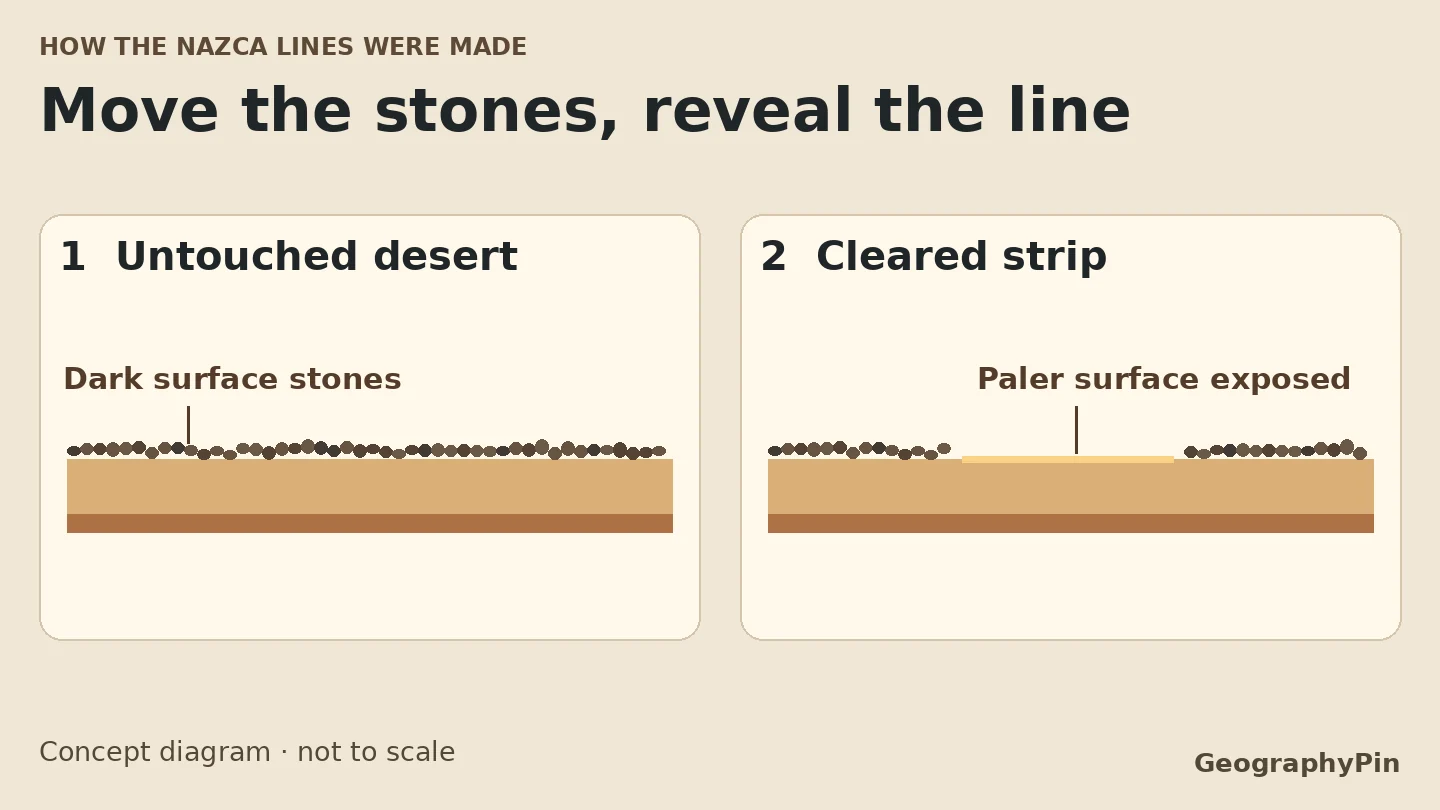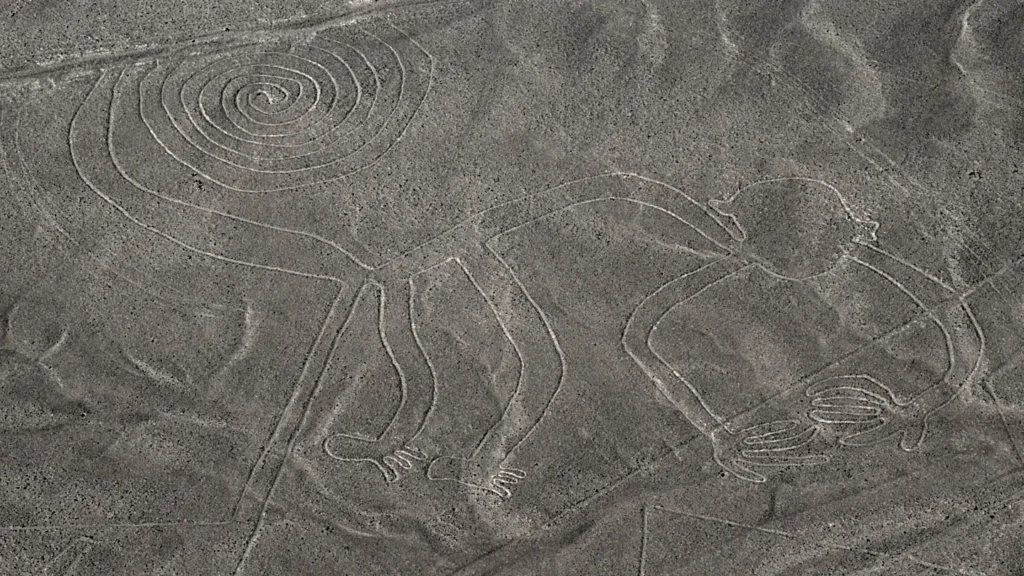
From the air, the Nazca Monkey’s spiral tail is easy to spot. On the desert surface, it is a pale strip of ground between darker stones. That difference in perspective helps explain both how people made the Nazca Lines and what someone walking past them could actually see.
The Nazca Lines are ancient designs in southern Peru’s desert. Their makers often moved dark surface stones aside to expose lighter ground. An aerial view helps you recognize a giant outline, but field surveys show that some smaller figures could be seen from nearby paths. No single explanation accounts for every line and figure.
How to use this article: See how the Monkey’s outline was made, what walkers could see, or how the water and sky hypotheses hold up.
How the Nazca Lines were made
The best-known examples lie on the Nazca Pampa, an expanse of coastal desert in the Ica region of southern Peru. The UNESCO site also includes designs near Palpa. Archaeologists call them geoglyphs: designs made on the ground by rearranging or removing surface material. “Nazca Lines” is the familiar name, but it covers more than straight lines.
The Monkey: an outline made by taking stones away
Look at the spiral in the aerial photograph. The light line is not painted. Where stones were moved, a paler surface showed through against the untouched desert. By keeping the cleared strip narrow, the makers could draw an outline instead of removing stones from the entire area inside it. Researchers who tested six sites around Nazca and Palpa found no evidence that salts or other added minerals had been used to change the surface there.

The finished spiral tells us where people moved stones, not exactly how they planned each curve. There is a similar limit to dating it. Early Nasca pottery from about 50 to 300 CE was found at the Monkey site. That helps place its use in time; the pottery does not date the day the outline was made. Other figures have different histories, and some smaller forms may predate the better-known outlines.
Why a straight line is not the same as a monkey
A straight line or a trapezoid is geometric. Some straight lines run for miles; a trapezoid can be a broad area of cleared ground. A figurative design depicts something recognizable, such as a monkey, a tree, a person or a tool. Archaeologists subdivide those figures again. In the inventory described in a 2024 paper, large outline figures averaged about 295 ft (90 m), while smaller relief-type figures averaged about 30 ft (9 m). The averages describe that survey’s groups, not the size of every example.
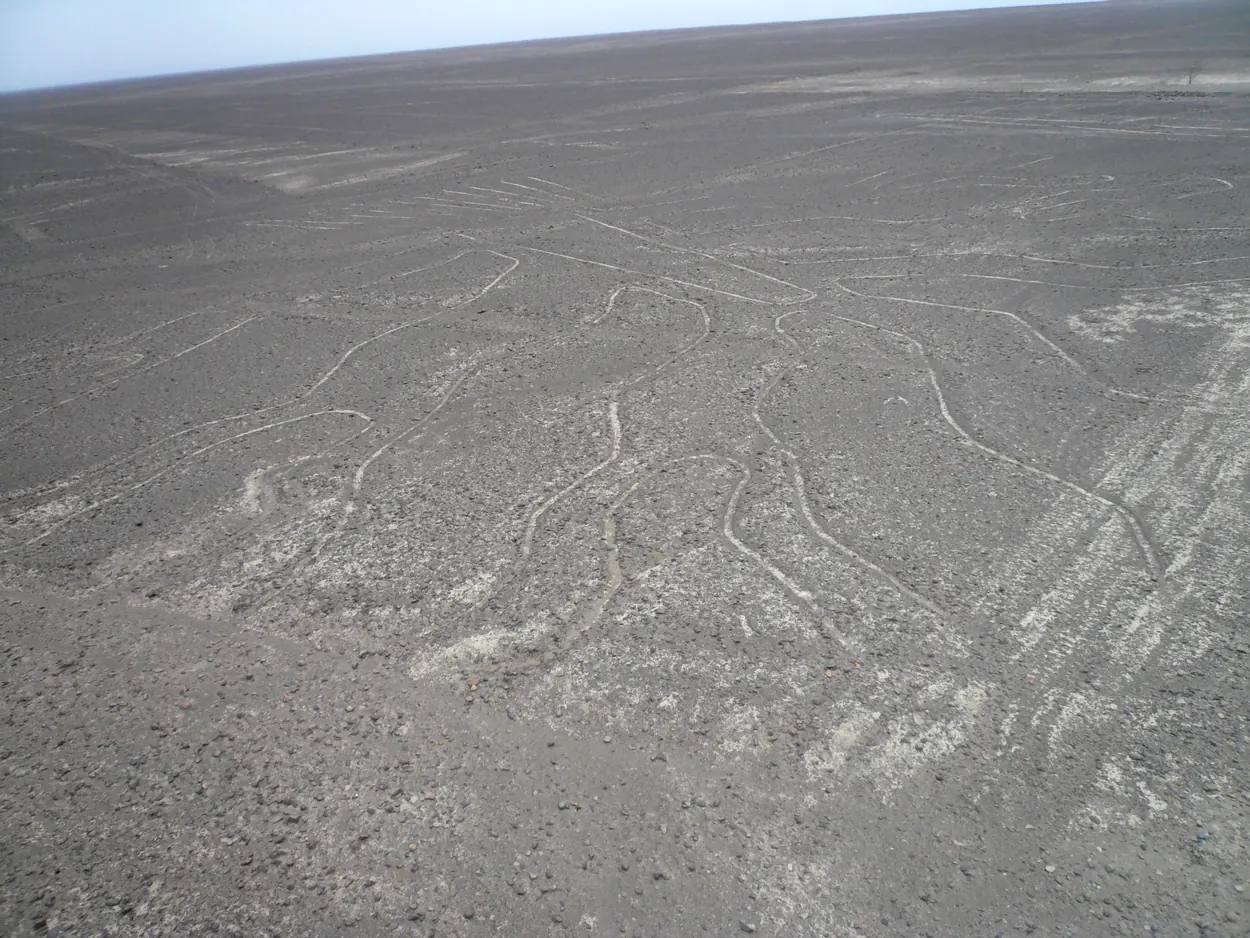
That difference changes what someone on foot might experience. A long straight mark is still recognizable in pieces; you can see it continue in the direction you are walking. On a large animal outline, you might see only the curve nearest you. A smaller design on a slope can present more of itself to someone coming along a path.
What people could see without flying
What the ancient paths reveal
In the 2024 survey, the researchers found that smaller relief-type figures often lay near informal trails. In the groupings they examined, one figure could be visible from the trail while others came into view only as the team walked closer. Not every ancient trail has been mapped, so the researchers limited their trail comparison to figures within about 1,640 ft (500 m) of mapped trails. The study shows that some ground-level views existed. It does not show that every figure could be seen in full from a path.
Near Palpa, archaeologists Karsten Lambers and Martin Sauerbier used a terrain model to test what could be seen from different points on the surrounding ground. The geoglyph locations tended to be more visible than randomly chosen locations in their study area. This is a separate line of evidence: the terrain itself could help people see the designs, even without a tower or aircraft.
What the designs may have been for
Ceremonies and messages along different routes
The 2024 survey found that large outline figures clustered near straight lines and trapezoids rather than along the same informal trails as the smaller figures. The team proposed that some of these larger designs were places for ceremonies on routes linked to Cahuachi, a ceremonial center. The pattern is consistent with that idea, but it cannot tell us what happened at each figure.
In July 2025, Yamagata University reported 248 further finds, including 160 figurative geoglyphs, bringing its figurative inventory to 893 at the time. Among the finds near trails, the team described different motifs recurring along different routes, such as birds of prey along some and llamas along others. The researchers think people might have used sequences of figures to tell stories or pass on messages. The placement is evidence; the original stories, if there were any, have not been recovered.
Could the lines point to water or mark dates?
Water mattered to farming in this dry region, and some scholars have proposed that water featured in rituals involving the lines. That is different from saying the lines point to hidden groundwater. A team testing the groundwater-marker hypothesis found no statistically significant alignment between geoglyphs and the fault-related features it mapped. The result does not rule out water as a ritual theme.
Astronomical interpretations likewise need a test. A line that points toward a sunrise can be a clue, but it does not by itself establish a calendar: with many lines pointing in different directions, some alignments can occur by chance. The trail and ceremony findings are useful because they compare groups of designs and their surroundings, rather than trying to infer a purpose from one striking match.
Frequently Asked Questions
Can any Nazca figures be seen from ground level?
Yes. In field surveys, researchers saw some smaller figures from ancient trails. The best viewpoint depends on the scale and slope of the design. That is not an invitation to walk onto the markings: moving the surface stones can damage them.
Do archaeologists know what every Nazca line was for?
No. They have evidence tying some shapes to trails and others to possible ceremonial routes. These settings help narrow the plausible uses, but the region’s figures and lines were not necessarily all made at the same time or for the same reason.
What did AI actually discover at Nazca?
In the study published in 2024, a model helped researchers decide where to look in aerial images. Archaeologists then checked candidates on the ground. The survey documented 303 new figurative geoglyphs; some were found outside the model’s suggestions. The 2025 update reports a later field campaign and counts geometric as well as figurative finds.
What Did We Learn Today?
The Nazca Lines get their contrast from the desert itself: clear away darker stones and the paler ground forms the design. An aerial view shows the whole Monkey, while a walk along a trail reveals some smaller figures. Some appear beside paths, others beside much larger geometric markings. Those different settings are a better starting point for interpreting the lines than looking for a single explanation.
Sources & Data Notes
Open research papers, survey counts and photo credits
The inventory of 893 refers only to figurative geoglyphs documented as of Yamagata University’s July 2025 announcement. The field survey published in 2024 and the later announcement are separate reports. Associated pottery constrains periods of use; it does not directly date a scraped surface. The article uses the common spelling Nazca; some sources use Nasca.
- ICOMOS evaluation for the UNESCO World Heritage listing: geography, construction and design categories.
- Hartsch and colleagues (2009): geophysical and geochemical study of Nazca and Palpa: surface measurements at six sites.
- Lambers and Sauerbier: investigating geoglyph visibility in Palpa: terrain-based comparison.
- Sakai and colleagues, PNAS (2024): site checks, style, trails, pottery, and proposed ceremonial routes.
- Yamagata University (July 28, 2025): additional field finds and possible trail themes.
- Donald Proulx: Nasca Lines Project: field testing and limits of the groundwater-marker hypothesis.
Aerial photograph of the Monkey: Markus Leupold-Löwenthal, CC BY-SA 3.0; cropped, contrast adjusted and resized. Lookout photograph of the Tree: Max Berger, CC BY-SA 4.0; contrast adjusted and resized.