In August 1846, households in Cloonahee, County Roscommon, told their landlord that their potatoes had rotted and that they had no grain to feed their families. The petition puts the central question of the Irish Potato Famine plainly: when the crop failed, what could a household eat instead?
The Irish Potato Famine began when late blight destroyed much of the potato crop in 1845 and returned in later seasons. It became a famine because many rural households had little land, few other sources of food or income, and too little money to buy replacements. Relief reached some people but was uneven and often inadequate.
How to use this article: Start with the Cloonahee petition, jump to food and relief, or follow the Quinn family’s crossing.
How the potato became a household’s last reserve
What the Cloonahee petition tells us
Cloonahee was a townland, a small named division of land, near Strokestown. The estate’s pre-famine rent rolls establish a basic fact about life there: tenants owed rent for the land they farmed. A household with a small holding could grow a substantial share of its food on a potato plot. That worked as long as the plot yielded a crop. Cash earned by labor or brought in by selling produce was not necessarily enough to buy a family’s meals at market prices.
The petition of August 22, 1846, records the moment this arrangement broke down for the people who signed it. Their potatoes were rotten, they had no grain, and they appealed to the estate for help.
Why repeated failures were worse than the first
Potato late blight was the trigger. The disease is caused by Phytophthora infestans, a fungus-like organism. The 1845 crop was only partly lost; the failure in 1846 was much more severe. The crop failed badly again in 1848. Even a better harvest between failures was not enough on its own to restore food supplies: when families had little seed left or planted less land, a healthier crop could still produce too little.
Why hunger spread when other food existed
Food in the market was not the same as food at home
Potato dependence varied. A farmer with livestock, grain, or savings had ways to replace a lost harvest that a farm laborer or a tenant cultivating a very small plot might not. Some families lost work just as they needed cash most. Ireland was then governed as part of the United Kingdom. Food exports continued during the famine, even as grain was imported. Neither a shipment leaving Ireland nor one arriving there tells you whether a household could afford that grain or reach a place selling it. In late 1846 and early 1847, both shortages and the cost of food mattered.
Relief also came in different forms. Public works offered wages, but a wage could buy less as food prices rose. Soup kitchens fed people directly. Workhouses provided institutional relief, but admission and capacity limited whom they could help. Later in 1847, the poor-law system took on more of the burden, relying heavily on local rates. Places with widespread poverty had greater need and a weaker base from which to raise money.
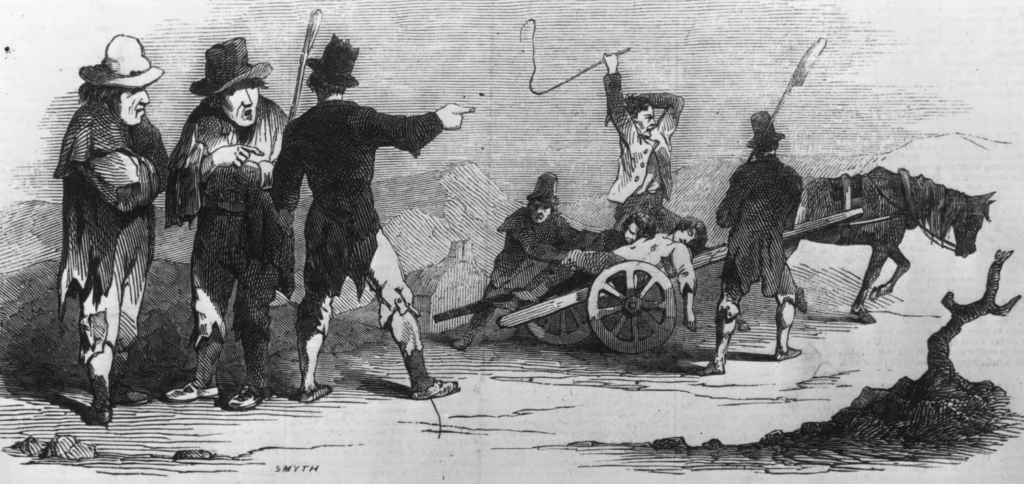
The cover engraving depicts a funeral in Skibbereen, County Cork, as reported in January 1847. In the same town, the local relief committee had opened a soup kitchen in November 1846, before the national soup-kitchen program. In a February 6, 1847 letter to relief official Sir Randolph Routh, the committee reported raising £900 in subscriptions. It was buying rice and grain at cost from the British Relief Association. The letter shows that the town had organized relief; it is not a count of people fed or proof that the aid was enough.
What the censuses can and cannot tell us
The census figures below cover the whole island, not the boundaries of today’s Republic of Ireland. The population counted in 1851 was roughly one fifth lower than in 1841. That gap is not a death toll. The two headcounts reflect births, deaths, and people moving in and out over the decade. The 1851 census also came before the end of the famine period commonly dated 1845–1852.
| Measure | Population |
|---|---|
| 1841 census | 8,175,124 |
| 1851 census | 6,552,385 |
| Difference | 1,622,739 fewer people |
Famine deaths and departures have to be estimated separately. Historians often put famine-related deaths at about one million, including people who died of disease as well as starvation. But estimates depend on the years and methods used, and deaths were not all recorded. Passenger returns are better evidence for particular ships or ports than a census gap, but they do not capture every departure.
From a Roscommon estate to the St. Lawrence
Following the Quinn family through the records
Leaving was not a choice every family could afford. On the Strokestown estate, some passages were paid for by the landlord. In an April 14, 1847 letter to his agent, Denis Mahon argued for giving passage assistance first to the poorest tenants, in part because the estate expected to bear the cost of their relief if they stayed.
James Quinn and his family came from Lissonuffy in County Roscommon. They crossed from Liverpool aboard the Naomi. Before ships reached Québec City, they could be stopped at Grosse Île, a quarantine station on the St. Lawrence about 30 mi (48 km) downstream. A Canadian register compiled from historical records lists a James Quinn, age 45, from the Naomi, among those who died and were buried on Grosse Île. The entry gives August 22–28, 1847, rather than an exact day.
In a 1912 speech, his son Thomas recalled a priest leading the children to their father’s bedside. Thomas and his brother Patrick were later adopted by a French-Canadian family. The two sources tell different parts of the story: the register records the death, while the son’s much later account describes what he remembered.
Frequently Asked Questions
Did the rest of Europe also have potato blight?
Yes. Potato late blight spread through other parts of Europe in the 1840s. The disease explains why crops failed. It does not explain by itself why the consequences were so severe in Ireland, where poor households in many districts depended on potatoes and had few affordable alternatives.
Why could some Irish households survive the same crop failure?
Access to land, wages, savings, alternative crops, and help varied even within one district. A household that grew grain it could keep or sell was in a different position from a laborer whose pay disappeared and whose potato plot had failed.
Which records can link an emigrant in Ireland to a ship in Canada?
Start with an estate list or local record, then compare it with passenger, quarantine, or burial registers. Match details such as age, vessel, and date rather than relying on a name. A later family account can add context but should not be used to invent a date an official record did not give.
What Did We Learn Today?
Blight destroyed a staple, but losing the potato crop became catastrophic when households had no affordable replacement and relief could not keep pace. The Cloonahee petition shows what that meant in one community. The island-wide censuses show the scale of the population change, while the Quinn family’s records trace one of the journeys behind it.
Sources & Data Notes
Open census tables, archival records and image credit
The 1841 and 1851 totals are from the historical whole-island series and do not include military and naval personnel. The difference is calculated from headcounts rather than from death or passenger records. The Strokestown letter is dated by its body, not the filing annotation. Thomas Quinn’s speech is a later first-person recollection.
- National Famine Museum: Cloonahee petition, August 22, 1846 and Strokestown Famine Archive: estate rentals and emigration records.
- Yoshida and colleagues: late blight in historic plant specimens; Ó Gráda: relief and migration.
- National Archives of Ireland: Distress Papers and Relief Commission; Terri Kearney, Famine Reports from Skibbereen, p. 12, for the February 1847 letter.
- Diet, Politics and Disaster: The Great Irish Famine: wages, food trade and relief. CSO historical crop estimates: Table 5.
- UK Parliament: published historical population returns; Ireland’s Central Statistics Office: historical census series for today’s state for the difference in coverage.
- Strokestown Famine Archive: Denis Mahon’s April 14, 1847 letter.
- University of Galway: Quinn family history and Thomas Quinn’s 1912 speech; Parks Canada: register of deaths at sea and on Grosse Île in 1847 and history of the quarantine station.
Cover: Funeral at Skibbereen, engraved by Frederick James Smyth after a sketch credited to H. Smith of Cork, The Illustrated London News, January 30, 1847. Public-domain reproduction via Wikimedia Commons, resized.