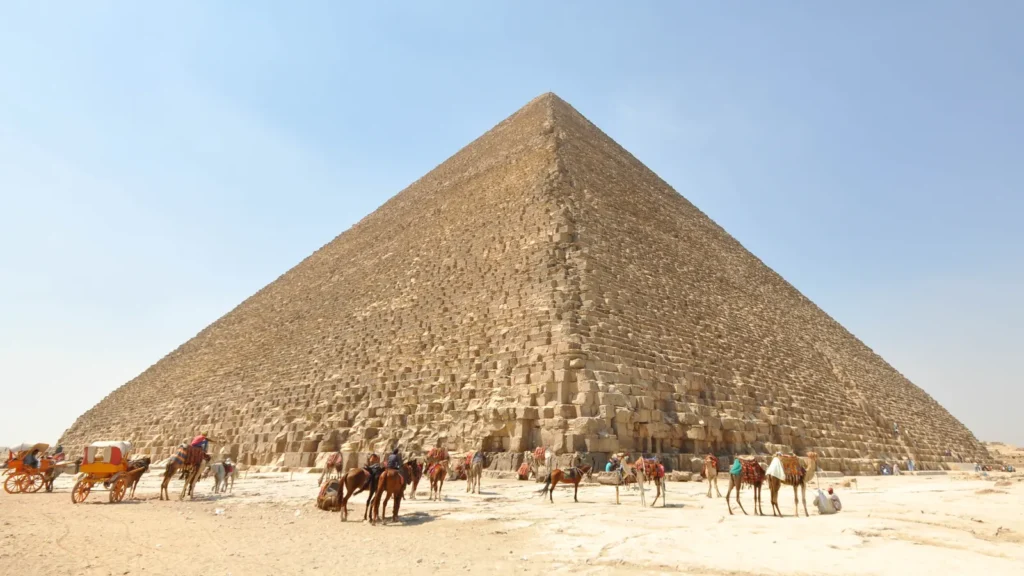
The Great Pyramid of Giza is the only one of the Seven Wonders of the Ancient World still standing substantially intact. But the other six didn’t all vanish without a trace. At some sites, archaeologists can point to ancient stonework. At others, even the location of the wonder is disputed.
Only Khufu’s Great Pyramid survives as a standing monument. The Temple of Artemis and the Mausoleum left ruins or fragments; the Statue of Zeus is gone, but its workshop was excavated. Underwater blocks have been linked to Alexandria’s lighthouse. No securely identified remains of the Colossus or the Hanging Gardens have been found.
How to use this article: Compare a rebuilt column at Ephesus with underwater finds at Alexandria, or jump to the evidence for the Nineveh theory.
1. The Seven Wonders and Their Present-Day Locations

The familiar list spans four present-day countries: Egypt, Greece, Türkiye and Iraq. It reflects the places known to writers in the Greek-speaking world, not a survey of all ancient civilizations. Ancient lists varied: the poet Antipater counted Babylon’s walls separately and left out the Lighthouse of Alexandria. The table uses the familiar later list, with modern locations and the evidence known at each site. It is not a ranking or a guide to site access.
| Ancient wonder | Modern location | What survives |
|---|---|---|
| Great Pyramid of Giza | Giza, Egypt | Standing monument. The original Pyramid of Khufu still stands. The other Giza pyramids are separate monuments. |
| Hanging Gardens of Babylon | Babylon, Iraq (traditional); Nineveh proposed | Unconfirmed. Babylon’s ruins are real; none is securely identified as the gardens. Nineveh has evidence of a royal garden, but its link to the wonder is disputed. |
| Statue of Zeus at Olympia | Olympia, Greece | Workshop and temple remains. Archaeologists found tools and molds in the sculptor’s workshop. The statue itself is gone; its final fate is uncertain. |
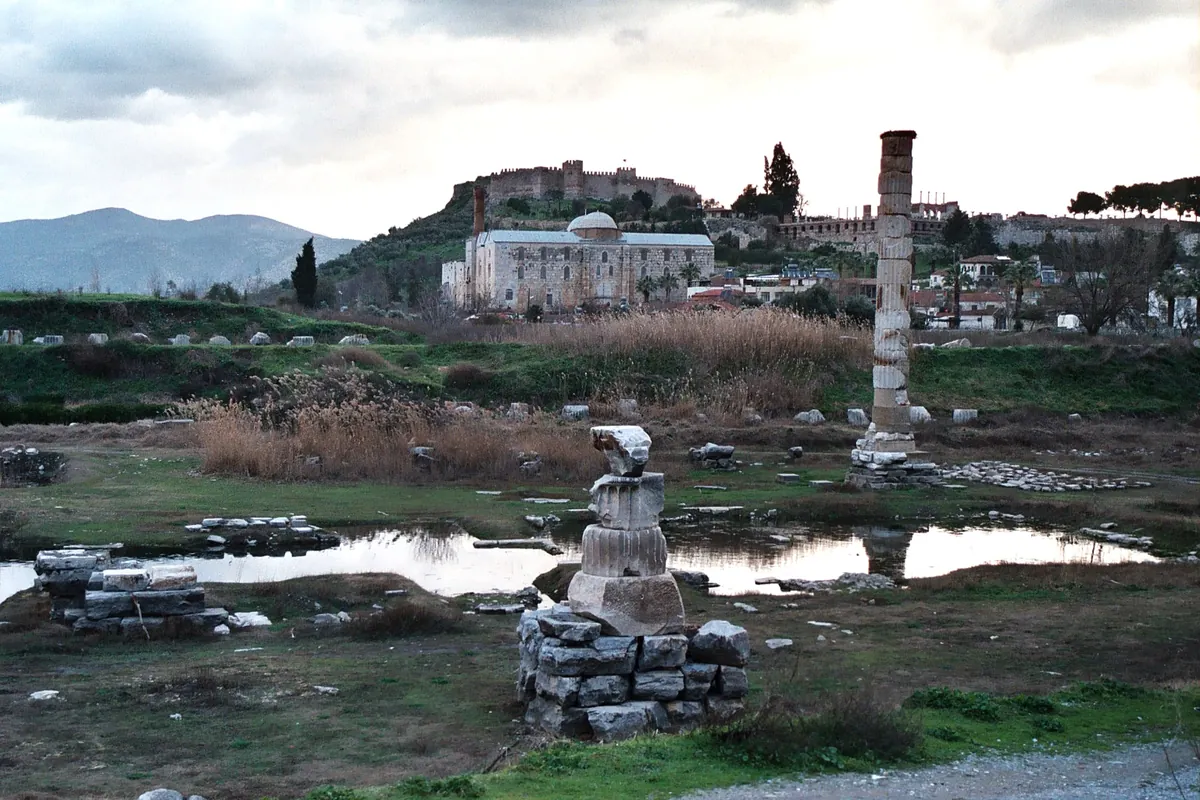
| Temple of Artemis at Ephesus | Selçuk, Türkiye | Low ruins and a re-erected column. Ancient carved fragments also survive in museum collections. The temple does not stand. |
| Mausoleum at Halicarnassus | Bodrum, Türkiye | Foundations and sculpture. The tomb’s foundations survive at Bodrum. Parts of its sculpture, including a marble horse from the chariot group that crowned the tomb, are held by the British Museum. |
| Colossus of Rhodes | Rhodes, Greece (exact spot uncertain) | No verified remains of the statue. An earthquake toppled the bronze figure of Helios. The famous image of it straddling the harbor is not established. |
| Lighthouse of Alexandria | Alexandria, Egypt | Submerged fragments linked to the lighthouse. Archaeologists have identified likely pieces among other harbor debris. Qaitbay Fort is a later structure. |
These are seven different archaeological stories, not six versions of the same disaster. At Giza, the standing monument raises a different question: how workers quarried and moved stone to build Khufu’s pyramid. At Olympia, evidence chiefly tells us how the work was made. At Bodrum, pieces of the tomb itself survived even though the building did not. And at Rhodes, the fact that a statue once stood does not tell us exactly where to place it.
2. What Survives at Each Site?
Ephesus and Alexandria show why “what can I see?” is not the same question as “what survives?” At one site, a tall visible feature is a later reassembly. At the other, a much later fort marks the location while archaeologists look underwater for pieces of the original.
Ephesus: The column is not a standing temple
The Temple of Artemis stood at the Artemision near modern Selçuk, apart from the better-known ruins of central Ephesus. The column above the site’s low stonework was re-erected; it is not a column that has stood continuously since antiquity. Excavated sculpture, including pieces taken to the British Museum, tells us about the ancient building even though it no longer stands.
Alexandria: The fort marks the site, not the surviving lighthouse
The lighthouse, also called the Pharos, stood at the entrance to Alexandria’s harbor. Earthquakes damaged it, and the 15th-century Qaitbay Fort was built on its site. Excavations in the water beside the fort have documented large blocks that may have come from the lighthouse. The harbor also contains remains from other structures, so a block’s size and location alone don’t make it part of the Pharos.
In October 2026, an underwater excavation team reported a bronze signet ring from a different site in the harbor bearing what it identified as a depiction of the lighthouse. It is evidence of how the lighthouse was pictured, not a piece of the building. That is a different kind of find from an architectural block at the foot of the fort.
3. Why the Hanging Gardens Are Disputed
Ancient accounts describe an elaborate garden on raised terraces. The traditional story places it at Babylon, south of present-day Baghdad. Archaeologists have uncovered Babylon’s palaces, gates and city walls, but none of the excavated structures can be securely identified as the wonder. A picture of terraced gardens at Babylon is therefore an interpretation, not a record of excavated remains.
What the Nineveh evidence does and doesn’t show
Assyriologist Stephanie Dalley argued that the story may refer to the royal garden of Sennacherib at Nineveh, beside modern Mosul in northern Iraq. Sennacherib’s own inscriptions describe a palace garden and the works that supplied it with water. Excavations at Jerwan also documented an Assyrian aqueduct from his reign. Together, these establish that the Assyrians created a royal garden and had the engineering to supply it.
What is missing is a secure connection between that garden and the one described by later writers. Nineveh is a proposed location for the wonder, not an eighth wonder or a confirmed replacement for Babylon.
4. How the Modern List Was Chosen
The New7Wonders campaign chose its list through a public vote organized by a private initiative, with results announced in Lisbon on July 7, 2007. It wasn’t a UNESCO selection or a revision of the ancient list. The organizers recognized the Great Pyramid separately as an honorary wonder, not as one of the seven vote winners.
The New Seven Wonders (2007): Great Wall of China, Petra, Chichén Itzá, Christ the Redeemer, the Colosseum, Machu Picchu and the Taj Mahal. “New” refers to the list, not when the landmarks were built.
Frequently Asked Questions
Which ancient wonder is still standing?
The Pyramid of Khufu, also called the Great Pyramid, stands on the Giza Plateau on the west side of the Nile in Greater Cairo. It is the specific wonder on the list, not all three Giza pyramids together.
Is there archaeological proof of the Hanging Gardens at Babylon?
No excavation has confirmed the Hanging Gardens at Babylon. Evidence for a separate garden at Nineveh makes that theory worth considering, but it doesn’t settle which garden inspired the ancient accounts.
What Did We Learn Today?
The Great Pyramid is the only one of the seven that still stands as a monument. For the others, the best clue might be a foundation, a piece in a museum, a workshop or a text. A visible ruin can belong to a different building, and a real ancient garden need not be the one in the story.
Sources & Data Notes
“Standing” means substantially surviving as the original monument, not a re-erected feature or a later building on the same site. Finds shown as probable or disputed are not counted as confirmed parts of an original wonder. The visible remains are not a statement of current visiting access.
Archaeological references and the two lists
- Greek Anthology, epigram 9.58 and Egyptian Ministry of Tourism and Antiquities: the Great Pyramid.
- UNESCO: Babylon; Stephanie Dalley: the Nineveh hypothesis; University of Hamburg: Sennacherib’s garden and University of Chicago: Jerwan excavation report.
- Archaeological Museum of Olympia: the workshop of Phidias.
- ICOMOS evaluation: the Temple of Artemis site and its excavated sculpture.
- University of Southern Denmark: excavations at Halicarnassus and Poul Pedersen: the Mausoleum’s foundations, burial chamber and sculpture.
- Nathan Badoud: The Colossus of Rhodes and what can be known of the statue’s appearance.
- Egyptian Ministry of Tourism and Antiquities: Qaitbay Fort and French Ministry of Culture: underwater archaeology at Alexandria.
- New7Wonders: the 2007 announcement and UNESCO’s statement on the campaign.
Photo credits
- The Great Pyramid of Giza (Pyramid of Cheops or Khufu), Jorge Láscar, CC BY 2.0. Cropped, resized and converted to WebP.
- Ephesus, ruins of the Temple of Artemis, Dguendel, CC BY 3.0. Resized and converted to WebP.