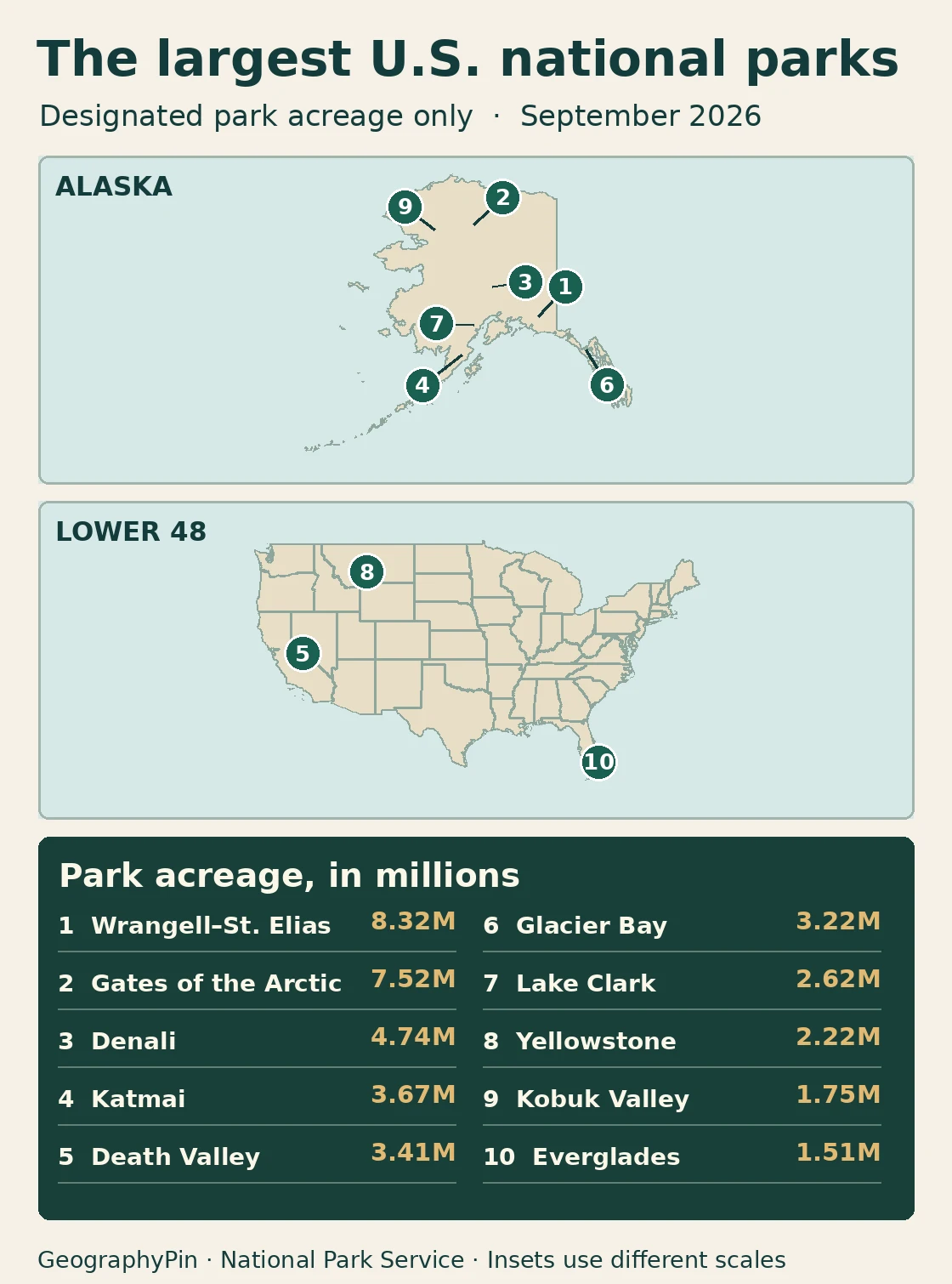
Wrangell–St. Elias is the largest U.S. national park, even before its adjoining national preserve is counted. The park alone covers 8.32 million acres in the September 30, 2026, National Park Service report. Gates of the Arctic follows at 7.52 million acres, and Denali is third at 4.74 million.
Wrangell–St. Elias is the largest U.S. national park at 8.32 million acres in the National Park Service’s September 30, 2026 report. Its separately listed preserve adds 4.85 million acres. Death Valley leads in the Lower 48 at 3.41 million acres and ranks fifth when only national park acreage is counted.
How to use this list: Find the biggest parks on the map and ranked table, then compare the separate preserve figures. See why one park has no rank in the same-date data.
The ten largest national parks by acreage
The ten parks in the September 2026 ranking
The ranking uses the National Park Service Land Resources Division’s Gross Area Acres column as of September 30, 2026. It counts only areas designated as national parks, not the whole family of sites administered by NPS. The downloadable table includes the separately reported parks in American Samoa and the U.S. Virgin Islands as well as the parks in the 50 states.
| Rank | National park | State(s) | Gross park acres |
|---|---|---|---|
| 1 | Wrangell–St. Elias | Alaska | 8,323,146.48 |
| 2 | Gates of the Arctic | Alaska | 7,523,897.45 |
| 3 | Denali | Alaska | 4,740,911.16 |
| 4 | Katmai | Alaska | 3,674,529.33 |
| 5 | Death Valley | California, Nevada | 3,408,374.95 |
| 6 | Glacier Bay | Alaska | 3,223,383.43 |
| 7 | Lake Clark | Alaska | 2,619,816.49 |
| 8 | Yellowstone | Idaho, Montana, Wyoming | 2,219,790.71 |
| 9 | Kobuk Valley | Alaska | 1,750,716.16 |
| 10 | Everglades | Florida | 1,508,939.07 |
Everglades includes an expansion item the NPS worksheet says should be added to the main row: 1,400,539.80 plus 108,399.27 acres gives 1,508,939.07. This addition is designated park acreage, unlike a separately designated preserve. Multistate parks are counted once. California and Nevada share the Death Valley entry; Idaho, Montana and Wyoming share Yellowstone’s single entry.
Download 62 park-only ranks and the unranked combined entry (CSV).
How a preserve changes the comparison
Park and preserve acreages separately
Two areas can share one name on signs, brochures and maps while retaining different designations. Wrangell–St. Elias is the clearest example. The workbook lists the national park at 8,323,146.48 acres and the national preserve at 4,852,644.89 acres. Add them and you get 13,175,791.37, the roughly 13.2 million acres often cited for the whole park-and-preserve complex. Both numbers can be correct without answering the same question.
| Place | Park acres | Preserve acres | Park + preserve |
|---|---|---|---|
| Wrangell–St. Elias | 8,323,146.48 | 4,852,644.89 | 13,175,791.37 |
| Gates of the Arctic | 7,523,897.45 | 948,608.07 | 8,472,505.52 |
| Denali | 4,740,911.16 | 1,334,117.80 | 6,075,028.96 |
| Katmai | 3,674,529.33 | 418,698.80 | 4,093,228.13 |
| Glacier Bay | 3,223,383.43 | 58,406.00 | 3,281,789.43 |
| Lake Clark | 2,619,816.49 | 1,410,293.68 | 4,030,110.17 |
Wrangell–St. Elias stays first either way. Lake Clark shows why the rule matters below first place: its 2.62-million-acre park is smaller than Death Valley and Glacier Bay as measured here, but its 4.03-million-acre park-and-preserve sum is larger than either Death Valley’s park or Glacier Bay’s combined complex. That is a change of comparison unit, not a change on the ground.
What gross park acreage counts
Gross acreage covers the full reported area of the designated unit. It is not the same as the acres the Park Service owns outright. The report has separate columns for NPS ownership and lesser interests, other federal land, and nonfederal holdings. Private or other public land can be inside a park boundary.
Water inside that boundary can count too. Glacier Bay National Park demonstrates why gross acreage should not be described as dry land. Its marine management documents identify extensive marine waters within the park. The national acreage spreadsheet does not divide each gross total into land and water, so the table cannot rank parks by land alone. For geographic context, the U.S. geography profile distinguishes Alaska from the contiguous states.
New River Gorge and the reporting cutoff
Why New River Gorge has no separate rank
The September workbook gives New River Gorge one combined park-and-preserve row: 72,405.24 gross acres. That number is in the CSV with no park-only rank. The designation includes separate park and preserve areas, but using a figure from a different date or subtracting an older preserve estimate would break the common-date comparison. Even the combined area is far below this table’s tenth-place result.
The workbook lists Chiricahua as a national monument. NPS now identifies it as a national park, but the latest designation is not substituted into the earlier workbook category. The ranking is tied to the September report’s classification. When a later acreage snapshot reflects that change, it should be rerun from that one report rather than patched with a standalone number.
To reproduce the ranked set, filter the workbook’s Listing of Acreage to national park-designated entries, keep the truncated Black Canyon of the Gunnison row and National Park of American Samoa, apply the Everglades expansion note, and leave out the separable preserve rows and combined-only New River Gorge. Those 62 gross areas sum to 52,449,746.80 acres, matching the workbook’s National Parks summary. No two values tie at the published precision.
Frequently Asked Questions
Does a national monument belong on this list?
No. National monuments, national recreation areas and national preserves are different designations, even when NPS manages them. The workbook’s category matters more than the informal use of the word “park.”
Why is Wrangell–St. Elias sometimes listed at 13.2 million acres?
That figure includes both the national park and its adjoining preserve. The September 30, 2026 report lists 8,323,146.48 acres of park and 4,852,644.89 acres of preserve, a combined 13,175,791.37. The ranking counts only the park. See park and preserve acreages separately.
How do I convert park acres to square miles?
Divide by 640. For example, Death Valley’s 3,408,374.95 acres equal about 5,326 square miles. Converting the units does not change which boundary was measured.
What Did We Learn Today?
Wrangell–St. Elias leads by park-designated acreage, and Death Valley leads in the Lower 48. Adding preserves changes some comparisons, while excluding water would produce a different measurement altogether. A park’s name is not enough to tell you what its acreage includes.
Sources & Data Notes
Show sources and acreage notes
- NPS Land Resources Division acreage reports; September 30, 2026 workbook. Listing of Acreage, Gross Area Acres and footnote 6; Summary of Acreage, National Parks category. Rankings use the published decimal values; selected map values are rounded.
- NPS system FAQ: approximate combined Wrangell–St. Elias acreage. NPS New River Gorge designation and NPS Chiricahua designation FAQ.
- NPS Glacier Bay Marine Management Plan: water within the park. NPS park boundary centroids: location symbols (park designation only); cartographic base uses Natural Earth, public domain.
- Featured photo: NPS / Neal Herbert, Glacier hike in Wrangell-St. Elias, June 1, 2010, public domain; cropped and compressed.