A U.S. dollar can buy something in a country without being that country’s legal tender. And even where it is legal tender, it may share a wallet with local coins or notes. Those distinctions explain why otherwise credible country lists give different totals.
As of November 22, 2026, this comparison identifies the United States and nine other countries: Ecuador, El Salvador, the Federated States of Micronesia, Liberia, the Marshall Islands, Palau, Panama, Timor-Leste and Zimbabwe. Liberia and Zimbabwe recognize the U.S. dollar alongside domestic currencies. Territories, exchange-rate pegs and informal acceptance do not add countries to the count.
How to use this article: Check the ten country rows, distinguish sovereign countries from territories, or compare what a dollar peg does and doesn’t do.
Which countries recognize the U.S. dollar?
The ten sovereign country rows
This table looks for a national law, an operative treaty provision, or an official monetary authority confirming that USD is legal tender in domestic payments. It does not treat permission to hold a dollar account, price a contract in USD or exchange foreign cash as proof. The rows are alphabetical, not ranked by how often people use dollar notes.
| Country | How USD fits | Legal basis or authority |
|---|---|---|
| Ecuador | USD; national fractional coins in the same dollar unit. | Central Bank of Ecuador; monetary code art. 94 (2024) |
| El Salvador | USD is the circulating currency; the law preserves legal-tender status of previously issued colón notes and coins. | Monetary Integration Law arts. 3–5 (2000; effective 2001) |
| Federated States of Micronesia | USD is the official circulating legal tender under its Compact. | Compact of Free Association §251 (2003 amended text) |
| Liberia | USD co-circulates with the Liberian dollar, the official domestic currency. | Central Bank of Liberia (Live, checked 2026) |
| Marshall Islands | USD is the official circulating legal tender under its Compact. | Compact of Free Association §251 (2003 amended text) |
| Palau | USD is the official circulating legal tender under its Compact. | Compact of Free Association §251 (1986; U.S. Code 2024 ed.) |
| Panama | USD circulates as tender; the national balboa is at par and issued as coins only. | Law 84; current financial education portal (1904; 2025 context) |
| Timor-Leste | USD cash is legal tender; locally issued centavo coins are denominations of USD. | Decree-Law 2003/20 §2; Central Bank (2003; live central bank) |
| United States | U.S. coins and currency are legal tender under federal law. | 31 U.S.C. §5103 (U.S. Code as of Nov. 2026) |
| Zimbabwe | USD is one of the authorized foreign currencies alongside Zimbabwe Gold (ZiG). | Reserve Bank of Zimbabwe, FXD5 §1.1.1 (2026) |
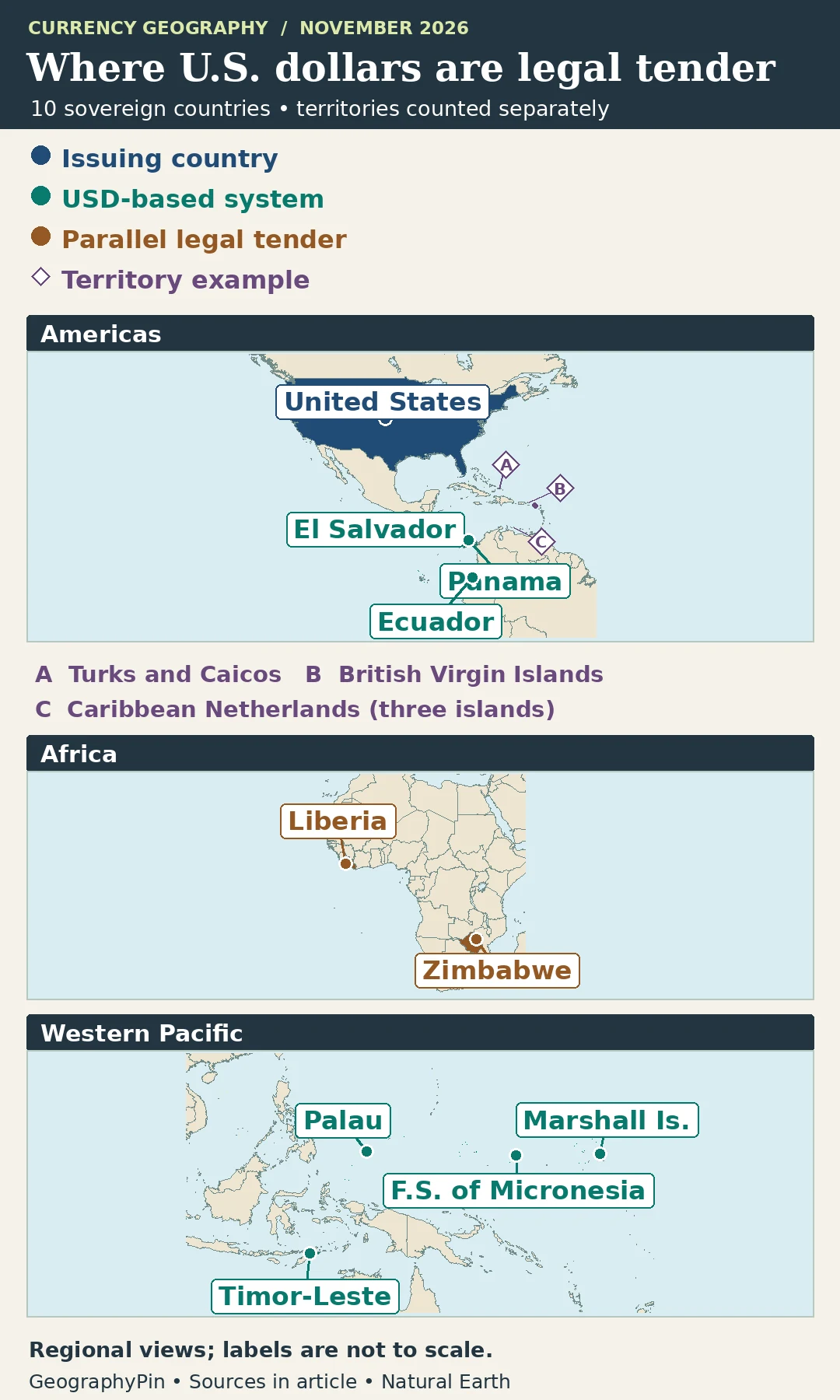
The three freely associated Pacific states are separate sovereign countries. Their agreements with the United States name the dollar as official circulating legal tender. That choice does not make those countries U.S. territories.
U.S. dollars can circulate alongside local money
Ecuador and Timor-Leste issue local fractional coins denominated in the same dollar unit. Twenty-five Ecuadorian cents are worth a quarter of a U.S. dollar domestically. Panama is different: the balboa is a national unit issued as coins, at one balboa per U.S. dollar, and U.S. currency itself circulates as tender. A dollar note and a local coin can therefore belong to the same payment without implying the same legal setup.
El Salvador’s 2000 monetary law gave the dollar legal-tender status and retained it for previously issued colón notes and coins. The colón’s legal status does not mean it circulates like the dollar. Liberia is a different case again: its central bank identifies the Liberian dollar as the official currency and confirms that U.S. dollars also circulate and are legal tender.
Zimbabwe recognizes designated foreign currencies, including USD, alongside Zimbabwe Gold (ZiG). The central bank’s March 2026 guidelines describe a gradual move toward using ZiG alone for domestic settlement, with timing contingent on economic conditions. That is a policy direction, not evidence that USD had already lost legal-tender status.
The comparison is about money’s legal status, not what a particular store must accept. In the United States, for example, the Federal Reserve distinguishes legal tender for debts from whether a private business has to accept cash for a purchase. State or local law can matter.
Territories that use the dollar aren’t extra countries
Bonaire is a useful check on the boundary
Bonaire, Sint Eustatius and Saba are part of the Caribbean Netherlands. Their monetary rules changed in 2011 when they adopted the U.S. dollar. Count those islands separately and you get three geographic entries; count national monetary systems and they add zero sovereign country rows. Their adoption does not make USD the legal tender of the European Netherlands.
The British Virgin Islands and Turks and Caicos Islands are additional examples. The former has a statute adopting U.S. currency; the latter’s government and financial regulator identify USD as its official currency. These are examples of separately administered jurisdictions, not a complete list of every territory where dollars circulate. U.S. territories such as Guam and Puerto Rico are not additional countries either.
A dollar peg is not the same as legal tender
Hong Kong and Cambodia show two different exclusions
Hong Kong’s monetary authority maintains a linked exchange-rate band of HK$7.75–7.85 per US$1. That describes the value of the Hong Kong dollar against the U.S. dollar. It does not turn a U.S. banknote into Hong Kong legal tender; the notes issued under Hong Kong’s own system remain the legal-tender notes.
In Cambodia, actual use is a different question. The IMF’s 2026 report describes the economy as highly dollarized, but identifies the riel as the country’s currency. Cambodia’s central bank law gives legal-tender status to its own notes and coins. Widespread use of U.S. dollars is not, by itself, evidence of their nationwide legal-tender status.
| Place | What the official source confirms | How the count treats it |
|---|---|---|
| Liberia | The Central Bank of Liberia identifies the Liberian dollar as the official currency and confirms U.S. dollars are also legal tender. | One sovereign country; parallel tender. |
| Bonaire | De Nederlandsche Bank confirms U.S. dollars are legal tender in the Caribbean Netherlands since January 1, 2011. | Not a separate sovereign country. |
| Hong Kong | The Hong Kong Monetary Authority publishes a band of HK$7.75–7.85 per US$1. Hong Kong’s own currency is legal tender there under Basic Law Article 111. | A peg is not U.S. dollar legal tender. |
How this count was checked
Start with the IMF’s seven countries using the dollar under its no separate legal tender classification. Check each against the national or treaty sources. Then add the issuing country and the two documented parallel-tender cases: 7 + 1 + 2 = 10 sovereign countries, or nine outside the United States. The IMF category describes exchange-rate systems; our test is broader and does not require USD to be the only legal tender.
Legal status can change with a law or a new effective date, while circulation can change even if the law stays put. A case without positive evidence stays outside the verified count; it is not proof that dollar use there is prohibited. This is a dated comparison of official currency rules, not guidance on a specific payment or exchange.
Frequently Asked Questions
How many countries use the U.S. dollar as legal tender outside the United States?
Nine sovereign countries meet the legal-tender test in this article’s November 22, 2026 comparison. Liberia is one: the U.S. dollar can be legal tender alongside the Liberian dollar. Bonaire uses U.S. dollars but does not add a sovereign country.
Does a dollar peg make U.S. notes legal tender?
No. Hong Kong’s exchange-rate system links the value of the Hong Kong dollar to the U.S. dollar. That relationship is an exchange-rate rule; it does not make U.S. notes legal tender there.
What Did We Learn Today?
Using U.S. dollars by law, using them in everyday trade, and tying a different currency’s value to the dollar are three different things. A country count should state which of those it means and keep territories separate.
Sources & Data Notes
GeographyPin compiled the rows from official sources and regulated-currency notes; this is not a single IMF list or a cash-usage survey. The primary authority for each included state is linked in the table.
- IMF, official dollarization comparison (2022) and Panama’s monetary arrangements (2025); Panama’s Law 84 record.
- Central Bank of Ecuador: notes and fractional coins; Central Bank of Timor-Leste: currency in circulation; IMF, El Salvador’s USD/colón status.
- U.S. Department of the Interior: sovereign status of the three freely associated states; Federal Reserve: cash acceptance.
- De Nederlandsche Bank: Caribbean Netherlands; British Virgin Islands: USD adoption law; Turks and Caicos government: currency and Financial Services Commission: legal tender.
- HKMA: linked exchange rate and legal-tender notes; Cambodia’s central bank law, arts. 41–43 and IMF, Cambodia’s 2026 Article IV consultation.
Map: GeographyPin classification and design; public-domain Natural Earth geographic outlines. Featured image: Josuadaniel, Mercado del Camal, Quito, Ecuador, September 2, 2015; cropped and resized under CC BY-SA 4.0.