Sweden is often used as shorthand in arguments about socialism. A clearer answer comes from looking at its businesses, public shareholdings and welfare institutions separately, rather than asking one political label to describe everything.
No, not under an economic definition centered on predominant social ownership. Sweden is better described as a mixed capitalist economy with extensive welfare institutions. Private enterprise and markets coexist with public companies, social insurance and collective bargaining. Those arrangements should be examined separately rather than treating welfare spending as proof of socialism.
How to use this article: Start with the ownership distinction, interpret company stakes, or separate welfare from workplace arrangements.
1. The Answer Depends on the Economic Definition
Ownership is the key distinction
Here, socialism means an economy organized around predominant social ownership or democratic control of productive resources. That is broader than government ownership: worker, cooperative and community arrangements can matter too. Some socialist models retain markets.
This working definition follows the Stanford Encyclopedia of Philosophy’s discussion. It is not an official certification of countries. Sweden’s combination of private enterprise, financial markets, public companies and social protection is better described as a mixed capitalist economy with a welfare state.
“Mixed” does not mean half capitalist and half socialist. It describes institutions operating together, without assigning an ideological percentage. The practical task is to separate who owns businesses from who finances benefits and who negotiates employment conditions.
2. Swedish Institutions Side by Side
| Institution | Swedish evidence | What it shows | What it does not show |
|---|---|---|---|
| Private enterprise | Household ownership of listed shares, June 2026 | Private investment and equity markets | A whole-economy ownership percentage |
| State shareholdings | Vattenfall 100%; Telia 41.1%, report covering 2025 (published 2026) | Full and partial public ownership | State ownership of all Swedish businesses |
| Social insurance | Benefits financed through taxes and dues | Publicly organized income protection | Ownership of the recipient’s employer |
| Collective agreements | 88% coverage, employees aged 18–68, 2025 | Extensive negotiated employment terms | 88% union membership or worker ownership |
The rows are complementary evidence, not ingredients in a national socialism score. Company shares, agreement coverage and benefit financing have different denominators. Adding or averaging their percentages would produce a meaningless result.
The table also avoids treating one institution as the entire economy. Public ownership is real, but so are private investment and bargaining between employers and employees. A useful description must accommodate all of them.
3. Private Markets and Public Companies Coexist
Read company percentages at company scale
Statistics Sweden’s first-half 2026 release records household shareholdings in companies listed on Swedish marketplaces. This is direct evidence of private financial ownership, not a complete census of factories, unlisted firms, housing or national wealth.
The OECD’s 2026 Sweden financing profile separately documents private-sector small and medium-sized enterprises and their access to business finance. Private enterprise is therefore not limited to famous companies traded on an exchange.
Meanwhile, the government’s report for 2025 lists a 100% state holding in Vattenfall and 41.1% in Telia. The first is complete state ownership; the second is a minority equity stake. Neither figure is a percentage of Sweden’s GDP.
These examples establish different ownership arrangements, not a numerical threshold at which a country changes systems. The existence of a public energy company does not erase private enterprise, just as the existence of private shareholders does not erase public ownership.
4. Welfare and Wage Bargaining Answer Different Questions
Protection is not the same as ownership
Försäkringskassan describes social insurance covering circumstances such as illness, disability and raising children. Taxes and dues fund the system, while eligibility and payment amounts follow legal rules. This does not mean every person automatically receives every benefit.
That is a system for sharing financial risks and providing support. It does not, by itself, determine who owns the business where a beneficiary works.
The National Mediation Office reports that collective agreements covered 88% of employees aged 18–68 in 2025. The figure measures coverage of employment terms, not union membership. Nor does an agreement transfer a company’s shares to its employees.
Keeping those categories separate prevents a common shortcut: interpreting a strong welfare system or extensive bargaining as proof that productive assets are generally socially owned.
5. Why Sweden Is Often Described as Socialist
Social democracy commonly describes reforms and social protection within a continuing market economy; social ownership addresses who controls productive assets. Sweden’s social-democratic tradition helps explain the shorthand. The Social Democrats’ own historical account emphasizes the 1932 electoral turning point, cooperation with the Agrarian Party and subsequent welfare reforms. This establishes how the party presents its history, not an independent verdict on every policy’s results.
The country’s constitutional framework also combines different principles. The Instrument of Government sets out welfare aims alongside property protections and freedom to engage in trade, subject to specified public-interest qualifications. It does not simply declare an economic system called “capitalism” or “socialism.”
Political traditions, constitutional objectives and actual ownership are related but distinct. A party can pursue reforms without its name becoming a permanent classification of the national economy.
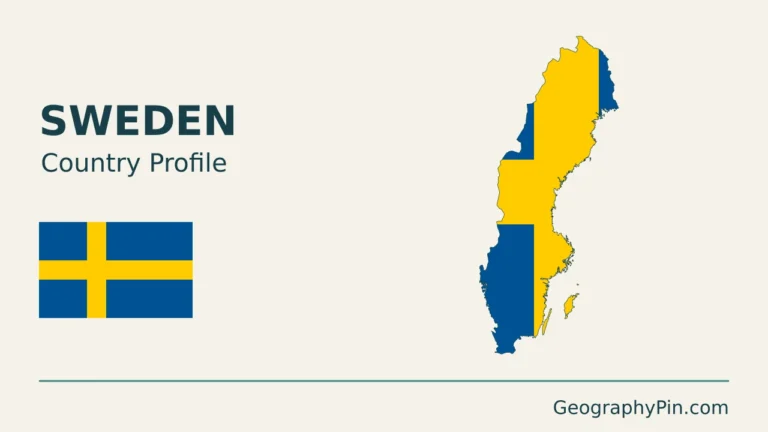
For the broader terminology, see the democratic-socialist country comparison. The Sweden country profile covers the country’s wider geography rather than using a political label as a substitute for it.
Frequently Asked Questions
Does a high tax rate make a country socialist?
No tax-rate threshold establishes an ownership system. Taxes measure revenue collection; ownership concerns control over assets. A claim about one cannot substitute for evidence about the other.
Is social ownership always state ownership?
No. It can include worker, cooperative or community control. Government ownership is one possible arrangement, and its democratic accountability requires separate examination.
What Did We Learn Today?
Sweden’s welfare institutions do not replace the need to examine ownership. Private markets, particular state shareholdings, social insurance and collective agreements describe different parts of its economy. Keeping their purposes and measurement scales separate gives a clearer answer than treating a party tradition or one percentage as the whole system.
Sources & Data Notes
The classification is an analytical synthesis under the stated ownership definition, not an official country certificate. Company shares refer to the report covering 2025; agreement coverage refers to employees aged 18–68 in 2025. The stock-market release concerns June 2026. These are different measures, not a synchronized national ownership survey.
- Stanford Encyclopedia of Philosophy: Socialism
- Statistics Sweden: share ownership, first half of 2026
- OECD: Financing SMEs and Entrepreneurs 2026, Sweden
- Government of Sweden: state-owned companies, 2025 report
- Försäkringskassan: Social Insurance in Sweden
- National Mediation Office: collective agreement coverage, 2025
- Riksdag: Instrument of Government, English 2023 edition
- Social Democrats: the party’s account of its history
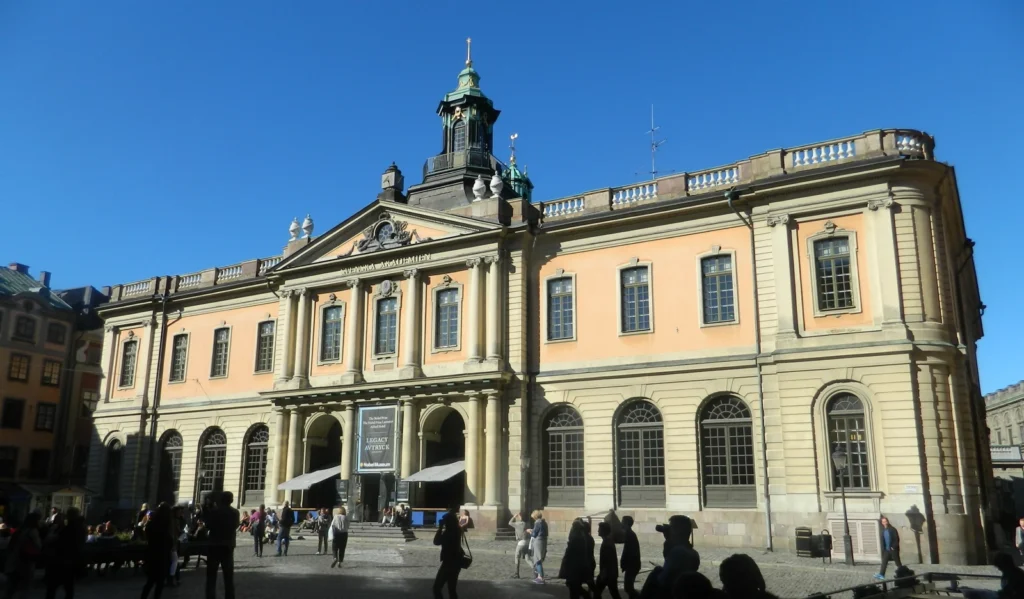
Börshuset, Stockholm’s former Stock Exchange Building, photographed September 20, 2015. Photo: Paasikivi / Wikimedia Commons, CC BY-SA 4.0; resized and converted to WebP.