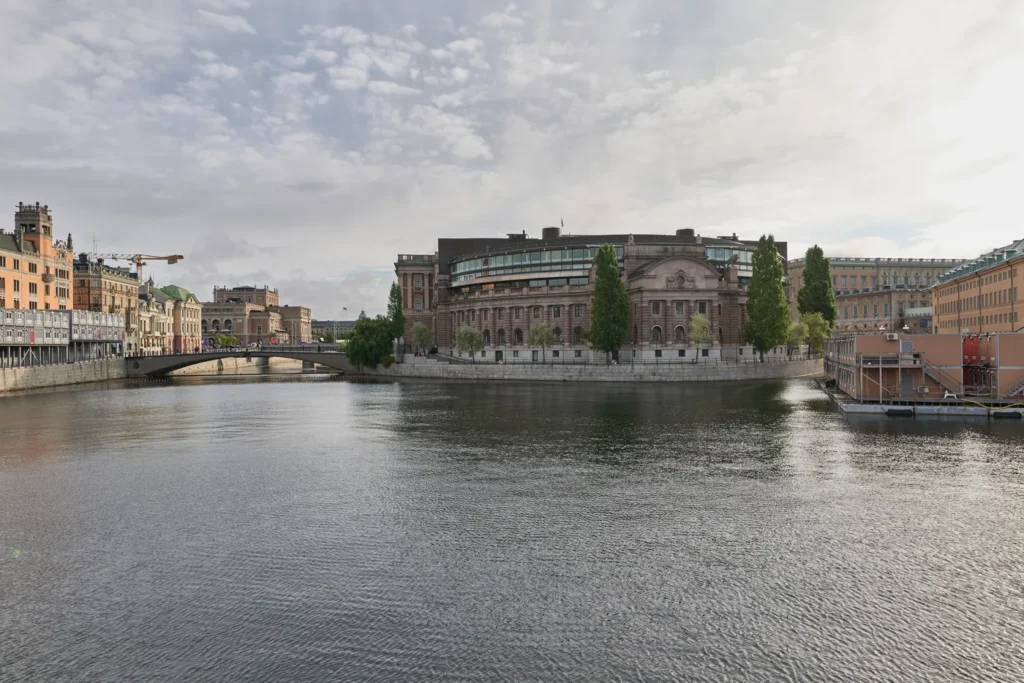
Sweden’s Parliament House in Stockholm, photographed September 20, 2022. Parliamentary institutions alone do not establish a country’s economic system.
Lists of democratic socialist countries often place Nordic welfare states, countries with socialist parties and states with socialist constitutional language in the same category. These are different kinds of examples. A useful comparison explains why each country appears and what the evidence actually establishes, rather than treating the label as a settled geographic fact.
There is no single agreed list of democratic socialist countries because the label can describe an economic goal, a political movement or a constitutional name. Denmark and Norway illustrate welfare-oriented market economies; Sri Lanka uses the term in its official name. Neither taxes nor a socialist party’s presence alone establishes a democratic socialist economic system.
How to use this article: Start with the country evidence table, distinguish constitutional names from economic practice, or use the three-part classification check.
1. Define the term before choosing the countries
For this comparison, democratic socialism means pursuing substantial social ownership or democratic control of economic activity while treating political democracy and civil liberties as essential. Social democracy usually describes a reform approach that combines social protection and regulation with a continuing market economy. These are useful distinctions, not universally fixed boundaries between every party and thinker.
The Stanford Encyclopedia of Philosophy’s 2024-revised Socialism entry emphasizes effective control of productive resources and the diversity of socialist institutional proposals. It also distinguishes reforming capitalism from replacing its underlying arrangements. A tax-financed service is therefore not, on its own, a sufficient test of an entire economic system.
Political movements sometimes use a broader vocabulary. The Socialist International’s 1989 declaration connects democratic socialism with human rights, worker participation and economic democracy, while allowing different institutional arrangements and markets. It does not prescribe one identical national model. This is a movement’s statement of principles, not a neutral statistical classification of countries.
That variation explains why two lists can disagree without even measuring the same thing. One may list governments led by particular parties; another may discuss welfare institutions; a third may repeat official state names. Before accepting any list, identify which of these questions it answers.
2. Country examples and the limits of each claim
Five examples, not a definitive membership list
| Country | Claim being examined | Relevant evidence | Classification limit |
|---|---|---|---|
| Denmark | A strong welfare state makes it socialist. | Its official country portal describes capitalism alongside a social safety net. | Public services do not establish general social ownership. |
| Norway | Public wealth and state companies define the whole economy. | The government holds named company stakes; the oil fund invests abroad. | State assets are not the same measure as domestic economic ownership. |
| France | A constitutionally social republic must be socialist. | Article 1 uses “social”; Article 4 provides for political pluralism. | That wording does not classify the whole economy as socialist. |
| United Kingdom | A democratic socialist party defines the country. | Labour’s 2025 rule book uses that description and also supports a private sector. | A party’s aims are not a country’s permanent institutional classification. |
| Sri Lanka | Its official name settles the economic question. | The constitutional text uses Democratic Socialist Republic and provides for public and private economic activity. | Constitutional identity and actual ownership patterns must be assessed separately. |
These cases were selected to demonstrate different classification problems, not because they share one system. Read each row as a claim to evaluate. The evidence comes from the institutional and constitutional sources explained below; the final column is an analytical limit, not an official international ruling.
A map coloring all five countries identically would conceal the very distinctions that matter here. Denmark’s welfare institutions, Labour’s party identity and Sri Lanka’s constitutional title are not interchangeable evidence. The table keeps the type of claim visible alongside each country.
3. Nordic welfare does not settle the ownership question
Denmark provides an especially clear starting point. Its official country portal’s business guide describes a capitalist economy with extensive social protection. That description permits strong public services and private enterprise to coexist. It is not a statement that Denmark has no public ownership or no socialist political traditions.
Norway adds another distinction: public ownership can take several forms. The government’s July 2026 ownership overview lists a 67% holding in Equinor and 34% in DNB Bank. These are stakes in named companies, not percentages of the Norwegian economy. A majority shareholding and a minority shareholding also describe different positions.
Meanwhile, Norges Bank Investment Management explains that the Government Pension Fund Global invests abroad. Public savings held in foreign assets should not be mistaken for state ownership of all Norwegian businesses. Company shares, sovereign savings and public-service spending belong in different columns of an economic comparison.
The Nordic examples are consequently more useful for discussing welfare, markets and particular ownership arrangements than for filling an unqualified list of democratic socialist states. To go further, compare specific policies and institutions. Do not assume that a successful service proves an entire theory, or that every country in the region has identical arrangements.
4. Constitutions and party names require careful reading
What constitutional wording does and does not establish
France’s Constitution of the Fifth Republic identifies it in Article 1 as a social republic, among other principles. “Social” is not the same word as “socialist.” Article 4 protects pluralistic political expression. Neither provision supplies an inventory of who owns productive assets, so neither should be treated as a complete economic classification.
Sri Lanka offers a different case because its constitutional name explicitly includes Democratic Socialist Republic. The Parliament Secretariat’s 2023 revised constitutional edition also sets out public and private economic activity in Article 27(2)(d). Article 27(2)(f) opposes concentrating productive resources either in the state or a privileged few. These provisions show why the title should be read alongside the text.
There is a further legal qualification: Article 29 says this chapter’s principles do not create enforceable rights or obligations. These are constitutional policy principles, not direct measurements of present-day ownership or proof that every stated objective has been achieved.
A political party is not the entire state
The UK Labour Party’s 2025 rule book describes the organization as a democratic socialist party. Its aims also envisage competitive enterprise, a private sector and public services. That combination illustrates how a political organization can use the term without proposing that every business immediately become state-owned.
Winning an election gives a party an opportunity to implement policies within existing institutions; it does not automatically replace those institutions with everything in its program. Any claim about a government also needs a date. This comparison uses a dated party document and makes no claim that a country permanently acquires the governing party’s ideology.
5. A practical test for a defensible classification
Check democracy, economic control and scale separately
- Democratic institutions: Examine political competition, rights, accountability and the possibility of peaceful changes in power. A self-description alone is not a performance assessment.
- Economic control: Identify who owns productive assets, who makes investment decisions and how workers or communities participate. Public spending is not a substitute for ownership evidence.
- Scope and date: Decide whether the claim concerns a party, a particular sector, a community or the national economy, and specify the period being described.
This is an editorial framework for asking better questions, not a new index. It assigns no numerical socialism score and does not certify countries as democratic. A country can have a cooperative sector without a predominantly cooperative economy, or substantial state assets without democratic control of those assets.
The distinction also matters when reading about historical examples. A policy adopted by one government may later change, while a party may retain its name. Evidence about an earlier administration should not silently become a statement about current law or current ownership.
6. Claims about the best examples need a defined outcome
“Best example” can mean the clearest ideological match, the strongest public services, the lowest poverty or the greatest political freedom. Those are different tests. A ranking cannot answer them all unless it explains its indicators and how they are weighted.
For a meaningful comparison, choose an outcome first, then use comparable data for the same period. If studying redistribution, distinguish income before and after taxes and transfers. If studying ownership, identify assets or enterprises rather than treating a tax rate as an ownership statistic. If studying democracy, assess institutions and their operation instead of relying on the state’s official name.
Even a sound comparison does not establish that one label caused the result. Policies, resources and historical circumstances interact. The useful question is which institutions contributed to which outcome, with what evidence. This article therefore offers a classification guide rather than a success-or-failure league table.
Frequently Asked Questions
Is Paraguay a socialist country because its constitution calls it a social state?
That wording alone does not establish socialism. Article 1 of Paraguay’s 1992 Constitution describes a social state governed by law and representative, participatory, pluralist democracy. Article 109 guarantees private property, subject to its legal framework. The social-state language should not be translated into a claim of general social ownership.
What Did We Learn Today?
There is no useful country list without a clear definition. Nordic welfare systems, constitutional names and socialist parties answer different questions. Comparing democratic institutions, economic control and the scale of a claim gives a more reliable picture than assigning countries a label from one service, word or election result.
Sources & Data Notes
The five examples illustrate different claims, not an exhaustive or official country classification. Constitutional text and party documents establish stated principles, not proof of implementation. Norway’s percentages are company shareholdings in the dated overview. No present-government roster, democracy score or ideological performance ranking is inferred from these sources. The Paraguay summary paraphrases the Spanish constitutional text.
For a different country-label discussion, see GeographyPin’s Socialist Countries guide.
- Stanford Encyclopedia of Philosophy, Socialism — substantive revision May 25, 2024
- Socialist International, Declaration of Principles — adopted June 1989, especially paragraphs 25 and 59–62
- Official Denmark portal, Doing business in Denmark — institutional description, not its dated rankings
- Government of Norway, What the State owns — July 1, 2026 overview
- Norges Bank Investment Management, About the fund — overseas investment
- Élysée, Constitution of the Fifth Republic — Articles 1 and 4
- Parliament of Sri Lanka, Constitution — revised 2023 edition, amendments through October 31, 2022; Articles 27 and 29
- Labour Party, Rule Book 2025 — Chapter 1, Clause IV
- Paraguay congressional legal library, Constitution of June 20, 1992 — Articles 1 and 109
Featured photo: Leonhard Lenz / Wikimedia Commons, CC0 1.0; resized and converted to WebP. Sweden’s Parliament House in Stockholm, photographed September 20, 2022. Parliamentary institutions alone do not establish a country’s economic system.