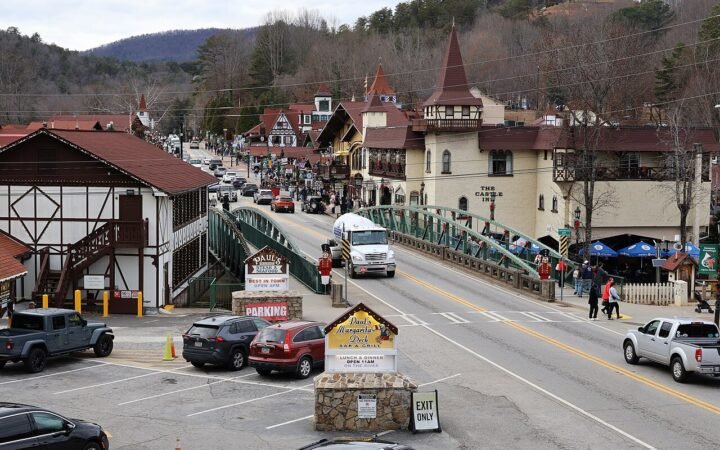
Helen’s Alpine-style buildings can make its history seem European at first glance. The town is better understood by separating three things: its Appalachian river setting, the communities and industries that preceded tourism, and the deliberate redesign of its business district.
A Georgia mountain town with an Alpine appearance
Helen is a small city on the Chattahoochee River in White County, northeastern Georgia. Its Bavarian-style center reflects a tourism redesign carried out in 1969, not the founding of a German colony. Earlier local history includes Indigenous communities, gold mining and timber, while tourism shapes the city’s economy today.
Find your starting point: Separate Helen from its wider region, understand the Alpine redesign, or look beyond it to local cultural institutions.
1. A small city on the upper Chattahoochee
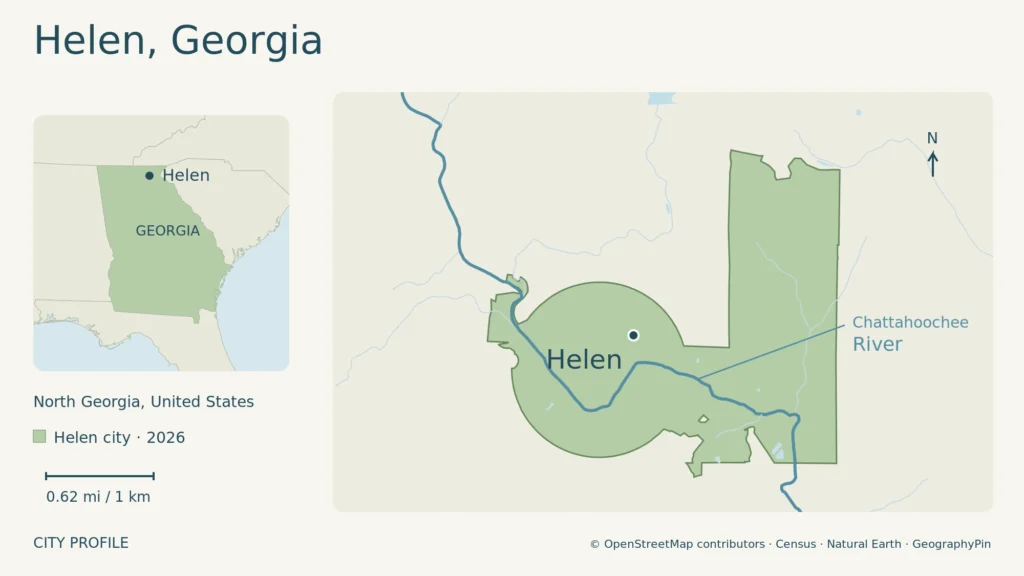
Helen is in White County, in the Appalachian mountain country of northeastern Georgia, the U.S. state. The Chattahoochee River runs through the city, linking its wooded surroundings with the commercial center. This is the river’s upper mountain reach, not the broad metropolitan river landscape associated with Atlanta.
The upper Chattahoochee flows from forested mountain slopes into Helen. Spoilcane Creek and Smith Creek join it near the city; farther downstream, the river enters the Nacoochee Valley. Those connections help explain why Helen combines a close mountain setting with a river running directly through its developed center.
The map above shows Helen’s municipal territory, not its wider visitor region. The river is drawn as a line; the dot represents the city rather than a downtown entrance. Enlarge map.
Helen is not the whole destination region
The municipality is one small part of White County. Cleveland is a separate city and the county seat; Sautee Nacoochee is a neighboring community, not another name for downtown Helen. Nearby parks, forests and historic sites help shape Helen’s regional role, but they should not all be counted as places inside its municipal limits.
The distinction is particularly useful for Hardman Farm: Georgia State Parks places this historic site just south of Helen, in the Sautee Nacoochee area. It belongs in the story of the surrounding valley without being used to stretch the city boundary.
2. The valley before the Alpine buildings
The region’s history long predates Helen’s themed streets. Hardman Farm preserves the Nacoochee Mound, a Native American burial site. Georgia State Parks says it was probably used long before Cherokee occupation of the area. Calling it simply a “Cherokee mound” would therefore give an uncertain attribution more certainty than the evidence supports.
Cherokee history is also part of the region’s past. The Cherokee Nation describes the forced removal of people from Georgia and other southeastern states beginning in 1838. The region’s later settlement and economic development must be understood alongside that history of dispossession.
Gold and timber brought later economic changes. Helen Arts & Heritage Center records the discovery of gold at nearby Dukes Creek in 1828 and the construction of the Byrd-Matthews sawmill in 1910. A railroad served the timber business, using part of the older Unicoi Turnpike corridor. The center dates the mill’s closure to 1931, after the available timber was depleted.
Helen’s municipal history belongs to this industrial period: the Georgia Municipal Association lists incorporation in 1913. The town therefore existed for decades before the buildings acquired the appearance that now makes them recognizable. Logging was not a Bavarian tradition transplanted to Georgia; it was part of the mountain region’s resource economy.
3. Why Helen looks Bavarian
A twentieth-century redesign, not a German founding
The city’s own history places the turning point in January 1969, when local businessmen sought a way to improve the main street and persuade passing tourists to stop. They consulted artist John Kollock, who drew on memories of Bavarian towns from his time in Germany. By that fall, many existing buildings had new facades.
The Alpine appearance was thus a deliberate tourism redevelopment. It does not establish that Helen began as a German immigrant settlement, nor does it make the surrounding Appalachian landscape part of the European Alps. The architectural theme and the town’s actual history answer different questions.
The 2026 joint comprehensive plan describes longstanding design regulation and calls for compatible redevelopment that maintains Helen’s Alpine theme without overwhelming infrastructure. Its proposals show how the visual identity continues to influence development.
4. Tourism, residents and regional culture
Tourism explains the contrast between Helen’s small resident population and its extensive visitor-facing business district. The joint comprehensive plan identifies the city as an important economic engine for White County, with shops, festivals and river recreation. Those activities draw on both the designed streetscape and the surrounding mountain landscape.
The plan also identifies event-time traffic on Helen Highway/State Route 75 and stormwater challenges in the narrow river valley. Its suggested parking and shuttle solutions remain proposals, not verified operating services. Mountain slopes and riverfront development leave the city with limited room to accommodate more activity.
Culture beyond the Bavarian theme
The Helen Arts & Heritage Center keeps local history visible through its museum and provides art classes. Its account of the mill town offers a different perspective from the facades outside: the tourism town grew out of an earlier working community rather than replacing a blank space.
Nearby Sautee Nacoochee adds other regional histories. Its Folk Pottery Museum explores a craft tradition spanning about two centuries and its continuation by contemporary potters. The center also preserves an African American Heritage Cabin that housed enslaved people around 1850 and interprets the lives of those people and their descendants.
These institutions are in different communities, but together they make an important distinction: northeast Georgia’s cultural history is broader than the Alpine theme. Indigenous history, enslavement, rural crafts and industrial work cannot be explained by the appearance of Helen’s commercial buildings alone.
5. Helen in dated city facts
The Census Bureau estimated Helen’s population at 631 on July 1, 2025, in its Vintage 2025 municipal estimates. The 2020 census count was 531. These are resident figures, not annual visitor totals or the number of people present during a festival.
| Fact | Reference |
|---|---|
| County and state | White County, Georgia, United States |
| River | Chattahoochee River |
| Population estimate | 631, July 1, 2025 (Vintage 2025) |
| Census population | 531, April 1, 2020 |
| Municipal incorporation | 1913 |
| Alpine-style transformation | 1969, the principal redesign year |
For a town walk, nearby trails and seasonal planning, use the Helen travel guide.
The difference between a small resident city and a wider visitor destination is central to understanding Helen. Its place in Georgia comes from the river valley, local communities and regional economy; its recognizable visual identity comes from a much more recent design decision.
What Did We Learn Today?
Helen’s appearance is a chapter in its history, not a substitute for it. The river valley, Indigenous past and resource industries came before the tourism redesign. Today the Alpine-style center supports a visitor economy, while local and neighboring cultural institutions preserve histories that reach well beyond that theme.
Sources & Data Notes
Open sources and data notes
The population estimate is Census Vintage 2025; the separate 2020 census count is reproduced in Georgia’s official legislative table. Earlier discussions about redesign are sometimes dated 1968; the city dates its main transformation to 1969. The 2018 watershed study supports physical geography, not current water safety. Planning proposals are not treated as completed projects.
Original GeographyPin map: Census TIGER/Line 2026 municipal boundaries (January 1, 2026) and area-water data; © OpenStreetMap contributors (ODbL, retrieved November 18, 2026); Natural Earth v5.1.1 public-domain inset. River line does not show measured width or access.
- City of Helen: About and History
- Georgia Municipal Association: Helen city profile
- Upper Chattahoochee Watershed Management Plan, 2018, geographic profile
- Georgia State Parks: Hardman Farm State Historic Site
- Cherokee Nation: Our Journey
- Helen Arts & Heritage Center: Helen’s Early History
- 2026 White County Joint Comprehensive Plan, pp. 5–10
- Sautee Nacoochee Center: Museums
- Census Bureau: Georgia municipal population estimates, Vintage 2025
- Georgia General Assembly: 2020 Census city counts, p. 9