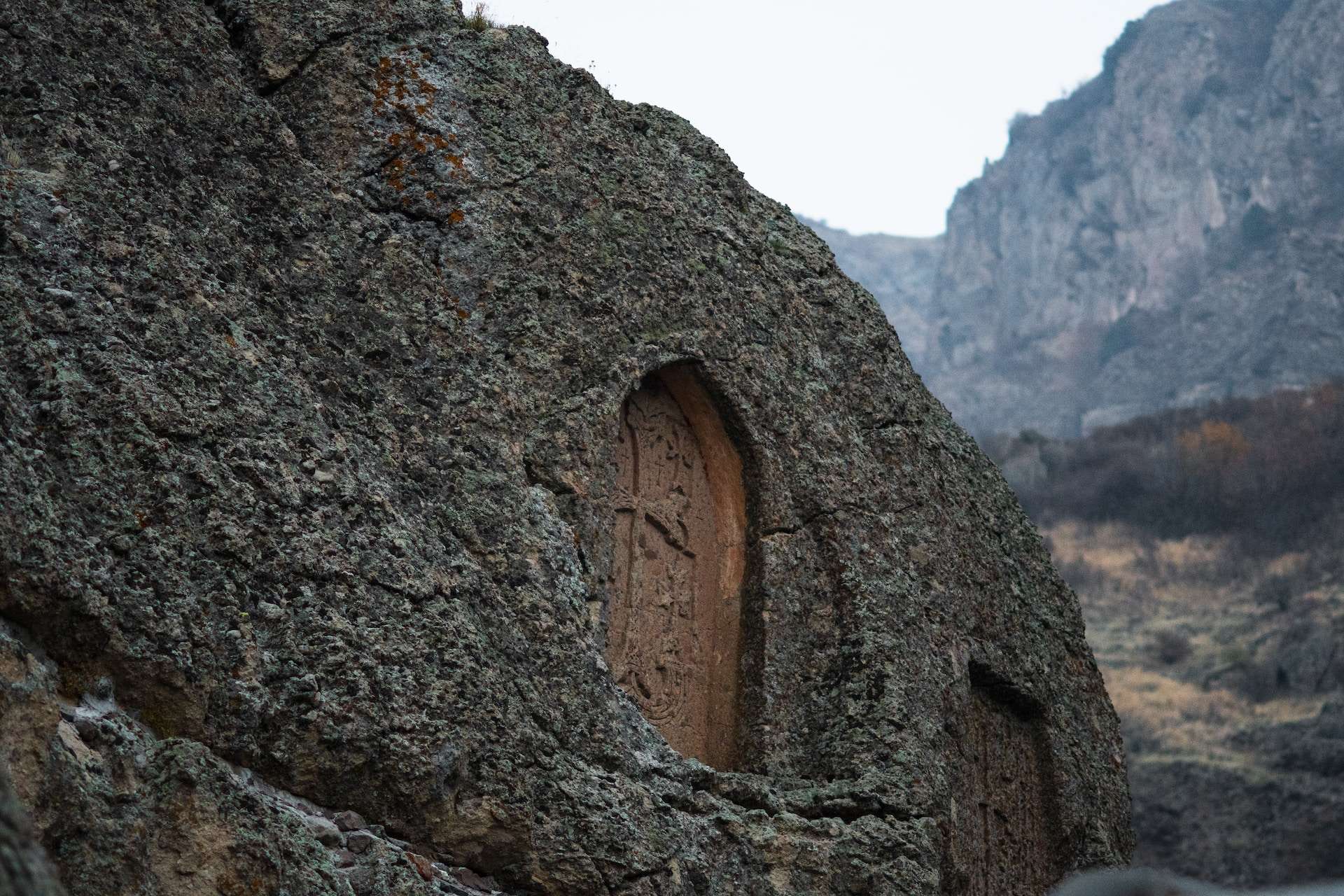
Geghard (Geghardavank, “Monastery of the Spear”) is a medieval Armenian monastery famed for its rock-hewn churches and sacred spring. The complex—founded in the 4th century, with the main church built in 1215—was inscribed on the UNESCO World Heritage List in 2000 for its outstanding architecture and setting in the Azat River gorge.
Overview & Quick Facts
Geghard Monastery sits in Kotayk Province, east of Yerevan, at roughly 5,740 feet (≈1,750 meters) above sea level. Much of the complex is hewn into the cliffs, giving interiors dramatic acoustics and a cave-like atmosphere. The ensemble includes the main Katoghike church (1215), a gavit (narthex), rock-cut chapels, and numerous khachkars (carved cross-stones).
Geghard’s full name—Geghardavank, “Monastery of the Spear”—refers to the Holy Lance that, by tradition, pierced Christ’s side and was long kept here (the spear is now displayed at the treasury museum in Etchmiadzin). The monastery and the surrounding Upper Azat Valley were added to the UNESCO World Heritage List in 2000 for their cultural value and landscape integrity.
Why the name “Geghard”?
“Geghard” means “spear” in Armenian. The monastery was first known as Ayrivank (“Monastery of the Cave”), then adopted the name Geghardavank after the Holy Lance (Geghard) was venerated here, attracting pilgrims for centuries.
| Metric | Value |
|---|---|
| Founding | 4th century (traditionally by Gregory the Illuminator) |
| Main church (Katoghike) | 1215 CE |
| Elevation | ≈5,740 ft (≈1,750 m) |
| UNESCO inscription | 2000 (Monastery of Geghard and the Upper Azat Valley) |
| Approx. distance from Yerevan | ≈22–25 miles (≈35–40 km) |
| Coordinates | ≈40.14°N, 44.82°E |
Sources: UNESCO; CyArk; Armenian Church museums; transport guides.
History & Timeline
The earliest monastic community formed around a sacred cave spring in the 4th century, a period linked to Saint Gregory the Illuminator and Armenia’s early Christianization. After centuries of upheaval, the complex saw major rebuilding in the 12th–13th centuries under the Zakarid and Proshian patrons.
In 2000, the site—together with its dramatic river gorge—entered the UNESCO World Heritage List. In 2023, UNESCO recorded clarifications to the property boundaries and areas to improve protection. These steps reflect ongoing stewardship by Armenian authorities and international partners.
From Ayrivank (Cave Monastery) to Geghard
Originally known as Ayrivank for its cave sanctuaries, the monastery’s fame spread with the veneration of the Holy Lance—hence Geghardavank, “Monastery of the Spear.” Relics associated with the Apostles also drew donations and pilgrims. Today, the Holy Lance can be viewed at the treasury museum in Etchmiadzin.
13th-century building boom
The main church (1215) and the adjoining gavit (early 13th century) date to this high medieval phase, as do several rock-hewn chapels and the Proshian family mausoleum (1283). Much of the carving—muqarnas-like vaults, reliefs of animals, and intricate door frames—shows master craftsmanship adapted to living rock.
Architecture & Rock-Hewn Spaces
Geghard’s architecture blends freestanding masonry with chambers sculpted within the cliff. This mix creates distinctive acoustics, diffused light from ceiling oculi, and a cool, incense-tinged atmosphere even on hot days. The surrounding basalt walls of the Azat gorge frame the complex like a natural fortress.
Rock-cut chapels such as Avazan incorporate a perpetual spring—continuing pre-Christian traditions of cave water veneration within a Christian setting. The gavit’s stone “stalactite” vault (akin to muqarnas) shows technical ambition and cross-cultural influence across medieval Armenia and its neighbors.
Gavit (narthex) and acoustics
The gavit functioned as an antechamber for teaching and receiving pilgrims. Four heavy columns support a roof pierced by a small oculus. The resulting resonance makes even soft chants carry, a feature many visitors notice today.
Cave churches and sacred spring
Cave chapels north-west of the gavit were carved in the 1240s and later. Their cross-in-square plans, rock-cut domes, and dripping spring create a rare combination of engineering and devotion.
Khachkars (cross-stones)
Khachkars—free-standing or rock-set cross-stones—dot the complex. Typically about 5 feet (≈1.5 meters) tall, they display crosses over suns or wheel motifs with vines and saints, serving as memorials and devotional markers across Armenia.
Location, Access & How to Visit
Geghard lies roughly 22–25 miles (≈35–40 km) east of Yerevan—about a 40–60 minute drive depending on traffic and road conditions. Public transport (shared minibus/line 284) and taxis operate the route; many travelers pair Geghard with the Hellenistic Temple of Garni on a single day trip.
The monastery sits around 5,740 ft (≈1,750 m). Take it easy on stairs, carry water, and wear non-slip shoes—the rock floors can be polished smooth. Photography is generally allowed; be respectful during services and when candles are lit. Weather can change quickly in the gorge, so pack a light layer in spring or autumn.
Distance, transport, and pairing with Garni
Many visitors combine the monastery with Garni’s temple and the “Symphony of Stones” basalt columns in the same valley. Buses and tours run most days, and rideshares/taxis are common. Budget around half a day for the trio of sights.
Practical tips (best season, dress, etiquette)
Spring (Apr–Jun) and autumn (Sep–Oct) offer mild weather and colorful landscapes. Shoulders and knees covered are appreciated inside chapels; candles and incense are common. Keep voices low in the caves—whispers travel.
Cultural & Spiritual Significance
Geghard’s identity intertwines with relics and pilgrimage. The Holy Lance—central to the site’s name and story—was long kept here and is now displayed at the Etchmiadzin treasury museum, about 13 miles (≈21 km) west of Yerevan. The monastery also housed relics of Apostles Andrew and John, drawing gifts and endowments through the medieval period.
UNESCO recognizes the ensemble for its “harmonious blend” of natural landscape and monastic architecture carved directly from rock. Ongoing documentation and boundary clarifications (most recently noted in 2023) support protection efforts led by Armenian authorities and partners.
Visiting Geghard Monastery (Practical Guide)
Where is it? Geghard Monastery sits in Armenia’s Upper Azat Valley, about 22–25 miles (≈35–40 kilometers) east of Yerevan. Expect a 40–60 minute drive in normal traffic.
How to get there
Most convenient: Taxi or rideshare direct from Yerevan (≈39 minutes; ≈US$12–15 one-way).
Public transport + short taxi: Take minibus/bus toward Garni/Goght (e.g., line 284 from Gai Bus Station), then a 9–10 km hop by local taxi to Geghard (≈US$4–5). Some buses end at Goght (no bus all the way to the monastery), so plan the last leg. :
Guided day tours: Common half-day trips combine Garni Temple, the “Symphony of Stones” gorge, and Geghard—handy if you want a driver and context.
| Option | Typical time | Approx. cost | Notes |
|---|---|---|---|
| Taxi Yerevan → Geghard | ≈39–60 min | ≈US$12–15 (one-way) | Door-to-door; easiest with 2–4 people. |
| Bus (Yerevan → Garni/Goght) + taxi | ≈60–75 min + 9–10 min | Bus ≈US$2–6; taxi ≈US$4–5 | Buses often end at Goght; no direct bus to monastery. |
| Organized tour | 4–6 hours total | Varies by operator | Usually includes Garni & Symphony of Stones. |
Table downloads (2)
- Why the name “Geghard”? (7 × 2)View tableDownload CSV
- How to get there (4 × 4)View tableDownload CSV
Hours, fees & best time
Entrance: Free; donations welcome. Tip: bring small AMD cash for candles and local sweets sold outside.
Opening hours: Typically daylight hours; many guides list around 09:00–20:00 daily, but times can be shorter in winter and during services—confirm locally.
When to go: Early morning or late afternoon for softer light and fewer tour groups; best seasons are spring (Apr–Jun) and autumn (Sep–Oct) for mild weather in the gorge.
What to wear & etiquette
Dress modestly (shoulders/knees covered) and use a quiet voice—whispers carry in the rock-hewn chapels. Remove hats inside; avoid flash during services. Respect worshippers and live liturgies.
Facilities & accessibility
Expect uneven stone floors and stairs; interior caves are dim. Much of the complex is not wheelchair-accessible, though the outer courtyard is flatter. Bring sturdy shoes and a light layer (elevation ≈5,740 ft / ≈1,750 m).
Vendors near the entrance sell local sweets and souvenirs; basic refreshments are available.
Combine with nearby sights
Pair Geghard with Garni Temple (Greco-Roman; ≈9–10 km / ≈6 miles away) and the Symphony of Stones in Garni Gorge for a full half-day.
Drones & photography
Drone rules in Armenia are regulated by the General Department of Civil Aviation; religious sites may have local restrictions. Always check current guidance and fly respectfully (keep low, avoid crowds/services).
Author’s note: information above aggregates official listings and recent transport sources; prices/times are indicative. Cross-check locally in winter or on religious holidays.
FAQ
How far is Geghard from Yerevan and how do I get there?
It’s roughly 22–25 miles (≈35–40 km) east of the capital. Many visitors go by taxi or join a day tour; public minibus (line 284) also runs to the site.
Why is it called “Geghard”?
The name means “spear,” referring to the Holy Lance venerated here for centuries; the relic is now in the Etchmiadzin treasury museum.
When was the main church built?
The Katoghike (main church) dates to 1215 CE, part of a larger 13th-century construction program that also produced the gavit and rock-cut chapels.
Is Geghard a UNESCO World Heritage Site?
Yes. “Monastery of Geghard and the Upper Azat Valley” was inscribed in 2000 for its rock-hewn architecture and dramatic natural setting.
What’s special about the khachkars?
Khachkars are Armenia’s carved cross-stones, usually about 5 ft (≈1.5 m) tall, with intricate crosses over sun-wheel motifs and vine patterns—both memorial and devotional.
What Did We Learn Today?
- Geghard blends rock-hewn chapels and masonry churches within a striking river gorge.
- The site emerged around a cave spring in the 4th century; the main church dates to 1215.
- Its name recalls the Holy Lance once kept here; the relic is now at Etchmiadzin’s treasury.
- UNESCO inscribed the “Monastery of Geghard and the Upper Azat Valley” in 2000.
- It’s an easy day trip from Yerevan—often combined with Garni and the Symphony of Stones.