Historical flag guide
Yugoslavia Flag: Meaning and History
The South Slav kingdom formed in 1918 used a blue-white-red tricolour and later took the name Yugoslavia.
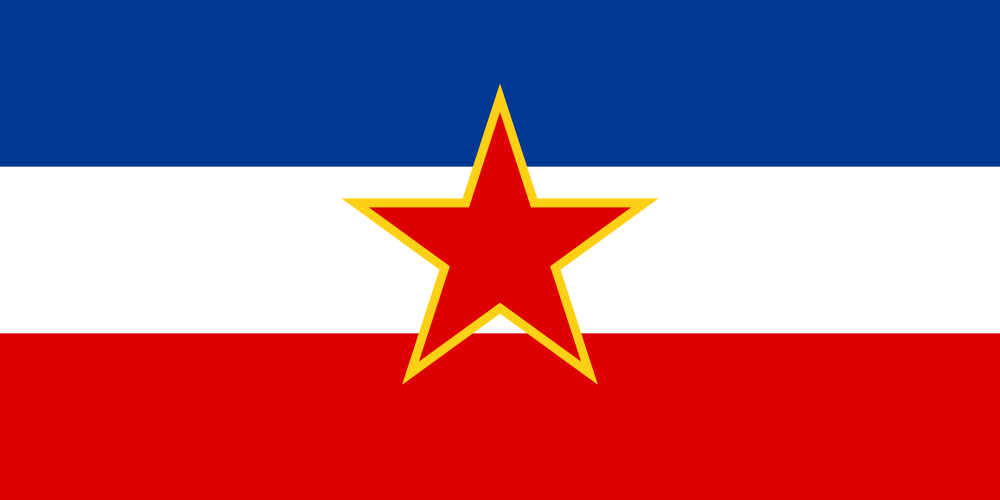
Blue, white and red horizontal bands with a large gold-bordered red star in the center. The red star identifies the socialist federal period. Yugoslavia’s earlier kingdom and later Federal Republic used related tricolours without the same central emblem. The flag version is narrower in date than the full history of states called Yugoslavia.
The design and its details
Blue, white and red horizontal bands with a large gold-bordered red star in the center.
| Flag | Yugoslavia |
|---|---|
| Collection | Historical flags |
| Adoption or specification | 1946 for the socialist federal national specification |
| Browsing region | Europe · Southern Europe |
| Illustrated period | 1946–1992 socialist federal flag |
What the flag means
The red star identifies the socialist federal period. Yugoslavia’s earlier kingdom and later Federal Republic used related tricolours without the same central emblem. The flag version is narrower in date than the full history of states called Yugoslavia.
| Element | Meaning or historical connection |
|---|---|
| Blue, white and red | The South Slavic tricolour tradition inherited from earlier national movements. |
| Red star | The socialist state and the partisan revolutionary heritage. |
| Gold border | Outlines the star in the adopted federal design. |
| Central federal emblem | Identifies the socialist-era flag, rather than the preceding kingdom or the later starless Federal Republic of Yugoslavia. |
How the flag developed
The South Slav kingdom formed in 1918 used a blue-white-red tricolour and later took the name Yugoslavia. During the Second World War, the Partisan movement added a red star to its flags.
The socialist federation established after the war adopted a national specification with a large gold-bordered red star in 1946. The star expressed the socialist state, while the tricolour continued the earlier South Slav national palette. Each constituent republic also had its own flag, often with a red star.
The federation broke apart during the wars and constitutional changes of the early 1990s. The Federal Republic of Yugoslavia formed by Serbia and Montenegro in 1992 used a plain blue-white-red flag. The illustrated starred flag therefore belongs to socialist federal Yugoslavia, not every later state that retained the name.
Successor states adopted distinct national flags, sometimes restoring older symbols or modifying their republican flags. Their separate histories help explain both the shared tricolour vocabulary and the differences visible today.
The main changes over time
1918 — South Slav kingdom
An earlier blue-white-red national tradition developed.
1946 — Socialist federal flag
The large gold-bordered red star became official.
1991–1992 — Federation dissolved
Successor states adopted independent symbols.
1992 — Later federal republic
Serbia and Montenegro used an unstarred tricolour.
How to recognise this flag
Blue is on top, white in the middle and red at the bottom, with a gold-bordered red star overlapping the bands.
Compare the relevant designs in these guides:
Earlier designs and other uses
Kingdom, socialist federation and later federal republic flags must be dated separately.
Questions about this flag
Which period does this historical flag represent?
1946–1992 socialist federal flag. Successor states adopted distinct national flags, sometimes restoring older symbols or modifying their republican flags. Their separate histories help explain both the shared tricolour vocabulary and the differences visible today.
What should I check before identifying an older example?
Kingdom, socialist federation and later federal republic flags must be dated separately.
What Did We Learn Today?
Blue is on top, white in the middle and red at the bottom, with a gold-bordered red star overlapping the bands. The historical label identifies a particular state or version; related modern flags have their own national histories.
Sources & Data Notes
This guide distinguishes first use, national adoption, restoration and later construction standards. Traditional or commonly reported interpretations are identified where they differ from a formal specification. It is a dated reference, not a live record of every change in official flag use.
Illustration credits
- Flag of Yugoslavia (1946–1992).svg — Flag designed by Đorđe Andrejević-Kun[3]SVG coding: Zscout370; Public domain.
