National flag guide
Flag of Bosnia and Herzegovina: Meaning, Symbols and History
Bosnia and Herzegovina’s present flag was introduced in 1998 during the postwar implementation of the Dayton settlement.
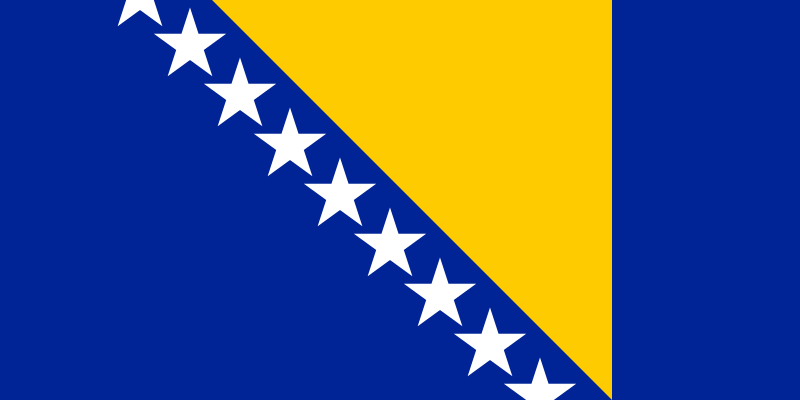
A wide blue vertical band on the right side, with a large yellow isosceles triangle in the middle of the flag, based at the top; the rest of the flag is blue, with seven five-pointed white stars and two half-stars along the triangle's hypotenuse. The triangle is associated with both the country’s approximate shape and its three constituent peoples: Bosniaks, Croats and Serbs.
The design and its details
A wide blue vertical band on the right side, with a large yellow isosceles triangle in the middle of the flag, based at the top; the rest of the flag is blue, with seven five-pointed white stars and two half-stars along the triangle's hypotenuse.
| Flag | Bosnia and Herzegovina |
|---|---|
| Collection | Country flags |
| Adoption or specification | 4 February 1998 |
| Browsing region | Europe · Southern Europe |
| Illustrated proportions (height:width) | 1:2 |
What the flag means
The triangle is associated with both the country’s approximate shape and its three constituent peoples: Bosniaks, Croats and Serbs. The stars refer to Europe. The half-stars at the ends make the line appear to continue beyond the flag, rather than forming a fixed count of administrative units.
| Element | Meaning or historical connection |
|---|---|
| Yellow triangle | Its three points are associated with Bosniaks, Croats and Serbs; its outline also suggests the country’s broad shape. |
| Blue and yellow | Colors associated with a neutral, European national design rather than one community’s older flag. |
| White stars | A European association and an open-ended line, with partial stars suggesting continuation beyond the cloth. |
How the flag developed
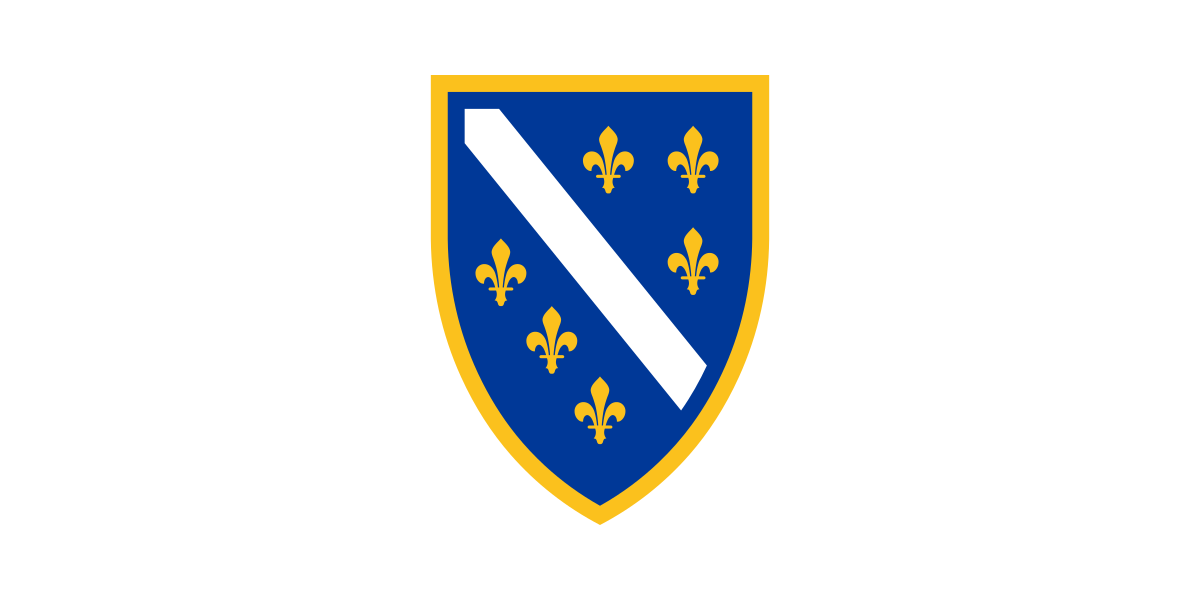
Bosnia and Herzegovina’s present flag was introduced in 1998 during the postwar implementation of the Dayton settlement. An earlier independence-era flag had displayed a shield with six golden lilies on white. In a state emerging from war, selecting a flag acceptable across communities became a political problem as well as a design exercise.
The High Representative introduced the new design after the domestic institutions failed to agree on a replacement. Its blue field, yellow triangle and line of white stars were chosen to avoid exclusively identifying the state with one ethnic group. The change did not alter Bosnia and Herzegovina’s international identity: it changed the visual language through which that shared state was represented. The flag’s deliberately open-ended stars and simplified geometry are central to understanding that choice.
The main changes over time
1946–1992 — Yugoslav republic flag
A red republican flag carried a Yugoslav tricolour canton.
1992–1998 — Lily-shield flag
The independence-era national flag showed a shield with golden lilies on white.
1998 — Present flag
The blue, yellow and white design replaced the earlier flag.
Historical flags in pictures
How to recognise this flag
Notice the yellow triangle and the diagonal row of stars, including the cut stars at the edges. The design has neither a crescent nor the lily shield of the 1992–1998 flag.
Earlier designs and other uses
Entity and local flags have separate identities. Flags used by the Federation of Bosnia and Herzegovina, Republika Srpska or particular communities should not be substituted for the state flag.
Questions about this flag
When was the flag adopted?
4 February 1998. An adoption date can refer to a design, its restoration or a later legal specification; the timeline above separates those stages.
What should I check before identifying an older example?
Entity and local flags have separate identities. Flags used by the Federation of Bosnia and Herzegovina, Republika Srpska or particular communities should not be substituted for the state flag.
What Did We Learn Today?
Notice the yellow triangle and the diagonal row of stars, including the cut stars at the edges. The design has neither a crescent nor the lily shield of the 1992–1998 flag. Its adoption and later changes reflect the national history described in the timeline, while older or specialist flags need their own labels.
Sources & Data Notes
This guide distinguishes first use, national adoption, restoration and later construction standards. Traditional or commonly reported interpretations are identified where they differ from a formal specification. It is a dated reference, not a live record of every change in official flag use.
- Archived World Factbook country record — background flag description and symbolic interpretations; later changes are explained above.
- Flagpedia: Bosnia and Herzegovina — flag artwork and comparison reference.
- Flag history reference and bibliography — chronology and links to underlying sources.
The main illustration preserves the selected flag artwork’s proportions; these are a reproduction guide, not a substitute for a legal construction drawing. Color names group shades for browsing.
Illustration credits
- Flag of Bosnia and Herzegovina (1992–1998).svg — The authors of the final version of the officially adopted flag are Prof. Dr. Enver Imamović and graphic designer Zvonimir Bebek. Other authors from the Working Group prior to the dissolution can be found in the cited sources.
The SVG version was created based on official documentation and other relevant sources, as cited above, by LeCorbusierB NRMostar (Reddit username u/LeCorbusierB) and FiliusBosnensis (Reddit username u/filius_bosnensis). It was entirely created from scratch, without using other people’s work.The original author of the previous, i.e. the older version of the flag that had been in use before the change, is Kseferovic. Others later revised his coat of arms on several occasions. See the file history for more information.; Public domain.
