National flag guide
Flag of Colombia: Meaning, Symbols and History
Colombia’s yellow-blue-red belongs to the independence-era flag tradition associated with Francisco de Miranda.
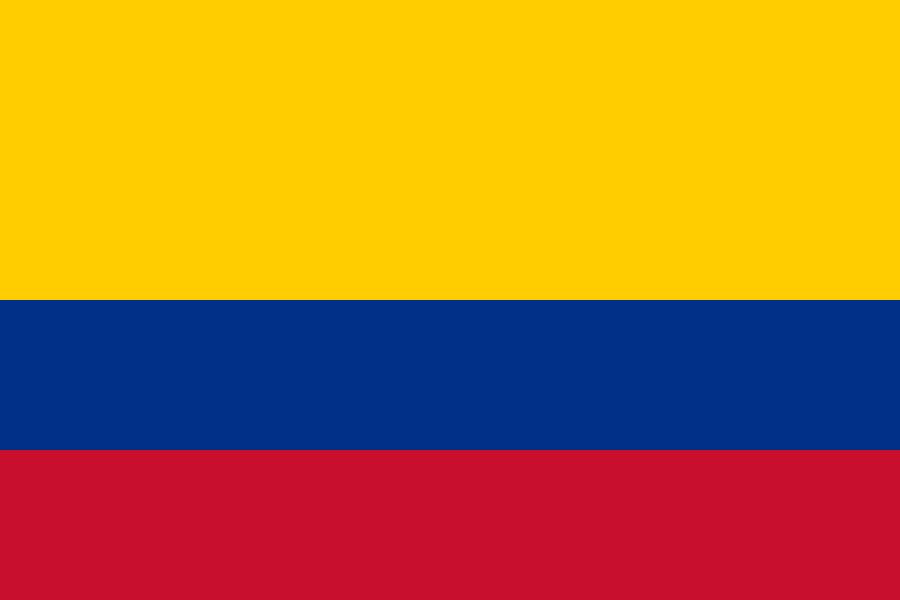
Three horizontal bands of yellow (top, double-width), blue, and red. Several color interpretations exist, including wealth and sunlight, water and the sky, and sacrifice for independence. Those modern readings should be presented alongside the documented common political ancestry of the three countries’ flags. The yellow band takes half the height; blue and red each take a quarter.
The design and its details
Three horizontal bands of yellow (top, double-width), blue, and red.
| Flag | Colombia |
|---|---|
| Collection | Country flags |
| Adoption or specification | 26 November 1861 for the present arrangement |
| Browsing region | South America · South America |
| Illustrated proportions (height:width) | 2:3 |
What the flag means
Several color interpretations exist, including wealth and sunlight, water and the sky, and sacrifice for independence. Those modern readings should be presented alongside the documented common political ancestry of the three countries’ flags.
| Element | Meaning or historical connection |
|---|---|
| Yellow | Often explained through national wealth, sunlight or sovereignty. Interpretations differ. |
| Blue | Commonly associated with the country’s waters, including its two ocean coasts. |
| Red | Commonly associated with the independence struggle and sacrifice. |
| Shared tricolour | The yellow-blue-red tradition connects Colombia’s flag history with Ecuador, Venezuela and the earlier Gran Colombian union. |
How the flag developed
Colombia’s yellow-blue-red belongs to the independence-era flag tradition associated with Francisco de Miranda. The colors were shared by Gran Colombia, the state whose former territories later became Colombia, Ecuador and Venezuela.
After Gran Colombia dissolved, Colombia’s predecessor state used different arrangements, including vertical stripes. The present horizontal design with a double-height yellow band was established in 1861. The absence of a central emblem distinguishes the ordinary national flag from Ecuador’s commonly illustrated state flag and Venezuela’s stars.
The main changes over time
1819–1830 — Gran Colombia
The independence-era state shared the three-color tradition.
1830s–1850s — New Granadan arrangements
Intervening national designs used different stripe arrangements.
1861 — Present horizontal flag
The double-height yellow band became the national arrangement.
How to recognise this flag
The yellow band takes half the height; blue and red each take a quarter. The plain Colombian national flag has neither the Ecuadorian arms nor Venezuela’s star arc.
Compare the relevant designs in these guides:
Earlier designs and other uses
Military and merchant variants can add devices. Those additions should not be placed on every ordinary Colombian national flag.
Questions about this flag
When was the flag adopted?
26 November 1861 for the present arrangement. An adoption date can refer to a design, its restoration or a later legal specification; the timeline above separates those stages.
What should I check before identifying an older example?
Military and merchant variants can add devices. Those additions should not be placed on every ordinary Colombian national flag.
What Did We Learn Today?
The yellow band takes half the height; blue and red each take a quarter. The plain Colombian national flag has neither the Ecuadorian arms nor Venezuela’s star arc. Its adoption and later changes reflect the national history described in the timeline, while older or specialist flags need their own labels.
Sources & Data Notes
This guide distinguishes first use, national adoption, restoration and later construction standards. Traditional or commonly reported interpretations are identified where they differ from a formal specification. It is a dated reference, not a live record of every change in official flag use.
- Archived World Factbook country record — background flag description and symbolic interpretations; later changes are explained above.
- Flagpedia: Colombia — flag artwork and comparison reference.
- Flag history reference and bibliography — chronology and links to underlying sources.
The main illustration preserves the selected flag artwork’s proportions; these are a reproduction guide, not a substitute for a legal construction drawing. Color names group shades for browsing.
Current flag artwork is supplied with the original flag collection; the package’s artwork register contains provenance and license details.