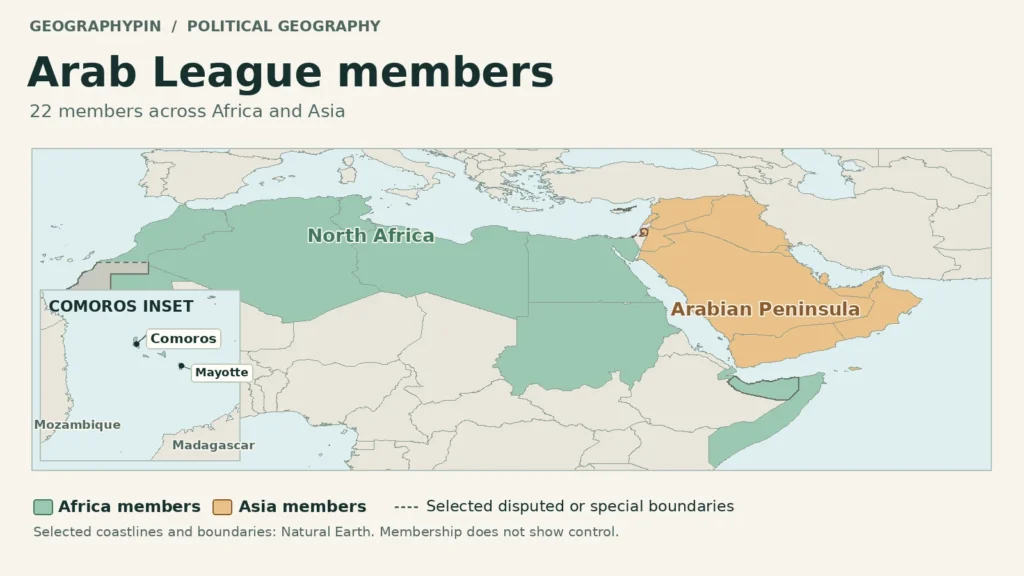
On a map, the Arab world reaches well beyond the Arabian Peninsula. Comoros and Somalia belong to the Arab League, while nearby Iran and Türkiye do not. If you want a list with a fixed count, membership in the League of Arab States gives you a clearer boundary than a label such as “Middle East.”
Membership checked: November 2026
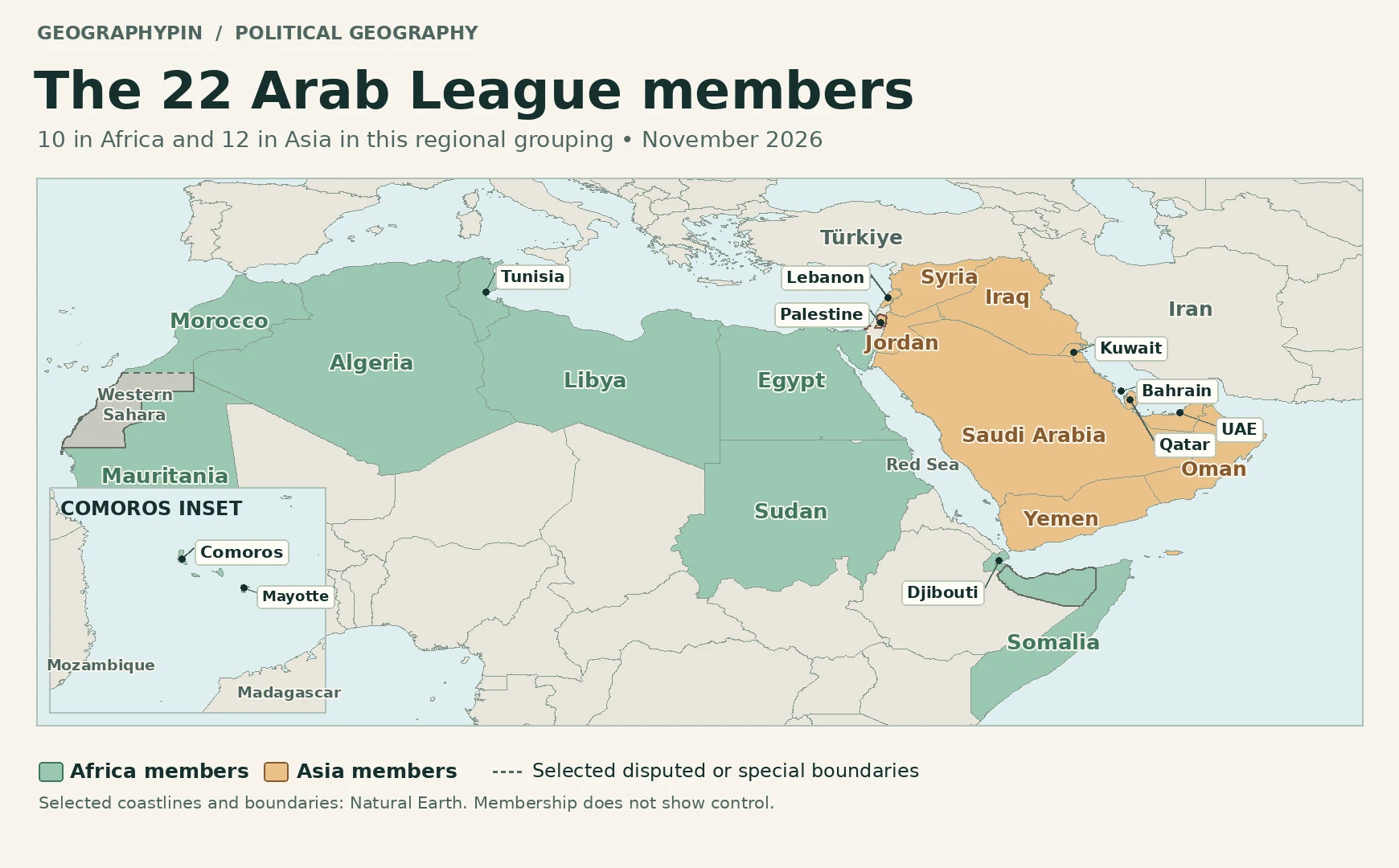
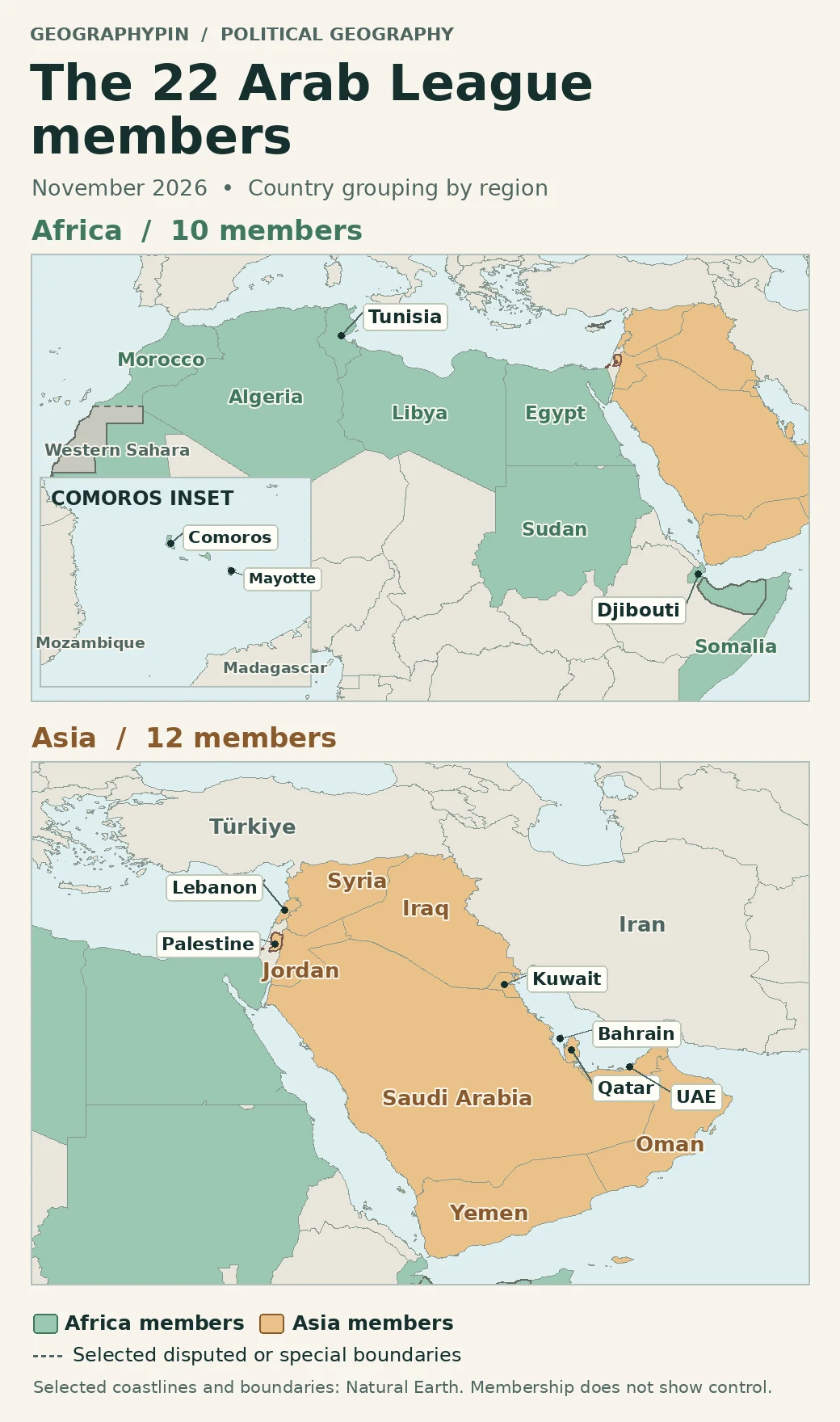
The League of Arab States has 22 members. Using the UN’s statistical regions to place each member once, 10 are in Africa and 12 in Asia. The roster includes the State of Palestine, Somalia and Comoros. Egypt is counted once, under Africa, even though its Sinai Peninsula lies in Asia.
How to use this article: Look up the full membership list, locate Somalia and Comoros, or compare the League, the Middle East and the GCC.
The 22 Arab League members by region
The list follows membership in the League, not the share of a country’s population that speaks Arabic or identifies as Arab. The continental columns follow the UN M49 statistical grouping. Egypt’s entire shape has the African member color because the table assigns Egypt to Africa as a single member, not because both sides of the Suez Canal are in Africa.
Full membership list
| Africa (10) | Asia (12) |
|---|---|
| Algeria | Bahrain |
| Comoros | Iraq |
| Djibouti | Jordan |
| Egypt | Kuwait |
| Libya | Lebanon |
| Mauritania | Oman |
| Morocco | Qatar |
| Somalia | Saudi Arabia |
| Sudan | State of Palestine |
| Tunisia | Syria |
| — | United Arab Emirates |
| — | Yemen |
Map from the Atlantic to the Indian Ocean
Why Somalia, Comoros and Palestine are included
The Horn of Africa and the Indian Ocean
Somalia projects into the Indian Ocean from the Horn of Africa, across the Gulf of Aden from Yemen. It joined the League in 1974. Its provisional constitution names Somali the official language and Arabic the second language. Membership alone does not tell you what language people use at home or what ethnic groups live there.
Comoros is an island country between Mozambique and Madagascar. It joined in 1993; Comorian, French and Arabic are official languages under its constitution. The inset labels Mayotte separately: France administers it and Comoros claims it. The League roster lists the Union of the Comoros, not Mayotte as a separate member.
Palestine’s status in the League and the UN
The State of Palestine is a full member of the League of Arab States. At the United Nations it has non-member observer State status. Those are separate organizations and their membership rules are different. The map identifies the West Bank and Gaza Strip in a generalized way; showing the League affiliation does not show who controls any location or resolve a legal boundary.
Where the Arab League and the Middle East overlap
Three groupings that answer different questions
- Arab League: A political organization with a membership roster. It includes countries in North Africa, the Horn of Africa, the Indian Ocean and Western Asia.
- Middle East: A geographic convention with varying edges. Under common definitions it includes Iran and Türkiye, neither of which belongs to the League. See why Middle East country lists vary.
- Gulf Cooperation Council: A separate organization with six members: Bahrain, Kuwait, Oman, Qatar, Saudi Arabia and the United Arab Emirates. All six are also in the Arab League, but Iraq and Yemen are League members without being GCC members. Compare the six GCC countries with the geography of the Arabian Peninsula.
The clearest way to use the roster is to ask which grouping you mean first. A membership map can answer whether a country belongs to an organization; it cannot tell you whether everyone in that country identifies with a particular culture or language.
Frequently Asked Questions
Is Western Sahara a separate Arab League member?
No. It is not on the roster. The UN lists it as a Non-Self-Governing Territory, and the map distinguishes it from the area shaded for Morocco. That convention is not a map of current control.
Why isn’t South Sudan in the table?
The League roster lists Sudan, not South Sudan. South Sudan is a separate state and appears without the member color.
Does “Arab countries” have a single definition outside this list?
Not always. It can describe an institutional grouping or a wider cultural or linguistic idea. This article uses League membership so that the count can be checked against a published roster.
What Did We Learn Today?
The Arab League has 22 members across Africa and Asia. Its membership accounts for places like Comoros and Somalia that a Middle East map often leaves out. The State of Palestine’s League membership and UN observer status are distinct, and the six-member GCC is a smaller group whose members all belong to the League.
Sources & Data Notes
The roster follows the 22-member list in the UN’s Arab Sustainable Development Report, checked against a 2026 list. M49 groups Egypt in Northern Africa and the State of Palestine in Western Asia. Map shapes are generalized. Western Sahara is shaded separately; the map does not depict its berm or present-day control lines. Boundary markers around the West Bank and Gaza, Somaliland and selected other areas indicate context rather than legal conclusions.
Show sources and boundary conventions
- UN ESCWA: Arab Sustainable Development Report 2024, roster. The 2026 U.S. Trade Representative report was used as a second roster check, not for Palestine’s official institutional designation.
- UN Statistics Division: M49 geographic regions.
- UN General Assembly resolution ES-10/23 and the UN list of non-member observer states, for the State of Palestine’s separate statuses.
- Organization of American States: League profile, for Somalia and Comoros accession years. See also Somalia’s provisional constitution (Article 5) and the 2018 Constitution of Comoros (Article 9).
- GCC General Secretariat: member states.
- Map data: Natural Earth, with the full Western Sahara outline checked against the UN MINURSO map. See the UN’s Western Sahara listing, the OCHA atlas for the West Bank and Gaza, and the UN resolution on Mayotte.