The Caspian tiger is extinct. It once lived far beyond the sea that gave it its name, from the South Caucasus and northern Iran to river valleys in western China. Tigers have returned to part of that range in Kazakhstan, but they are Amur tigers, not survivors of the vanished Caspian population.
Hunting, loss of riverside forests and reed beds, and declining prey drove the Caspian tiger’s disappearance. A killing reported in eastern Turkey in 1970 is often cited among the last records. In 2026 Kazakhstan released two closely related Amur tigers near Lake Balkhash, where the Caspian tiger once lived.
How to use this article: Start with the dates and places on the map, see why the last sighting is hard to pin down, or go straight to Kazakhstan’s 2026 releases.
Where did the Caspian tiger live?
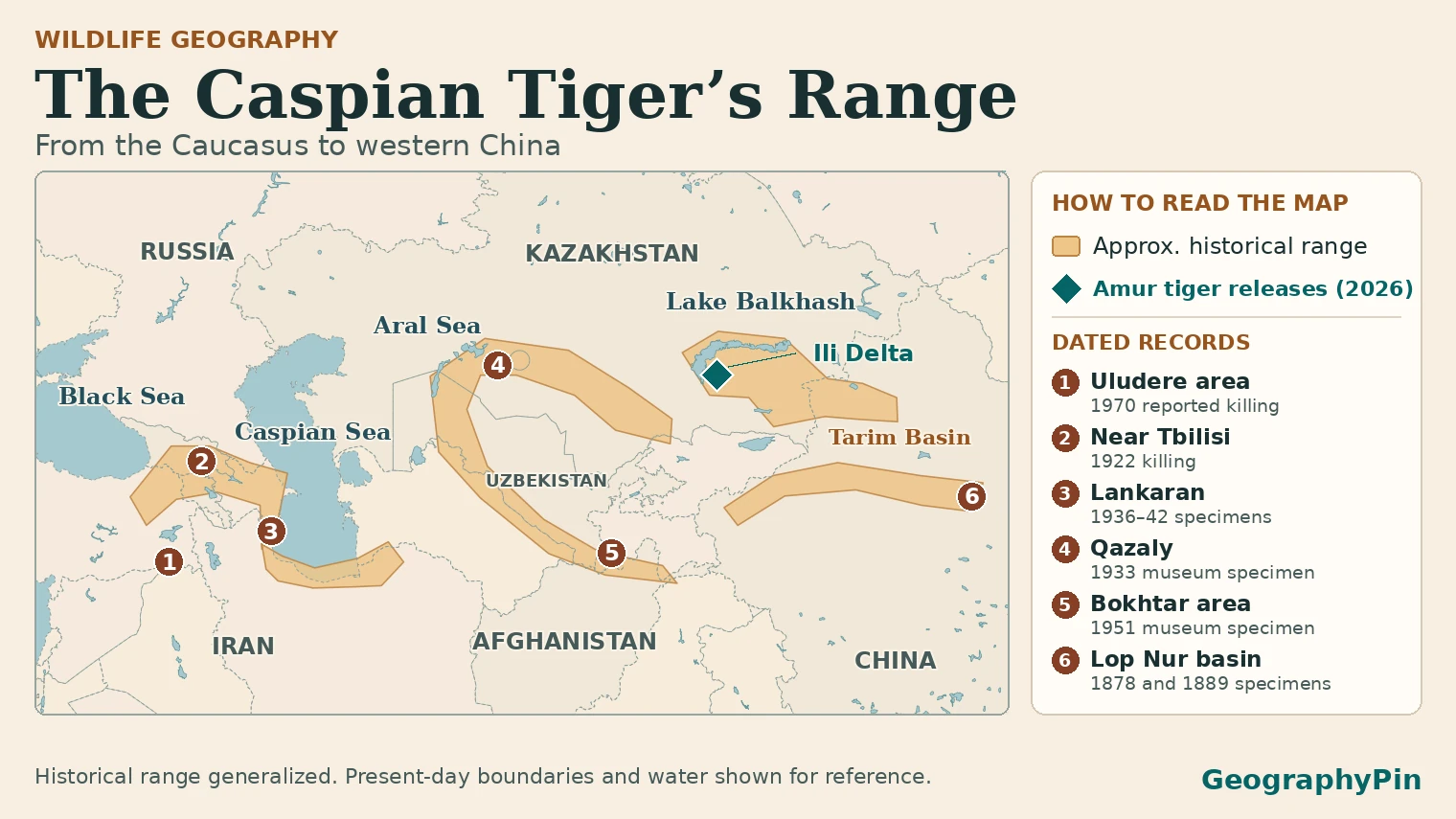
The name comes from northern Iran, on the southern shore of the Caspian Sea. There, tigers inhabited coastal reeds and the wooded northern slopes of the Alborz. West of the sea they occurred in parts of the South Caucasus and eastern Anatolia. The Caucasus records include a tiger killed near Tbilisi in Georgia and museum specimens traced to Lankaran in southeastern Azerbaijan. They do not mean tigers occupied the whole Caucasus mountain chain.
Farther east, water mattered more than the sea. The Amu Darya and Syr Darya crossed dry country but supported belts of dense vegetation. Tigers also lived along the Ili near Lake Balkhash and in river basins in what is now Xinjiang, China. In Central Asia, many relied on tugai, the forest, scrub and thickets that grow along seasonally flooded rivers.
What the dated records show

Driscoll and colleagues cataloged specimens from Qazaly near the Aral Sea (1933), the area of present-day Bokhtar in Tajikistan (1951), and the Lop Nur basin in western China (1878 and 1889). The dates are not evidence that all the shaded areas were occupied at the same time.
Why did the Caspian tiger go extinct?
A river valley could look extensive on a map while offering only a narrow strip of usable cover. Clearing riverside forests and reed beds for crops broke up that cover. In parts of Central Asia, cotton fields replaced habitat. As large prey declined and people hunted tigers or killed them in response to livestock losses, the remaining pockets became harder to sustain.
Was 1970 the year of extinction?
That is the year of an often-cited reported killing near Uludere in eastern Turkey. It is not a proven date for the death of the last tiger anywhere. The IUCN’s historical account gives 1948 for the last Ili River record and treats a 1968 observation near Nukus as unconfirmed. Searches in the Iranian Alborz in the 1970s photographed leopards and other wildlife, but no tigers.
Are Caspian tigers coming back?
No. The animals released in Kazakhstan are Amur tigers brought from Russia. A study of mitochondrial DNA from museum specimens found a close relationship between Caspian and Amur tigers. That helped make the living Amur tiger a candidate for restoration. The goal is to bring tigers back to habitat they once occupied, not to recover the extinct Caspian population itself.
Two wild releases at Ili–Balkhash
The wetlands south of Lake Balkhash made the Ili Delta a candidate, provided the river keeps flowing and prey recovers. The reserve’s work includes rebuilding prey populations and monitoring the released animals, with a local response team for conflicts. The real measure of success is whether tigers can survive and reproduce there over time.
Frequently Asked Questions
Is the Persian tiger the same as the Caspian tiger?
Yes. Persian tiger and Turanian tiger are other names for the historical Caspian tiger, traditionally called Panthera tigris virgata. The Persian leopard is a different cat.
Were there Caspian tigers on both sides of the Caspian Sea?
Yes. Lankaran is on the western coast, and museum notes also list the Atrak River in what is now southwestern Turkmenistan, east of the Caspian. Records are associated with particular valleys and shorelands, not an unbroken ring of tiger habitat.
What Did We Learn Today?
The Caspian tiger’s range was tied to water, from coastal marshes in Iran to wooded river valleys in Central Asia. Loss of cover and prey, together with hunting, ended that population. Kazakhstan is restoring tigers to one of those old river systems, but the animals it released there are living Amur tigers.
Sources & Data Notes
View historical records, project updates and map notes
Shading generalizes the main range in historical syntheses, principally the mid-1800s to mid-1900s. It does not map every outlying record or define exact habitat boundaries. Numbered points indicate approximate named localities; dates come from the IUCN account or specimen notes. The basemap uses present-day boundaries and water outlines from Natural Earth, not historical frontiers or shorelines. The Ili Delta symbol marks the project area, not an individual tiger’s position.
- IUCN/SSC Cat Specialist Group, Wild Cats: Status Survey and Conservation Action Plan (1996), pp. 58–59, historical distribution and the quality of late records.
- Driscoll et al., PLOS ONE (2009), historical range and mitochondrial relationship; Table S1 (DOC), museum localities and specimen dates.
- Paul Joslin, Encyclopaedia Iranica (1988; updated 2016), northern Iran habitat, habitat loss and the field searches.
- Tajikistan Ministry of Transport, identifies modern Bokhtar as the former Kurgan-Tyube named in the museum records.
- Chestin et al., Biological Conservation (2017), feasibility study for the Ili Delta and south shore of Lake Balkhash.
- Kazakhstan Ministry of Ecology: July 31 release, October 31 release and the November 4, 2026 program update.
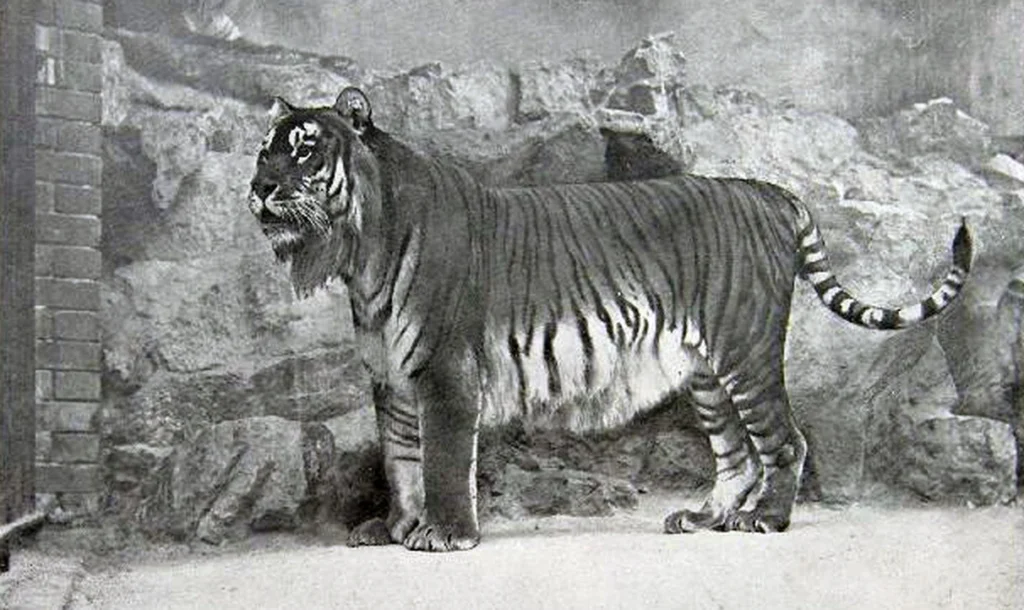
- Cover: archival image of a Caspian tiger at Berlin Zoo, late 19th century, unknown photographer, public domain, cropped.