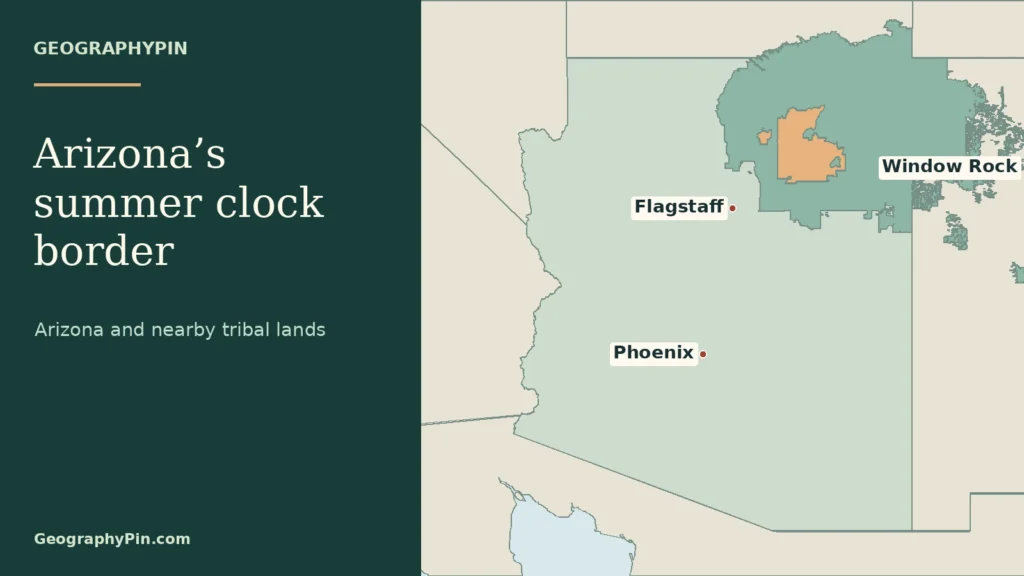
A summer drive from Flagstaff to Window Rock changes the hour displayed by a local clock. A trip from Flagstaff to the Hopi community of Keams Canyon does not. All three destinations are in Arizona.
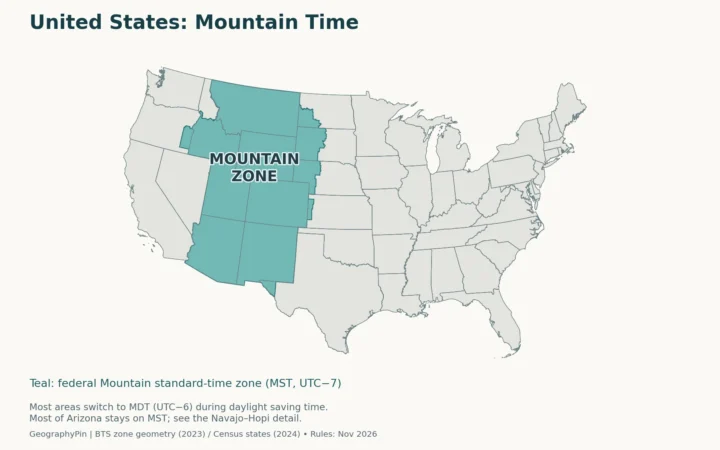
Most of Arizona stays on Mountain Standard Time, UTC−7, throughout the year. The Navajo Nation observes daylight saving time, moving to UTC−6 in summer. The Hopi Reservation stays on UTC−7. In winter all three use UTC−7. A map showing only the Arizona state outline misses the tribal jurisdictions that change the summer answer.
How to use this article: Jump to the discussion you need: A call between Phoenix and Window Rock, The shape inside the shape or Pacific time can look identical for part of the year.
Three clocks in the same state
| Place | January 15 | July 15 |
|---|---|---|
| Flagstaff, Arizona | 11:00 a.m. MST | 11:00 a.m. MST |
| Window Rock, Navajo Nation | 11:00 a.m. MST | 12:00 noon MDT |
| Keams Canyon, Hopi Reservation | 11:00 a.m. MST | 11:00 a.m. MST |
| Phoenix, Arizona | 11:00 a.m. MST | 11:00 a.m. MST |

The table holds the instant constant rather than comparing random local appointments. Subtract seven hours from 18:00 and the result is 11:00. Subtract six and the result is noon. A calendar entry labeled only “Mountain Time” can refer to standard or daylight time. Naming the community or specifying the UTC offset removes the ambiguity.
A call between Phoenix and Window Rock
Suppose someone in Phoenix calls Window Rock at 9 a.m. Phoenix time. In January the other office also reads 9 a.m. In July its clock reads 10 a.m. A call from Phoenix to a Hopi community generally stays at 9 a.m. on both dates. The map matters even for a short trip because these changes follow the relevant jurisdictions, not a meridian outside Arizona.
State exemption and tribal practice
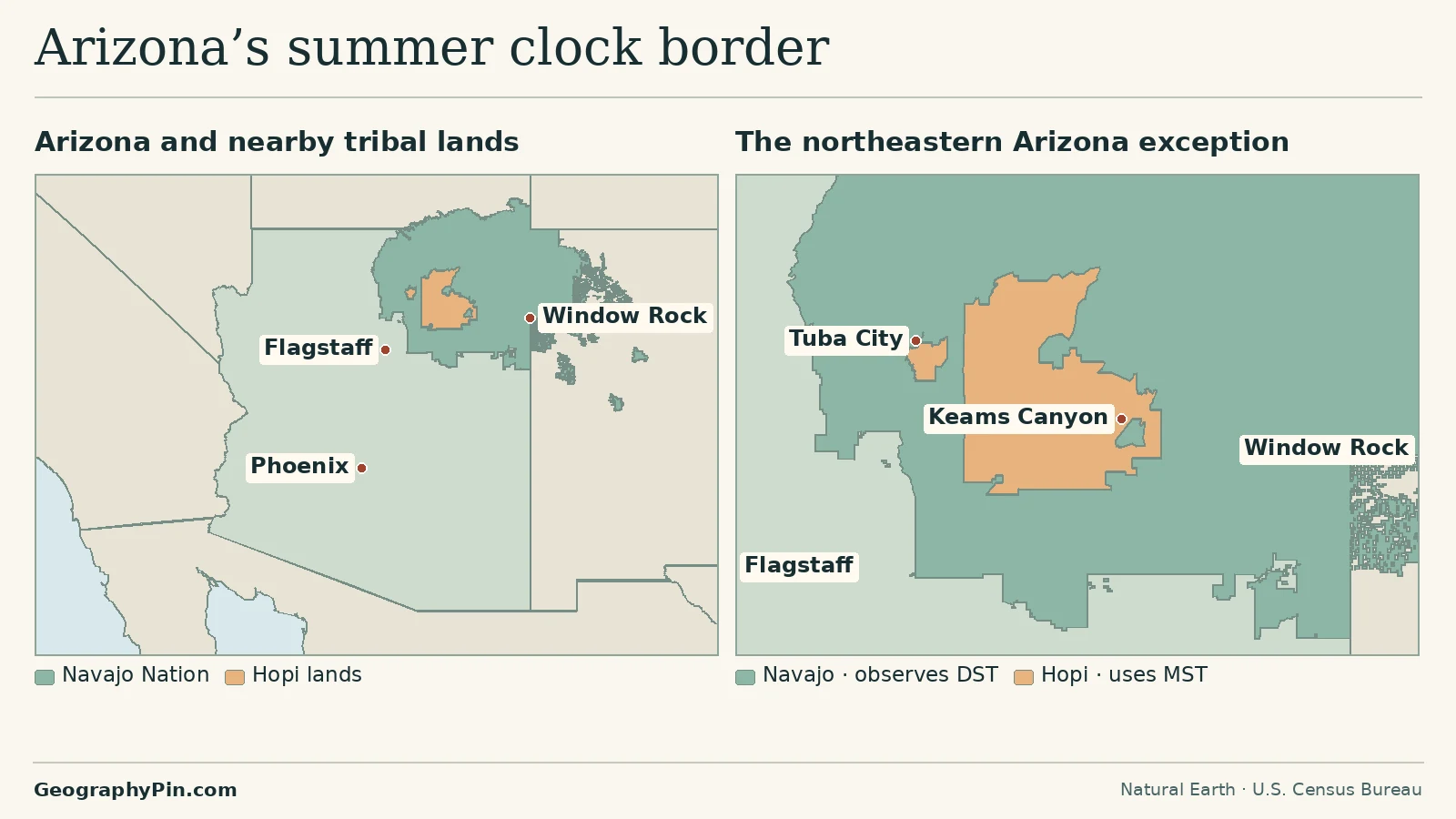
Federal rules allow states to remain on standard time. Most of Arizona uses that option. The Navajo Nation spans Arizona, New Mexico and Utah and observes the seasonal change across its territory. Keeping one seasonal schedule across the Navajo Nation produces a difference inside Arizona in summer. The Hopi Reservation in northeastern Arizona follows standard time. These distinct decisions are why a single statewide rule gives an incomplete answer.
The shape inside the shape
The Hopi areas lie within the broader Navajo region on a small-scale map, with more complex boundaries locally, including the separate Moenkopi area. County lines are poor substitutes for reservation boundaries. So is a locator pin that identifies only the nearest municipality. As a trip moves through different jurisdictions, time can change more than once without crossing a state line.
Plan a meeting in summer and then in winter
Arrange a video call for noon in Window Rock on July 15, 2026. The UTC instant is 18:00 and the call starts at 11:00 a.m. in Phoenix or Keams Canyon. Arrange it for noon in Window Rock on January 15, 2026 and it starts at noon in both other places. The seasonal change occurs in Window Rock’s offset, not in the location of the tribal or state line.
Pacific time can look identical for part of the year
In summer, Los Angeles uses Pacific Daylight Time at UTC−7, which matches the hour displayed in Phoenix. In winter Los Angeles returns to UTC−8, while Phoenix stays on UTC−7. Equal clock readings for part of a year do not make Phoenix a Pacific Time city. The U.S. time-zone map distinguishes the base zone from seasonal observance. In India’s half-hour time zone, the difference comes from the national offset itself, while Arizona’s summer variation follows daylight-saving rules.
A route that changes its summer clock twice
Flagstaff → Window Rock (Navajo Nation) → Keams Canyon (Hopi). At one summer instant, the three clocks read 11 a.m. → noon → 11 a.m. The first boundary advances the displayed time by an hour and the second takes it back. These are simultaneous readings, with no driving time added.
For a meeting, confirm the town and the local time with the host. A phone receiving a signal across a boundary can show the neighboring clock.
Frequently Asked Questions
Are Phoenix and Denver always one hour apart?
No. They generally agree in winter on Mountain Standard Time. Denver moves ahead in summer while Phoenix normally remains at UTC−7.
Which clock should I use for an event on reservation land?
Use the time specified by the local organizer and the community hosting it. A listing identified only as Arizona time may omit the Navajo or Hopi distinction.
What Did We Learn Today?
The state outline sets the scene, but the summer hour depends on the jurisdiction. In winter the clock differences disappear even though the boundaries remain exactly where they were.
Sources & Data Notes
Evidence checked November 23, 2026. The examples use January 15 and July 15, 2026, away from transition days. Tribal areas are generalized from U.S. Census boundaries. Local event times should identify the host community. Civil-time examples were checked against IANA Time Zone Database release 2026f.
- U.S. Department of Transportation, daylight saving time
- Office of the Navajo Nation President, daylight saving notice
- Hopi Tribe, tribal government and community information
- Timeanddate, Arizona and Hopi time conventions
- IANA Time Zone Database, Phoenix and the Mountain time zone
- Natural Earth, source vectors for boundaries, coasts and rivers
- U.S. Census Bureau, TIGER/Line boundary, road or water geography