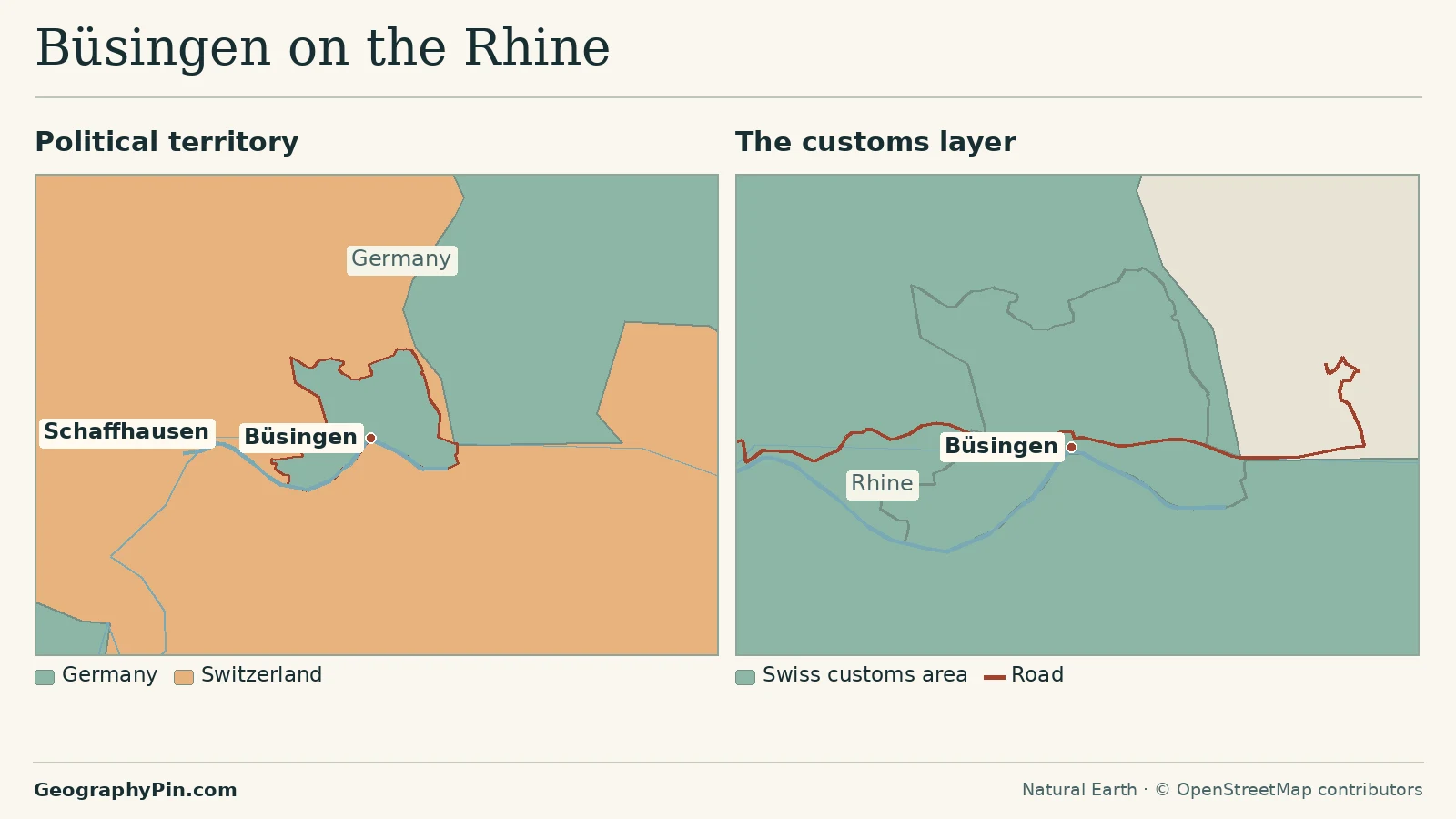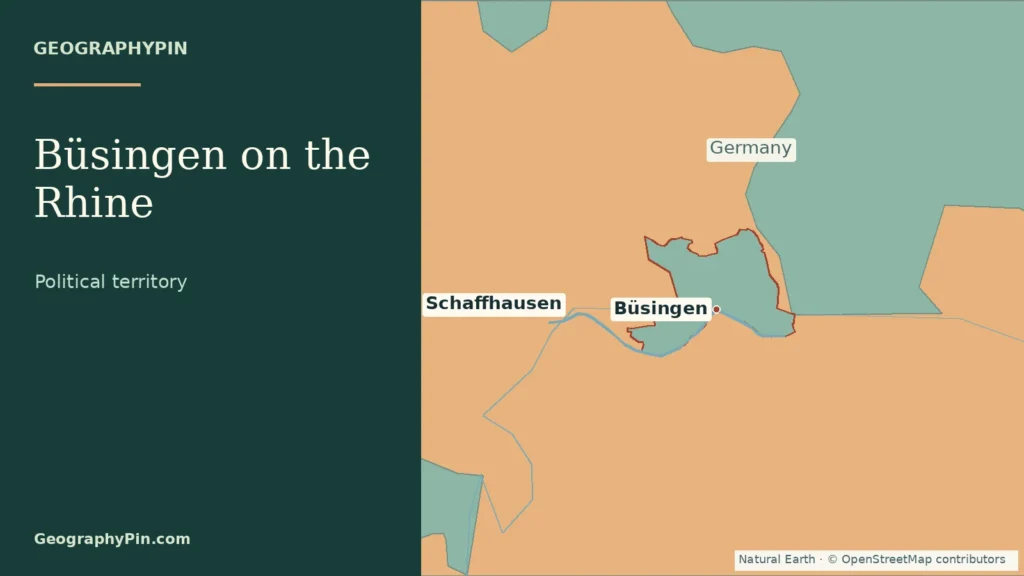
Approach Büsingen from Schaffhausen along the Rhine and a political boundary takes you into Germany. A customs map can continue to shade both places the same color. Each map is describing a different agreement.
Büsingen am Hochrhein is a German municipality surrounded by Switzerland. A bilateral treaty signed in 1964 and in force from 1967 includes it in Swiss customs territory while preserving its political membership in Germany. The Rhine locates the town, but following one bank of the river is insufficient to trace its boundary.
How to use this article: Jump to the discussion you need: Reading a parcel label in Büsingen, The treaty’s two dates or Which bank belongs to whom.
Find the German patch east of Schaffhausen
Büsingen lies on the north bank of the High Rhine, near the Swiss city of Schaffhausen. It belongs to Baden-Württemberg and the district of Konstanz. To drive from the main body of Germany into the municipality, a traveler crosses Swiss territory. Local roads connect it west toward Schaffhausen and east toward other Swiss communities.

| Question | Answer at Büsingen | What to draw |
|---|---|---|
| Which country governs it? | Germany | A closed political boundary around the municipality. |
| Which customs area includes it? | Switzerland | Continuous customs shading across the municipal border. |
| Which German state includes it? | Baden-Württemberg | An administrative link across the gap on a regional locator. |
| Where is the public road? | Along the Rhine corridor | A road crossing the political perimeter. |
Follow those two map layers along the road from Schaffhausen.
- Entering Büsingen from Switzerland. The municipal boundary takes the traveler into German territory. The customs shading continues across it.
- Continuing toward the rest of Germany. The road leaves the enclave, passes through Switzerland and reaches Germany again. At that last crossing the political boundary and the change of customs territory coincide.
Calling Büsingen an enclave and an exclave describes its territorial setting. Calling it Swiss customs territory describes how a treaty treats goods. Residents need neither a third state nor a second municipality to explain the two facts.
Reading a parcel label in Büsingen
A German place-name and a Swiss customs connection can both be appropriate on paperwork concerning Büsingen. The first follows the municipality’s political location, the second its special economic arrangements. A German postal address by itself therefore does not settle an import question. The treaty and the relevant customs authority identify the rules for goods. The nested boundaries of Madha and Nahwa show what happens when an enclave itself surrounds a second jurisdiction.
A boundary preserved through political changes
Büsingen belonged to an Austrian political sphere while nearby places became part of the Swiss Confederation. It later passed through German territorial arrangements to Baden. Local disputes and changing rulers help explain the exception. The twentieth-century treaty did not create German sovereignty there; it dealt with the practical cost of maintaining a small German municipality amid Swiss neighbors.
The treaty’s two dates
Germany and Switzerland signed the customs treaty on November 23, 1964. It took effect in 1967. Its opening provisions explicitly preserve the municipality’s political allegiance while including its territory in the Swiss customs area. A source dating the arrangement by signature and one dating it by operation can both be correct.
Why the distinction matters beside the Rhine
A resident can buy goods or travel between neighboring settlements within one customs area while crossing an international political boundary. Other questions, such as municipal elections, public administration and particular taxes, have their own rules. It is unsafe to read the word “Swiss” on a customs map as an answer to every public-service or legal question.
Which bank belongs to whom?
The Rhine is a valuable landmark, but it is not an all-purpose border symbol. Identify the municipality’s closed perimeter, then locate the river relative to it. Nearby banks and settlements are Swiss in places. A regional map of Switzerland needs a local inset to show why Büsingen differs from an ordinary settlement on Germany’s outer bank.
Frequently Asked Questions
Is the town governed by Schaffhausen canton?
No. Schaffhausen is the neighboring Swiss canton most closely associated with the town. German municipal and state institutions retain their political roles.
Would a customs union eliminate the enclave?
It can reduce the economic significance of a border for specified goods. Only a change to the political boundary would eliminate the territorial enclave.
What Did We Learn Today?
A German municipality can lie within the Swiss customs perimeter because sovereignty and customs are governed by separate instruments. On the ground, both arrangements apply to the same roads and riverfront.
Sources & Data Notes
The legal comparison follows the bilateral treaty and the municipality’s account. Local borders are shown at a different scale from the regional location.