Three places can elect legislatures and still hold very different kinds of power. To tell if a country is federal, ask which law gives its regions the authority to legislate, not what their governments are called.
Federal countries divide governing powers between a national government and constituent units under a constitution. Germany’s Länder, Canada’s provinces and U.S. states are examples of those units. The name “state” or “province” proves little: the key is whether a region has its own constitutionally assigned powers rather than only powers delegated to it.
How to use this article: Use the constitutional test, compare the source of powers in four countries, or see why an elected territory is not necessarily a state.
The constitutional test for a federal country
Ask who makes the law and who can change the rule
Constitutional examples checked November 20, 2026. The definition follows International IDEA’s constitutional design reference: the constitution gives constituent units their own powers in some fields and sets rules for sharing power in others.
- Identify the lawmaker. Can the regional legislature make its own laws in the policy area, or does a local office administer rules made somewhere else?
- Find the source. Read the constitutional provision, not just the title of the region. Does its authority follow from the constitutional allocation or from a national statute delegating power?
- Check who can change it. A constitution can give regions protections that an ordinary act of the national legislature cannot simply remove. Read the amendment and dispute rules; the strength and shape of those protections vary.
A regional assembly is evidence of self-government, not proof of federalism. The UK Parliament’s description of devolution offers a converse example: Scotland has an elected parliament with lawmaking powers, but the source and structure of those powers differ from constitutionally assigned Canadian provincial powers.
Four examples: which level can legislate?
The same question in different constitutions
| Country and units | Constitutional reading | What that looks like |
|---|---|---|
| Germany: Länder | Basic Law, Articles 30 and 70: the Länder govern and legislate where the Basic Law does not place the relevant authority with the federation. | School education is mainly the responsibility of the Länder, such as Bavaria. |
| Canada: provinces | Constitution Act, 1867, sections 91–93: Parliament and provincial legislatures have distinct fields, with education assigned to provinces subject to constitutional provisions. | Ontario’s provincial legislature can make education laws under that allocation. Canada’s territories have a different source of powers. |
| India: states | Article 246 and Seventh Schedule: Union, State and Concurrent Lists separate or share fields, with special provisions and exceptions. | Public health and sanitation are State List subjects, including in Maharashtra. |
| United States: states | Article I, section 8 lists powers of Congress. The Tenth Amendment reserves powers not granted to the United States or forbidden to states to the states or the people. | Congress has a specific constitutional power over interstate commerce. Its authority is not a general power to pass laws on every subject. |
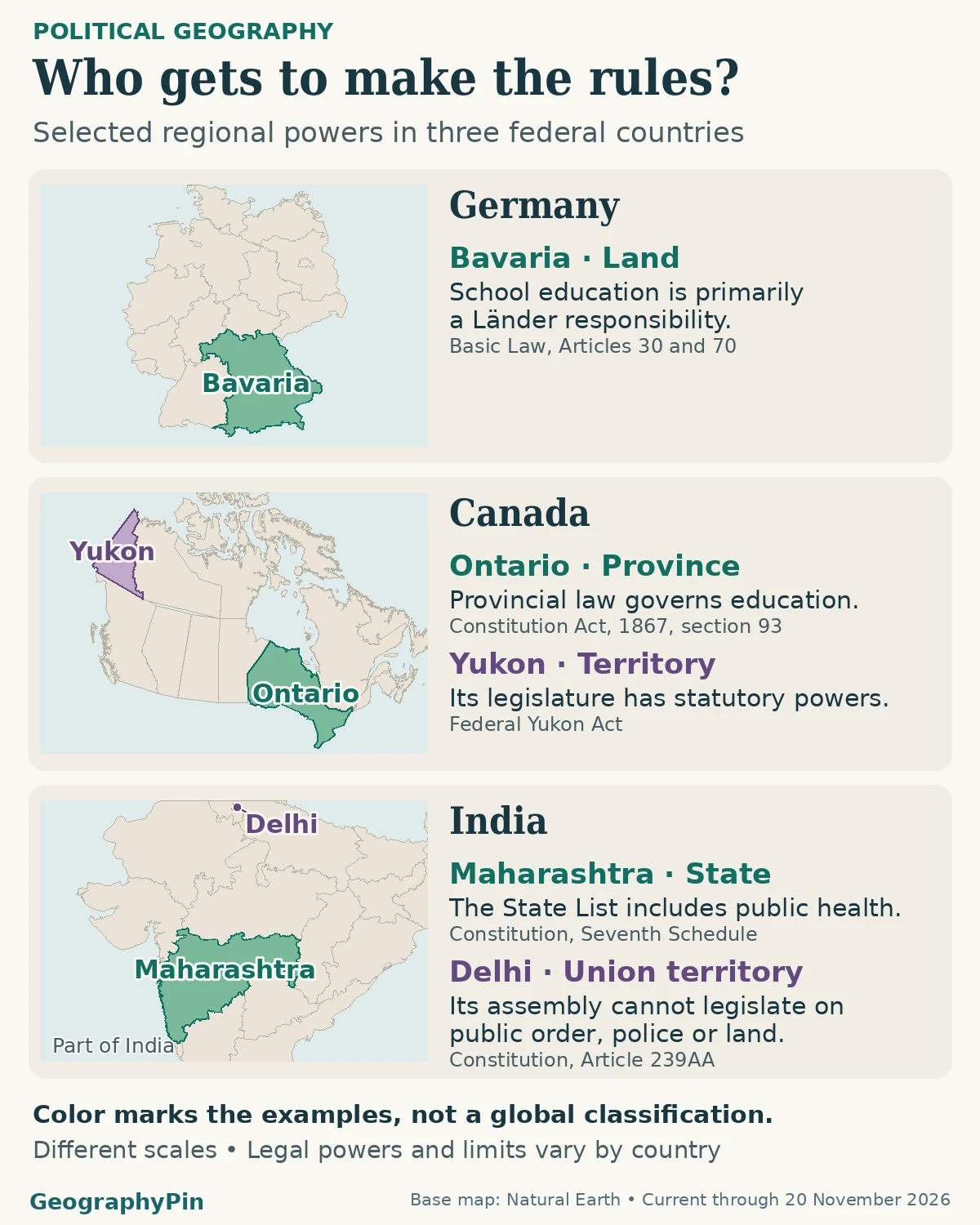
The German education ministers’ conference describes school education as primarily a Land responsibility, with coordination among the Länder. Ontario and Bavaria may both legislate on schools, but the precise legal basis differs. The table gives one matched example per constitution, not a claim that all school policy or government spending is regional.
Regional legislatures and shared government
Self-government is one side of federalism. The other is how constituent units take part in national decisions. In Germany, Articles 50 and 51 of the Basic Law provide for the Länder to participate through the Bundesrat. Its members come from Land governments, not from a separate direct Bundesrat election.
Who implements a law is another separate question. Under Article 83, German Länder generally carry out federal laws themselves unless the Basic Law provides otherwise. A Land agency administering a federal law is not exercising the same function as a Land legislature writing its own school law.
When regions in one country have different powers
Ontario versus Yukon, and Maharashtra versus Delhi
Yukon and Ontario both have elected legislatures, but Canada’s intergovernmental affairs office distinguishes territorial powers delegated under federal statutes from the powers the Constitution recognizes for provinces. Meaningful local authority does not turn a territory into a province.
For education in Ontario, see section 93 of the Constitution Act, 1867; for Yukon, see section 18(1)(o) of the federal Yukon Act. Both provide for education lawmaking, subject to conditions, but the legal source differs.
India calls itself a Union of States in Article 1. The Supreme Court of India describes the Union–state relationship as federal; that does not make every unit identical. The Seventh Schedule puts public health and sanitation on the State List. Article 239AA gives the National Capital Territory of Delhi an elected assembly but leaves public order, police and land outside its ordinary State List legislative remit, and Parliament retains authority to make laws for the territory. The Supreme Court’s 2023 explanation of Delhi’s constitutional position distinguishes the territory from a full state.
Article 3 also permits India’s Parliament to reorganize states by law after the required procedure, including referring the proposal to the affected state legislature for its views where the provision calls for it. That procedure is not a blanket veto for a state. Strong constitutional powers in assigned fields can coexist with a stronger central role in drawing internal boundaries.
Why the dates matter on a federal map
Do not read a map of today’s constituent units back into an earlier constitution. In Germany, the Unification Treaty timeline puts the extension of the Basic Law to the former East Germany at October 3, 1990. A map of the earlier federal republic and a post-unification map therefore show different sets of Länder even though the basic federal framework continued.
Likewise, a change to a region’s powers can occur without moving its outline. For historical questions, match the date of the map to the constitutional text and any law changing the powers or boundaries. There is no single date on which countries worldwide acquired one uniform federal model.
Frequently Asked Questions
Do constituent units have equal voting weight at the national level?
Not necessarily. In the U.S. Senate every state has two seats. The German Bundesrat assigns Länder between three and six votes based on population bands. The constitution of the particular federation decides the formula.
Does a federal country need a presidential system?
No. Federalism divides authority geographically, not between a president and a legislature. The Supreme Court of India describes India as both parliamentary and federal.
Does a state get its own seat at the United Nations because it is part of a federation?
No. Being a constituent state does not by itself make it a separate sovereign country or a UN member. The two uses of “state” answer different questions.
Does federal law always win when it differs from a state law?
Not simply because it is federal. First check whether the federal law falls within national authority, then apply the constitution’s rules for conflict. For instance, the U.S. Constitution’s Article VI gives supremacy to the Constitution and federal laws made pursuant to it.
What Did We Learn Today?
Federal countries divide power geographically through a constitutional framework. Regional legislatures may have their own protected powers, take part in national decisions or carry out national laws, but those roles are not interchangeable. To classify a place, read the source of its powers rather than the label on the map.
Sources & Data Notes
Examples use Germany’s Basic Law and official Länder education and Bundesrat sources, Canada’s Constitution and intergovernmental briefing, India’s constitutional text and Supreme Court materials, and the U.S. National Archives. International IDEA supplies the comparative framing. The locator shows selected cases rather than a global classification and does not imply equivalent regional powers.
Featured image: Ontario Legislative Building, Toronto, South view, DXR, April 17, 2017, CC BY-SA 4.0. Cropped, resized and converted to WebP; the adaptation remains under CC BY-SA 4.0. Map data: Natural Earth Admin 1 (public domain), shown at different local scales. The selected examples do not represent a complete comparison of federal areas.