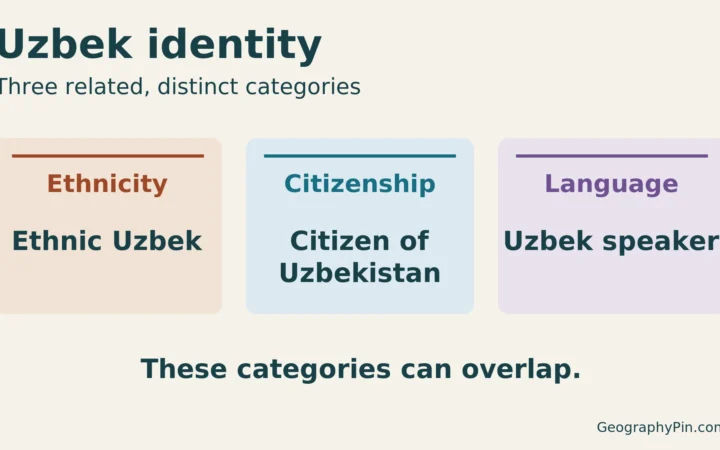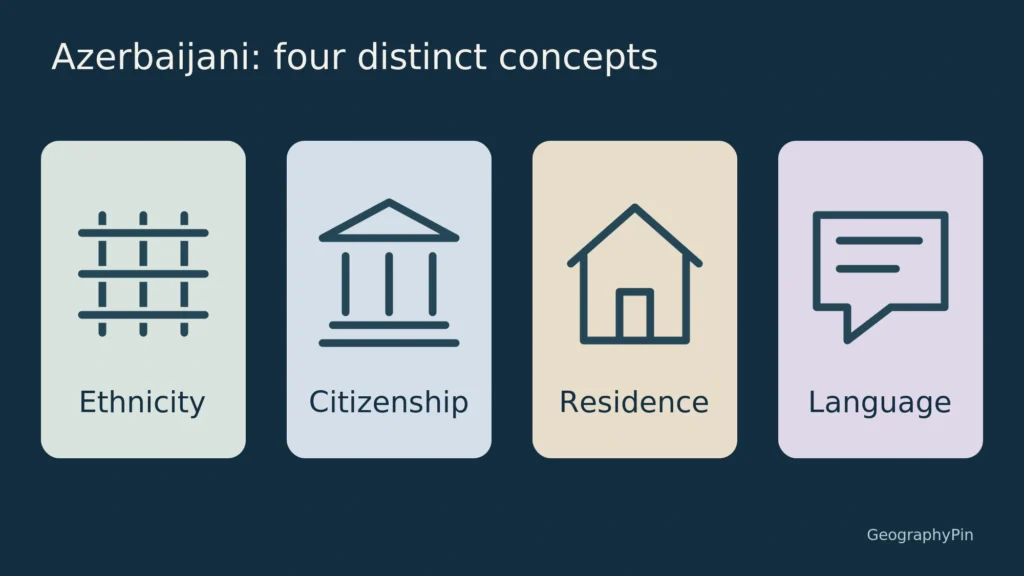
“Azerbaijani” can identify a people, describe a citizen of a country or name a language. The meaning matters: a report about Azerbaijan’s citizens is not automatically a count of ethnic Azerbaijanis, and a community outside the republic is not necessarily a community of its passport holders.
A people, a citizenship and a language
Ethnic Azerbaijanis are a people associated with Azerbaijani language and cultural traditions, including communities in the Republic of Azerbaijan, Iran and elsewhere. The word Azerbaijani can also describe citizenship of the republic. Ethnic identity, legal citizenship, residence and language use are related but separate categories; one does not automatically establish the others.
How to use this article: Compare the four meanings, distinguish Iranian Azerbaijani communities, or see the Georgia census example.
1. One word can describe different connections
Ask which connection the sentence describes
| Category | What it describes | What it does not establish |
|---|---|---|
| Ethnic Azerbaijani | A cultural and ethnic identification | A particular passport or current address |
| Citizen of Azerbaijan | A legal relationship with the republic | One uniform ethnic identity |
| Resident of Azerbaijan | Living in the country under the definition being used | Citizenship or ethnicity by itself |
| Azerbaijani speaker | Use or knowledge of the language | An exclusive identity or political allegiance |
A person can belong to several of these categories at once. That does not make them interchangeable. Someone may speak Azerbaijani at home, use another language at work and hold citizenship elsewhere; describing one connection does not cancel the others.
“Nationality” also needs context. On a travel form it often concerns citizenship; in a demographic table, “national (ethnic) composition” may classify ethnicity. Read the heading and notes before interpreting the number.
2. The people are not the same category as the state
The Republic of Azerbaijan is the state. “Azerbaijani people,” when used ethnically, is a broader identity term rather than another name for the population inside its borders. The country profile covers the state’s geography and population; the distinction here is what the label tells you about people.
The constitution treats these matters separately. Article 52 describes citizenship as a political and legal relationship involving reciprocal rights and duties. Article 21 names Azerbaijani as the official language, while Articles 44 and 45 address national identity and native-language rights. These are constitutional provisions, not a claim that identity, citizenship and language always coincide.
For a practical description, choose the category you actually know. “A citizen of Azerbaijan living abroad” is more precise than using an ethnic label when the available information concerns citizenship only. Likewise, a census ethnic category does not tell you which passport an individual holds.
3. Language connects communities across borders
Azerbaijani belongs to the Oghuz branch of Turkic languages. Gernot Windfuhr’s Encyclopaedia Iranica account describes Iranian Azerbaijani varieties associated with Tabriz, Urmia, Ardabil and Zanjan, alongside communities elsewhere in Iran. A linguistic relationship is not the same thing as citizenship of Türkiye, Azerbaijan or any other state.
Iranian Azerbaijan is not the Republic of Azerbaijan
Iranian Azerbaijani communities are part of Iran’s society, not automatically citizens of the neighboring republic. Richard Tapper’s academic account of Iranian Azerbaijan emphasizes regional diversity and Azerbaijani communities beyond the region. It does not support imagining a uniform population bounded by a single provincial outline.
The names require care. The Republic of Azerbaijan is a country; East Azerbaijan and West Azerbaijan are provinces within Iran. The West Azerbaijan province in Iran profile locates the province and distinguishes its communities from its administrative boundaries. The broader historical and cultural expression “Iranian Azerbaijan” is not a declaration of sovereignty, and a province’s name cannot establish the ethnicity of every resident.
English-language scholarship also uses “Azeri” and “Azerbaijani Turkish.” This article uses “Azerbaijani” consistently for the modern people and language. Not every Turkic-speaking community in Iran is Azerbaijani: the linguistic literature distinguishes other groups, including Qashqai and Turkmen.
4. Georgia’s census shows why the distinction matters
Two counts, two different questions
Georgia’s 2024 census results, released June 22, 2026, report 268,832 ethnic Azerbaijanis. The citizenship section separately records 8,309 citizens of Azerbaijan among foreign citizens permanently residing in Georgia.
The reference moment was midnight between November 13 and 14, 2024. Coverage excluded territories outside Georgian government control. These are census-year observations, not a count taken on the 2026 publication date.
The figures answer different questions: ethnic identification and citizenship. They are not competing estimates of one group. Do not add them together or subtract one from the other to calculate “everyone else”: the published totals do not identify the overlap between the categories.
This is why an ethnic community should not automatically be described as recent migrants from the modern republic. A citizenship total cannot supply a community’s history, and an ethnic total does not establish each person’s migration background.
5. Read population claims with their definitions attached
Azerbaijan’s State Statistical Committee distinguishes population totals, ethnic composition, native language and languages spoken fluently. A newer national population estimate does not turn an older ethnic breakdown into a newly measured one. Keep the observation date attached to the category.
Iran presents another measurement problem. In their 2019 research on Iranian provinces, Andrew Ledford and Scott Lynch described the difficulty of obtaining ethnicity data and their use of survey evidence. That study is not a current ethnic census. A precise Iranian Azerbaijani total would need its own dated definition and defensible measurement, not simply a province’s population.
Before repeating a claim, ask three questions: does it count ethnic identification, speakers or citizens; what territory does it cover; and when were people actually counted? Those checks make comparisons more useful without reducing someone’s identity to a single statistic.
What Did We Learn Today?
Azerbaijani identity is not confined to one passport category or provincial boundary. Ethnicity, citizenship, residence and language describe different connections, and a careful description states which one it means. Georgia’s census makes the distinction visible; Iranian communities show why the name of a state cannot stand in for the full geography of a people.
Sources & Data Notes
View identity and census sources
Sources checked November 18, 2026. Georgia’s figures refer to the 2024 census, published in 2026. Older academic works supply linguistic and regional context, not present-day population totals. No global or Iranian ethnic count is asserted, and no ethnicity is inferred from an individual’s language, appearance or citizenship.
- Azerbaijan Constitution: language, identity and citizenship
- State Statistical Committee: demographic categories
- Geostat: main results of the 2024 census, pages 2, 12 and 13
- Richard Tapper, Iranica: Iranian Azerbaijan (1988)
- Gernot Windfuhr, Iranica: Turkic languages of Iran (2006)
- Ledford and Lynch: Iranian provincial research (2019)
The conceptual cover was created by GeographyPin to distinguish four categories; its symbols do not depict specific people or imply that any one category determines the others.