A country can add urban residents without becoming more urbanized. To read a population chart correctly, separate the number of people from their share of the total, then check what the source counts as urban.
Urbanization is an increase in the share of a population living in urban areas; urban growth is an increase in the number of urban residents. They often occur together, but either can happen without the other. Compare counts and percentages using consistent boundaries, dates and definitions.
How to use this article: Compare the worked examples, separate percentage points from percentages, then check the urban definitions.
Counts, Shares, and Growth Rates
Urbanization describes an increasing proportion of people living in urban areas. The UN DESA glossary uses this demographic meaning. The proportion at one moment is the level of urbanization; a high level does not necessarily mean rapid change.
Urban population growth measures the increase in urban residents. It can be stated as people added or as a percentage increase in that population. Here, “urban growth” means population growth, not expansion of buildings or developed land.
| Question | Urban growth | Urbanization |
|---|---|---|
| What changes? | Number of urban residents | Urban share of total population |
| What is compared? | Urban population at two dates | Urban percentages at two dates |
| Must both happen? | No; the share may stay unchanged | No; total population may decline |
For a country, count everyone classified as urban, not just residents of its largest city. These questions belong to both population and urban studies within the branches of human geography.
Three Worked Population Examples
Start with the Same Population
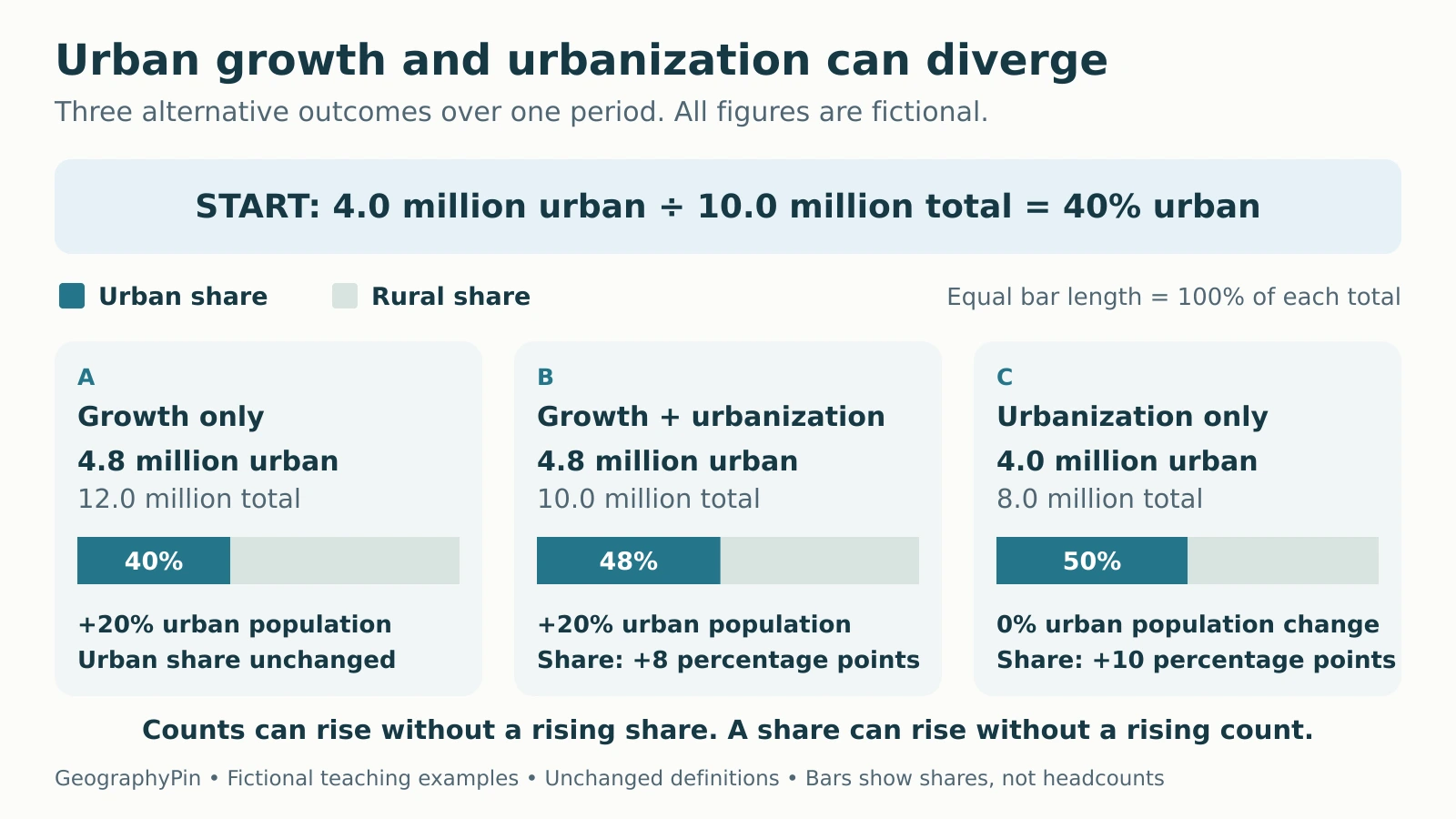
Imagine a country with 4 million urban residents and 10 million people altogether. Its urban share is 4 ÷ 10 × 100 = 40%. The following are alternative outcomes over the same unspecified period, not successive years or real countries. Definitions stay unchanged.
| Outcome | Urban / total population | New urban share |
|---|---|---|
| A: Growth only | 4.8 million / 12 million | 40% |
| B: Growth and urbanization | 4.8 million / 10 million | 48% |
| C: Urbanization only | 4 million / 8 million | 50% |
In A, the urban population rises by 800,000, or 20%, but the total also rises by 20%. In B, the same urban increase produces urbanization because the total is unchanged. In C, the urban count stays fixed while the rural population falls, lifting the urban share.

Percentage Points Are Not Percent Growth
From 40% to 48% is an increase of 8 percentage points. The relative increase in that share is 8 ÷ 40 × 100 = 20%. State which measure you mean.
For simple population growth over a period, calculate (new urban population − old urban population) ÷ old urban population × 100. This is a period change, not an annualized rate. Check a dataset’s method before comparing published annual growth rates.
Why Urban Populations Change
UN DESA’s definition and methodology explanation identifies several processes behind settlement growth:
- Natural increase: births exceed deaths among urban residents. Natural decrease occurs when deaths exceed births.
- Net migration: more people move into an urban population than leave it. Rural-to-urban moves and international migration can add residents; flows in the opposite direction can reduce the total.
- Reclassification and boundary changes: previously rural settlements may be counted as urban, or a city’s boundary may incorporate neighboring communities.
A reclassified resident need not have moved house. Likewise, a move between two urban places within the same country can enlarge one city without changing the country’s total urban population. Natural increase does not automatically raise the urban share: the rural population’s change also matters.
There is no universal percentage split among these causes. Their contributions depend on the place, period and classification. A growing city alone cannot demonstrate national urbanization.
Definitions Can Change the Answer
National Rules and a Common UN Measure
National agencies may use administrative status, population, density or other settlement characteristics to define urban areas. The World Bank’s national-definition indicator warns that cross-country comparisons require care.
World Urbanization Prospects 2025 adds the harmonized Degree of Urbanization, or DEGURBA, alongside national definitions. It applies common spatial criteria to distinguish cities, towns and semi-dense areas, and rural areas. It does not replace every country’s own classification.
A share living in DEGURBA cities is different from a share living in cities plus towns and semi-dense areas. Do not splice those categories, or national-definition figures, into one trend without checking comparability.
The U.S. Census Shows Why This Matters
The U.S. Census Bureau reported that the urban population increased 6.4% between 2010 and 2020, yet the reported urban share fell from 80.7% to 80.0%. It attributed the small share decline largely to changed classification criteria, rather than substantial urban-to-rural migration.
This is a warning about measurement, not a clean experiment using unchanged boundaries. Before interpreting a trend, check the population dates, the definition of urban and whether earlier figures were adjusted to match later rules.
Population Growth Is Not Land Expansion
More residents can occupy an existing built-up area through denser housing or greater occupancy. Developed land can also expand faster than population. A bigger footprint, more residents and a rising national urban share are three different observations.
Keep the geographic unit consistent too: a municipality and the surrounding urban agglomeration may cover different populations. Changing from one boundary to another can create apparent growth.
The distinction matters for human geography and planning. Counts help describe the scale of housing and service needs; shares describe population distribution. UN-Habitat emphasizes planning for housing, transport, water and sanitation. Neither measure alone tells planners where that demand will occur.
Frequently Asked Questions
Can urbanization occur while the urban population shrinks?
Yes, if the total population shrinks proportionally faster. In another fictional example, 4 million urban residents out of 10 million become 3.6 million out of 8 million. The urban count falls 10%, but its share rises from 40% to 45%. This describes a relative shift, not urban population growth.
What Did We Learn Today?
Read the count, calculate the share, and inspect the definition before explaining a trend. Urban population growth need not raise the urban share, and a rising share need not mean more urban residents. Separate demographic change from reclassification and land expansion.
Sources & Data Notes
Worked examples and diagram are fictional and use unchanged definitions. U.S. figures compare the 2010 and 2020 classifications; they are not directly comparable measures under one fixed rule. WUP 2025 supplies the international methodological context. No global urban percentage or projection is implied.
- UN DESA: WUP 2025 Glossary of Demographic Terms
- UN DESA: Methodology: Definition Issues
- UN DESA: World Urbanization Prospects 2025 FAQs
- U.S. Census Bureau: Nation’s Urban and Rural Populations Shift Following 2020 Census
- World Bank: Urban population (% of total population) metadata
- UN-Habitat Fukuoka: What is Urbanisation?