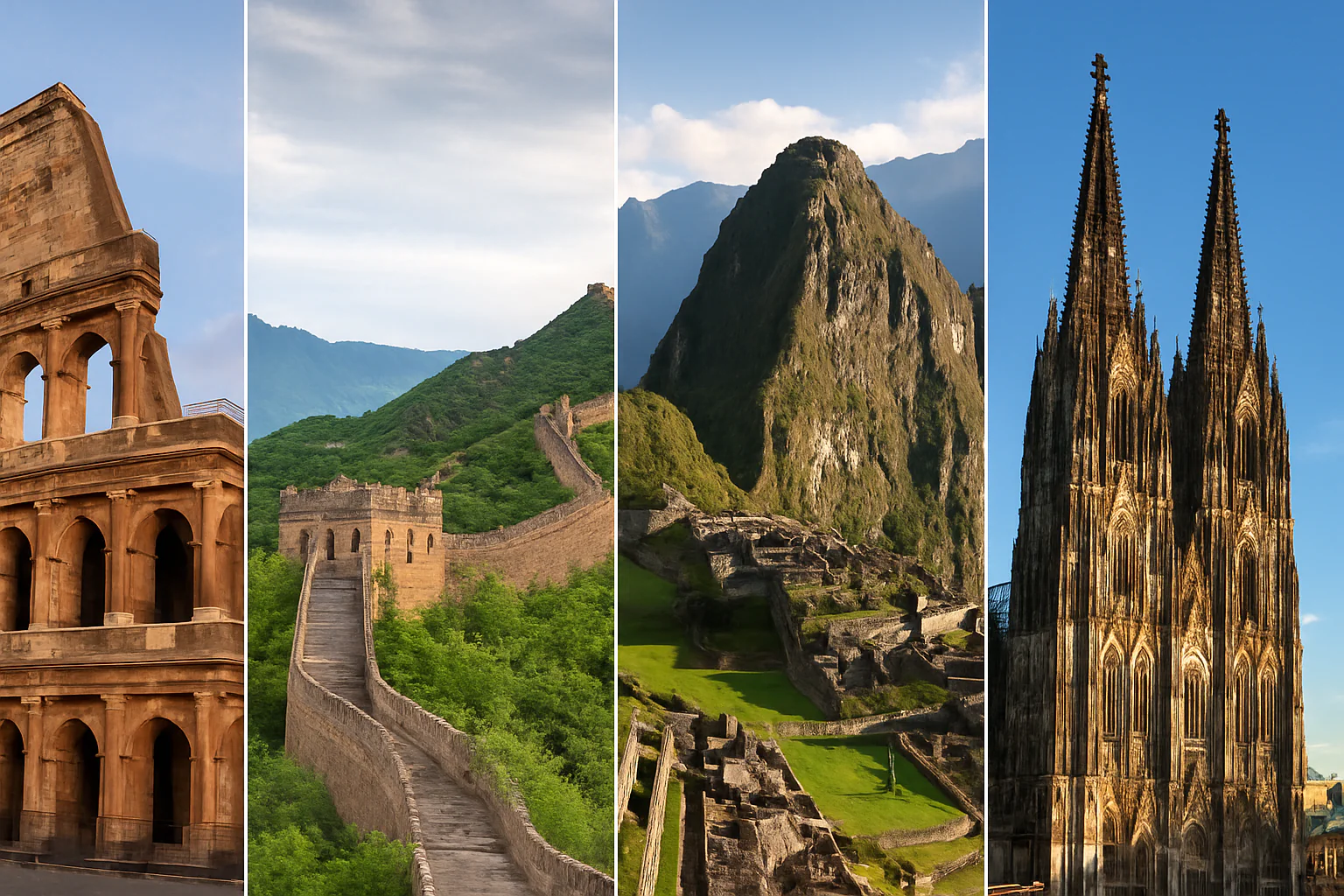
UNESCO’s World Heritage List is not a simple prestige scoreboard, but country totals do show where large clusters of officially inscribed cultural, natural, and mixed properties are concentrated. As of March 2026, UNESCO’s country pages place Italy first, China second, and Germany third.
The countries with the most UNESCO World Heritage Sites are Italy, China, and Germany. UNESCO’s current state-party pages show Italy with 61 properties, China with 60, and Germany with 55, followed by France with 54 and Spain with 50; those totals combine cultural, natural, and mixed properties credited to each state party.
How to use this article: Start with the current ranking table, jump to how UNESCO actually counts sites, use why totals change to avoid common confusion, or skip to the top-three snapshot for the fastest interpretation.
Top 10 Countries by UNESCO Sites
The ranking below updates the older 2025 version of this article. UNESCO’s current country pages now show several higher totals than the pasted draft used, including Italy at 61, France at 54, India at 44, Mexico at 36, and Russia at 33.
Current ranking table
| Rank | Country | Total Sites | Cultural | Natural | Mixed |
|---|---|---|---|---|---|
| 1 | Italy | 61 | 55 | 6 | 0 |
| 2 | China | 60 | 41 | 15 | 4 |
| 3 | Germany | 55 | 52 | 3 | 0 |
| 4 | France | 54 | 45 | 7 | 2 |
| 5 | Spain | 50 | 44 | 4 | 2 |
| 6 | India | 44 | 36 | 7 | 1 |
| 7 | Mexico | 36 | 28 | 6 | 2 |
| 8 | United Kingdom | 35 | 29 | 5 | 1 |
| 9 | Russia | 33 | 22 | 11 | 0 |
| 10 | United States | 26 | 13 | 12 | 1 |
This is a state-party ranking, not a count of fully unique places detached from country attribution. UNESCO’s own statistics note that transboundary sites are counted in the totals of participating states, so a shared property can appear in more than one national column.
Why the totals change
Country totals move when the World Heritage Committee inscribes new properties, approves extensions, or updates how properties are recorded across states parties. That is why older roundups age quickly: UNESCO’s current pages show recent additions in countries such as Italy, France, India, and Russia, which pushes today’s ranking above the numbers many 2025 lists still show.
How UNESCO Counts and Classifies Sites
A World Heritage Site is not added because it is simply famous or old. UNESCO says a property must have Outstanding Universal Value and meet at least one of ten selection criteria before it can be inscribed on the World Heritage List.
From tentative list to inscription
- Tentative List first: a country cannot nominate a property unless it already appears on that state party’s Tentative List.
- Nomination file: the state party prepares the formal nomination dossier and submits it to the World Heritage Centre.
- Expert evaluation: ICOMOS and IUCN provide the main independent evaluations for cultural and natural nominations, while UNESCO’s advisory system includes ICCROM as well.
- Committee decision: the World Heritage Committee meets once a year and makes the final inscription decision.
- Monitoring after inscription: listed sites remain under conservation scrutiny through state of conservation procedures and periodic reporting on a six-year regional cycle; threatened properties can be placed on the List of World Heritage in Danger.
Cultural, natural, and mixed
UNESCO’s country totals usually combine three buckets: cultural, natural, and mixed. Mixed properties are the rare cases that satisfy both the cultural and natural definitions of the Convention rather than fitting only one side.
That matters when you compare countries. Italy and Germany are overwhelmingly cultural in their current totals, while China carries a broader spread across cultural, natural, and mixed properties; the United States, by contrast, has an unusually large natural share relative to its total.
So the country table should not be read as a simple measure of “most important heritage.” In practice, it reflects how many properties have been nominated, evaluated, and inscribed for a given state party, plus how shared properties are attributed in UNESCO’s statistics.
Highlights from the Leaderboard
The raw totals become more useful once you look at their internal mix. Italy leads because of an exceptionally deep cultural stack, China stays close because it combines scale with variety, and Germany’s total is driven by a dense concentration of cultural properties.
Italy
Italy now stands at 61 World Heritage properties, with 55 cultural and 6 natural. That profile tells you exactly why it leads: the country is packed with long-recognized urban, archaeological, and artistic sites, from the historic centres of Rome and Florence to the archaeological areas of Pompeii, Herculaneum, and Torre Annunziata.
China
China’s 60 properties are more balanced: 41 cultural, 15 natural, and 4 mixed. That mix helps explain why China stays close to Italy while looking very different on the ground, spanning imperial and archaeological sites on one side and mountain, karst, and mixed sacred landscapes on the other.
Germany
Germany holds 55 properties, and 52 of them are cultural. Its ranking is built less on natural-area volume and more on churches, historic towns, frontier remains, industrial landscapes, and architectural ensembles such as Aachen Cathedral, Cologne Cathedral, and the Roman frontier listings.
Just outside the top three, France remains close enough to matter at 54, while Spain stays solidly fifth at 50. After that, the gap opens more clearly: India sits on 44, Mexico on 36, the United Kingdom on 35, Russia on 33, and the United States on 26.
FAQ
How often does UNESCO add new sites?
The World Heritage Committee meets once a year and decides which nominated properties will be inscribed, deferred, or sent back for more work. That annual cycle is why country rankings can shift from one committee session to the next.
Do shared sites count for more than one country?
Yes. UNESCO’s state-party statistics attribute transboundary properties to the participating countries, so a shared site can appear in more than one national total.
What is a mixed World Heritage Site?
A mixed site is one that satisfies both the cultural and natural definitions used by the Convention. It is not just a scenic place with history attached; it has to qualify on both sides of UNESCO’s framework.
Can a site be removed from the list?
Yes, although it is rare. UNESCO can place threatened properties on the List of World Heritage in Danger, and if a site loses the characteristics that justified inscription, the Committee can ultimately delete it from the World Heritage List.
Why is the United States lower than several European countries?
Because this ranking reflects UNESCO inscriptions, not general historical importance or tourism popularity. The United States has a relatively small total of 26, but nearly half of those are natural properties, which gives it a very different profile from countries whose totals are built mainly on cultural sites.
What Did We Learn Today?
The countries with the most UNESCO World Heritage Sites are not just the ones with famous landmarks, but the ones whose cultural, natural, and sometimes shared properties have moved successfully through UNESCO’s nomination and monitoring system over time. Right now that puts Italy first, China second, and Germany third, but the deeper point is that these rankings change as new inscriptions, extensions, and state-party updates reshape the table.
Sources & Data Notes
For this piece, I checked UNESCO’s own state-party pages first, then used UNESCO guidance pages on criteria, nominations, statistics, and monitoring to make sure the ranking logic matched the way the World Heritage system actually works. Country totals can shift after committee sessions, extensions, or shared-property updates, so newer releases may change some details, and a few figures here are presented in rounded editorial form where that keeps the article cleaner. I sometimes use AI to tighten wording or structure, but the factual backbone here comes from UNESCO material rather than travel-list recycling.