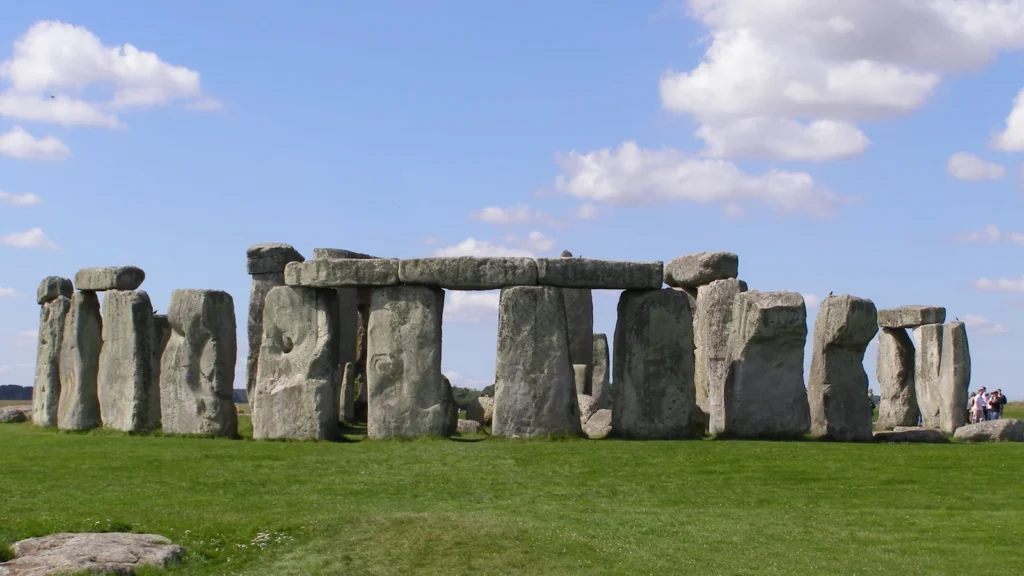
If you could visit Stonehenge around 3000 BCE, you would not see the circle of tall stones that stands there today. The first major monument was a circular earthwork. The centuries between its ditch and the famous stone settings are the clearest clue to who built the site.
Prehistoric communities in Britain built Stonehenge in stages. Late Neolithic people dug the first major earthwork around 3000 BCE. Later generations raised most of the famous stones around 2500 BCE and altered the site again. Archaeology can date these phases, but it cannot name their builders. The main work predates the historical Druids.
How to use this article: Compare the three building phases, see why the Druid story doesn’t fit the dates, or learn what the stones reveal about where they came from.
1. Three Traces Left by the Builders
The ditch, the stone settings and the Avenue
| Date | Physical trace | What it tells us |
|---|---|---|
| c. 3000 BCE | Ring of earth banks and a ditch; 56 pits just inside the bank. | The first major enclosure predates the familiar stone circle. |
| c. 2500 BCE | Large sarsen uprights and stone crosspieces; smaller bluestones. | Later builders organized workers to shape and raise the stones. |
| 2300–2200 BCE | New positions for the bluestones; the Avenue toward the River Avon. | People kept adapting the monument and tied it to the river landscape. |
The ditch and the stone circle are roughly five centuries apart. That is too long for a single generation but does not tell us whether later builders descended from the first or had the same beliefs. The 56 pits, called the Aubrey Holes, are a good example of the limit: their positions survive, but scholars disagree over whether they once held timber posts or stones.
2. What Archaeology Can Say About the People
Stonehenge stands on Salisbury Plain in Wiltshire, in southern England. The names of its prehistoric builders are unknown, but the surrounding landscape contains evidence of the people who lived, gathered and buried their dead there. Early cremations show that the enclosure served as a burial place. Later, near the time the large stones went up, people lived in houses at nearby Durrington Walls. Archaeologists found pottery and evidence of feasting there. Those finds reveal a community in the landscape, not a roster of who worked on the stones.
A buried bone or piece of charcoal with a clear relationship to a feature can help date that feature. It cannot tell us a builder’s name, and a date on a burial does not prove that the buried person helped build the monument. The strongest conclusion comes from comparing several kinds of evidence rather than treating any one object as a signature.
Why the Druid story came later
John Aubrey and William Stukeley, early investigators of Stonehenge, helped popularize the idea that Druids built it. The Druids known from classical accounts belong to Iron Age Britain, well over a thousand years after the main stone settings. That rules them out as the original builders. It is a different question from how ancient or modern people might have used the monument after it was built.
3. Where the Stones Came From
A geological match is not a transport route
- The large sarsens: A sample from one upright matched rock at West Woods near Marlborough, about 15 miles (24 km) north of Stonehenge. Most of the surviving sarsens share similar chemistry, making West Woods the best-supported source for the main group, not necessarily for every stone.
- Some of the smaller bluestones: Geological matches and excavations point to outcrops in the Preseli Hills of west Wales, including Carn Goedog and Craig Rhos-y-felin. Those findings do not put every bluestone at the same quarry or establish when each arrived.
- The Altar Stone: This sandstone slab is separate from the Welsh examples. A 2024 study traced its geological origin to the Orcadian Basin in northeast Scotland. A 2026 study narrowed the likely areas on the Scottish mainland but did not identify an exact source or prove how the slab moved.
Compare a stone with a rock outcrop and you may learn where the material formed. That does not establish where people first picked it up, what they carried it on or which way they went. The 2026 study considered whether ice could have moved the Altar Stone partway, under specific conditions. Even its favorable scenario leaves roughly 250 miles (400 km) of later movement by people. The exact route remains unknown.
Frequently Asked Questions
Were there stones at Stonehenge before 2500 BCE?
Possibly. Some archaeologists think bluestones stood in at least some of the Aubrey Holes around the time of the first ditch. The large arrangement recognizable today belongs to a later phase. The early pits alone do not settle whether they held stones or timber.
When did people stop changing Stonehenge?
Work did not simply end once the Avenue was built. Among the last known prehistoric works were two rings of pits dug outside the stone circle, dated by antlers found in them to about 1800–1500 BCE. They may have been intended for a rearrangement that never happened.
Was Stonehenge built as a cemetery?
We know people buried cremated remains there early on. That makes burial one established use, but it does not tell us whether the enclosure was built only for burials, or why later generations erected the large stones.
What Did We Learn Today?
Stonehenge was built and changed by successive prehistoric communities, not a single crew. The ditch, stone settings and Avenue let us put some of their work in order, without telling us their names. And a stone’s geological origin, even when well supported, is not a record of the journey it took.
Sources & Data Notes
Archaeological dates, stone provenance and image credit
The table follows English Heritage’s approximate construction dates. The dates of ditch digging, quarrying a stone, setting it upright and moving it again refer to different events.
- English Heritage: construction timeline; monument history and Aubrey Holes; history of research, including Durrington Walls and the Druid attribution.
- English Heritage’s report on the 2020 sarsen study; Parker Pearson and coauthors on the Preseli quarries.
- Clarke and coauthors: 2024 Scottish provenance study (full paper) and 2026 analysis of possible source areas and transport.
- Cover: Stonehenge, photographed by garethwiscombe, July 2007, cropped under CC BY 2.0.