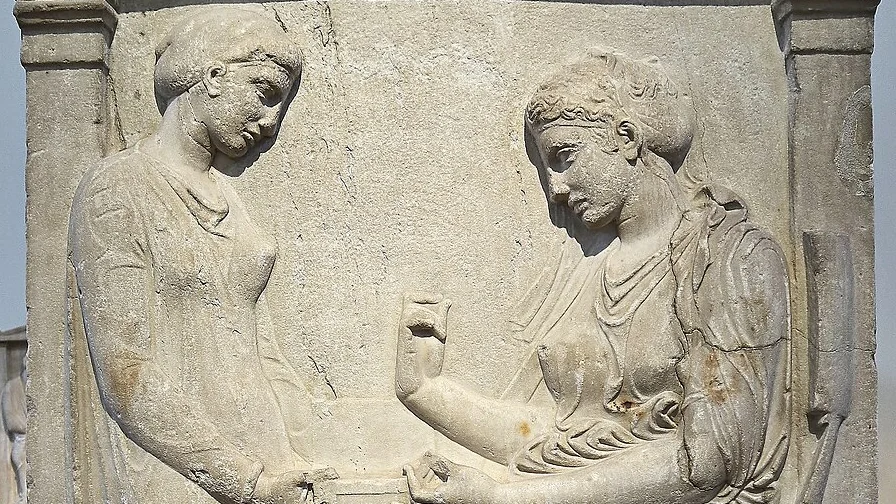
An Athenian priestess could be paid by the city but could not vote in its assembly. In Sparta, women could hold significant property without gaining an assembly vote. Comparing the two city-states means asking separate questions: Who made decisions, who held property, and whose labor kept each system going?
Athens gave its adult male citizens direct power to debate and vote on public decisions. Sparta also had a male citizen assembly, but kings, elders and elected officials shared power with it. Both excluded women, free noncitizens and enslaved people from assembly voting, though those groups had different rights and roles in each society.
How to use this article: Compare rights and obligations side by side, follow two actual assembly votes, or see why owning property did not mean holding political power.
1. Who Had Rights in Athens and Sparta?
Voting, work and property around 430 BCE
| Question | Athens | Sparta |
|---|---|---|
| Full political membership | Adult men admitted to Athenian citizenship. After Pericles’ law of 451/450 BCE, Athenian parentage on both sides was generally required. | Adult male full citizens, known as Spartiates. Free residents of neighboring communities were not Spartiates. |
| Political participation | Citizen men could speak and vote in the assembly, which made decisions directly. | Full citizen men took part in the assembly; kings, the council of elders and magistrates called ephors also held power. |
| Free noncitizens | Metics were free registered residents from outside the citizen body. They could work or trade but had no assembly vote. | The perioikoi were free members of surrounding communities under Spartan authority. They could serve in the army but did not vote in Sparta’s assembly. |
| Coerced labor | Enslaved people could be owned and sold, as the records of an Athenian auction show. They had no vote. | Helots were a subordinated population whose coerced agricultural labor supported Spartan households. They had no vote. |
| Land and other property | Male citizens could hold land; free noncitizens generally needed an exceptional grant. Women could benefit from family property and dowries, but had limited independent control over estates. | Spartan women could hold substantial landed wealth. This did not qualify them to vote. The evidence does not establish a reliable share of land held by women in 430 BCE. |
A polis was a self-governing community centered on a city, not just the buildings inside it. Athens governed Attica, which included the port of Piraeus. Sparta lay in Laconia in the southern Peloponnese, and its power extended west into Messenia. The Greece country profile shows the Attica and Peloponnese setting on a modern map. The table describes the classical period; citizenship rules and property arrangements did not stay fixed for all of antiquity.
2. How Athenians and Spartans Made Decisions
Two assemblies faced decisions about war
In 427 BCE, the Athenians met after the revolt of Mytilene, a city on the island of Lesbos. The assembly first ordered the death of the city’s adult men. The following day it debated the punishment again and narrowly reversed course. A second ship was sent after the first with the new instructions. This was direct democracy at work: eligible citizens did not elect someone to cast this vote for them. They could hear the argument and take the decision themselves. The people of Mytilene did not vote on it.
At Sparta in 432/431 BCE, the assembly considered whether Athens had broken a truce. Sthenelaidas, one of Sparta’s ephors, said he could not judge which side shouted louder. He told the two sides to stand in different places. In Thucydides’ account, a clear majority went to the side that held Athens responsible. This was a real assembly decision, but it was not a vote by everyone who lived under Spartan authority, nor did it by itself settle what Sparta’s allies would do.
Calling Sparta an oligarchy, meaning rule concentrated in a small group, makes sense if you ask who wielded power. It does not mean there was no assembly. Sparta had two kings, a council of elders and ephors in addition to its assembly. The difference is not simply that Athenians voted and Spartans did not. The two cities organized the power of those allowed to vote quite differently.
3. Whose Work Sustained Each City-State?
Freedom and political membership were separate. An Athenian metic could have a household, do business and own goods despite being unable to vote. In 414 BCE, the city recorded an auction of confiscated property that included enslaved people formerly held by Kephisodoros, a metic living at Piraeus. The same inscription identifies a free resident by name and lists the people he held, often by origin and sale price. Neither had an assembly vote, but that was one of the few things their statuses had in common.
Sparta’s free perioikoi were members of surrounding communities rather than the equivalent of outsiders registered in Athens. Herodotus distinguishes them from full Spartan citizens in the forces at Plataea in 479 BCE. A person could serve alongside Spartans without acquiring the same political rights.
The helots, by contrast, were subject to coerced labor. Their agricultural work helped support the Spartan citizen system. Some also served in war: Thucydides records that Sparta sent 700 helots as heavy infantry with Brasidas in 424 BCE. That detail matters because it shows that military service, like farming, could be demanded without bringing political membership. Neither that deployment nor the Athenian auction describes every enslaved person’s life.
4. Could Women Own Land or Hold Public Roles?
Land, family wealth and public service were separate
Athenian women were essential to the transmission of civic status under the two-parent rule, even though they could not vote. A dowry could give a woman a claim on family wealth without giving her the same power to sell or dispose of an estate as a man. That is why “Athenian women owned nothing” is misleading. Athenian rules could distinguish the right to benefit from property, the power to manage it and the right to dispose of it.
There were limits for free noncitizens, too. A fragmented decree for Herakleides of Klazomenai grants him a right to own real property. Some words and the dating are disputed. Its point for this comparison is limited but useful: Athens could confer a right that did not follow automatically from simply living there.
Spartan women had more scope to hold landed wealth. In the fourth century BCE, Aristotle claimed that women held nearly two-fifths of the land, which he associated with inheritances and large dowries. He was criticizing the concentration of Spartan property, not reporting a fifth-century land survey. The passage is evidence that women could hold substantial land, not a reliable percentage for the period of the table or a measure of how many women owned any land at all.
Property was not the only kind of power. Athens publicly paid the priestess of Athena Nike, although no woman could take an assembly vote. That office is an example of civic participation through a religious institution. It was not an alternative route into the assembly.
5. What Two Ancient Sources Leave Out
Athens: Payment for a priestess
A stone decree, probably from 424/423 BCE, tells officials to pay the priestess of Athena Nike 50 drachmas. Myrrhine’s gravestone identifies her as the first priestess and records that she was selected by lot.
What it leaves out: The decree records a public obligation and the gravestone commemorates an officeholder. Neither tells us how Myrrhine felt about the work or how common such opportunities were.
Sparta: A decision made by standing apart
In his account of the Spartan assembly of 432/431 BCE, Thucydides describes an ephor replacing a shouted vote with a physical division. The scene shows that the assembly could decide an important question and that an official could shape how the decision was reached.
What it leaves out: Thucydides was an Athenian historian. He supplies his own explanation of the ephor’s motive and does not give us a record of how ordinary citizens, Spartan women, perioikoi or helots understood the decision.
Frequently Asked Questions
Could someone born in Athens vote just because they were born there?
No. Birthplace alone did not qualify a person. Male voters needed formal citizenship, and the rule associated with Pericles generally required Athenian parents on both sides. A woman from an Athenian family could transmit civic status to her children without herself becoming an assembly voter.
Were Spartan helots and enslaved Athenians the same?
Both were subject to coercion and excluded from political power. But the Spartan system depended on a subordinated population, notably in Laconia and Messenia, whose labor supported citizen households. The Athenian auction, by contrast, documents individuals held and sold as property. One label should not erase the different arrangements.
Did owning land give Spartan women political rights?
No. Control of property and the right to participate in the assembly were distinct. The evidence of female landholding shows an economic difference from Athens, not a Spartan rule allowing women to vote.
What Did We Learn Today?
Athens and Sparta both relied on people who had no assembly vote. Athens allowed male citizens to decide policy directly, while Spartan citizens shared decision-making with powerful officeholders. Looking separately at voting, land, labor and religious office explains what the labels “democracy” and “oligarchy” leave out.
Sources & Data Notes
Primary sources, historical context and image credit
- Athenian Constitution, sections 26 and 42–43: the earlier citizenship law and the author’s later description of civic registration and government.
- Thucydides 1.87, 3.36–50 and 4.80: the Spartan assembly, Mytilene and helot soldiers, respectively.
- Herodotus 9.11 and 9.28: the Spartan and perioikic contingents in the Greek force at Plataea.
- Attic Inscriptions Online: payment decree for the priestess of Athena Nike, Myrrhine’s gravestone, the 414 BCE Attic property sale, and the decree honoring Herakleides.
- Lin Foxhall, “Female Inheritance in Athenian Law”; Aristotle, Politics, Book II. These sources clarify distinct powers over property and the limitations of the Spartan landholding estimate.
- The cover shows the late fifth-century BCE grave stele of Hegeso, with Hegeso seated and an attendant holding a box. It does not depict Myrrhine. Photo by George E. Koronaios, cropped and distributed under CC BY-SA 4.0.
The table centers on the decades around 430 BCE and distinguishes direct contemporary evidence from the later accounts used to interpret property rights. It does not use uncertain ancient population figures to calculate what share of residents could vote.