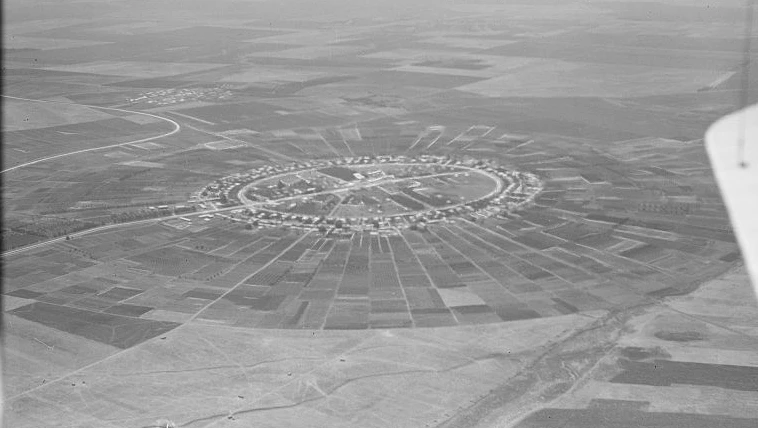
Two neighbors can work on separate dairy farms but order feed together and sell milk through the same organization. That division is the key to understanding a moshav. In the village of Nahalal, it was even written into the layout: public buildings in the middle, family homes around them and farmland stretching outward.
A moshav is an Israeli cooperative village. In the classic family-farm model, each household runs its own farm and manages its own household budget, while the cooperative can buy supplies and sell produce for members. A collective moshav goes further by pooling production, but households still manage their own spending.
How to use this article: Follow a dairy farm from purchasing to sale, read Nahalal’s layout from the air, or compare the three village models.
1. How a Family Farm Uses the Cooperative
Follow a Dairy Farm From Feed to Sale
Start with a household that keeps dairy cattle. The family is responsible for caring for the cows and running the farm. Its neighbors do not become co-owners of the household business just because they belong to the same agricultural cooperative. But it may make sense for the families to combine their orders for feed and to market the milk through a common organization instead of negotiating each order and sale separately.

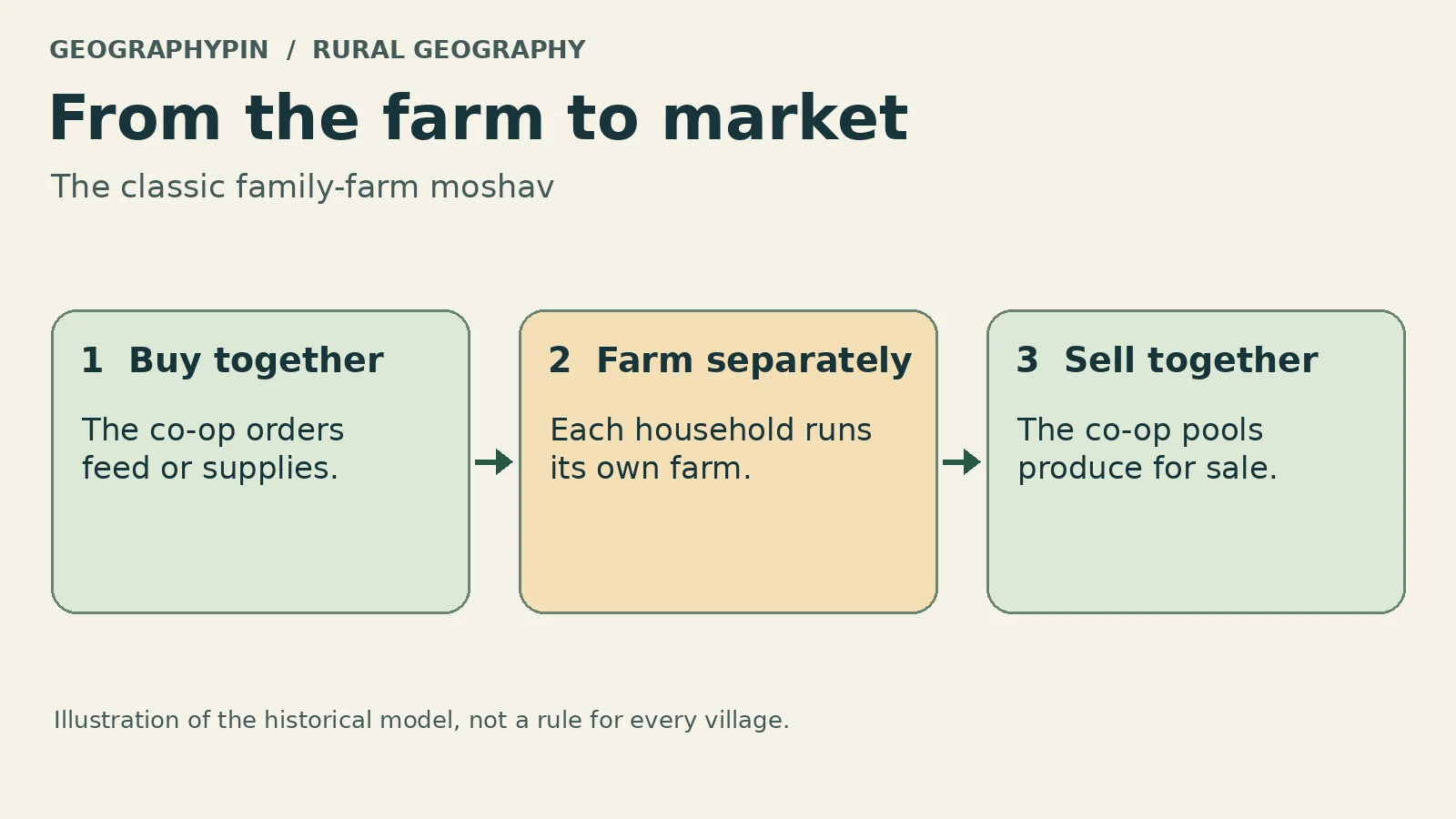
That example illustrates the division of responsibilities rather than promising that every village sells milk the same way. Agricultural economist Yoav Kislev describes mutual help, joint purchasing and joint marketing as parts of the early model. Over time, some families specialized in dairy, orchards or flowers, while others stopped farming. Israel’s Central Bureau of Statistics likewise leaves the degree of cooperation to members.
2. Why Nahalal Was Built in Rings
What the 1937 Aerial Photograph Shows
Nahalal, in the Jezreel Valley in northern Israel, was founded in 1921 and is generally identified as the first workers’ moshav. Architect Richard Kauffmann put communal buildings in the center, grouped homes around an oval road and laid out farm plots beyond the ring. The opening photograph, taken in 1937, shows the road and the narrow plots spreading away from it.
Look first at the center and then at the fields. A shared center put public institutions within reach of different households; the outer plots gave the household farms separate working space. The settlement could share institutions without turning the surrounding fields into one village-run farm. The oval suited this plan. It was not part of the definition of a moshav.
3. Moshav, Collective Moshav or Kibbutz?
Who Runs the Business and Who Manages the Household?
The family-farm version is called a moshav ovdim, or workers’ moshav. In a moshav shitufi, or collective moshav, the cooperative runs production and marketing together, but households keep their spending separate. The traditional kibbutz took collective organization further. Modern kibbutzim do not all handle pay alike: Ketura and Degania Alef illustrate two approaches to wages and shared benefits.
| Village model | Farm production and sales | Household spending |
|---|---|---|
| Moshav ovdim | Households run farms; cooperative purchasing and marketing may be shared. | Separate household budgets. |
| Moshav shitufi | The cooperative runs production and marketing. | Separate household spending. |
| Traditional kibbutz | Production and marketing organized collectively. | A common budget provides for members; current practice varies by kibbutz. |
Frequently Asked Questions
Does every household in a moshav run its own farm?
No. A family-operated farm is the classic workers’ moshav model, not a requirement that every resident farm today. A collective moshav organizes production jointly instead.
Are all moshavim laid out like Nahalal?
No. Nahalal’s oval road and radiating plots came from Kauffmann’s plan for that village. The name moshav refers to a cooperative structure, not a street pattern.
What Did We Learn Today?
In the classic moshav, the household runs the farm and the cooperative can handle tasks that make sense to do together. A collective moshav also pools the farm work, but not household spending. Nahalal’s rings show how family farms and shared village institutions once fit together in a single plan.
Sources & Data Notes
View the definitions, Nahalal records and photograph credit
The diagram follows the historical family-farm model. It does not represent the accounts of a particular dairy or the current rules of every cooperative.
- Israel Central Bureau of Statistics, locality definitions, p. 10, for moshav, collective moshav and kibbutz.
- Yoav Kislev, Agricultural Cooperatives in Israel: Past and Present, pp. 283–284, for how purchasing and sales worked and how household farming changed.
- National Library of Israel, Nahalal, c. 1937 and the 2024 field study of rural public space, section 1.2 for the settlement and its plan.
- Cover: American Colony (Jerusalem) Photo Department, aerial photograph of Nahalal, July 10, 1937, G. Eric and Edith Matson Photograph Collection, Library of Congress, LC-DIG-matpc-22273. Cropped and converted to WebP. No known publication restrictions.
