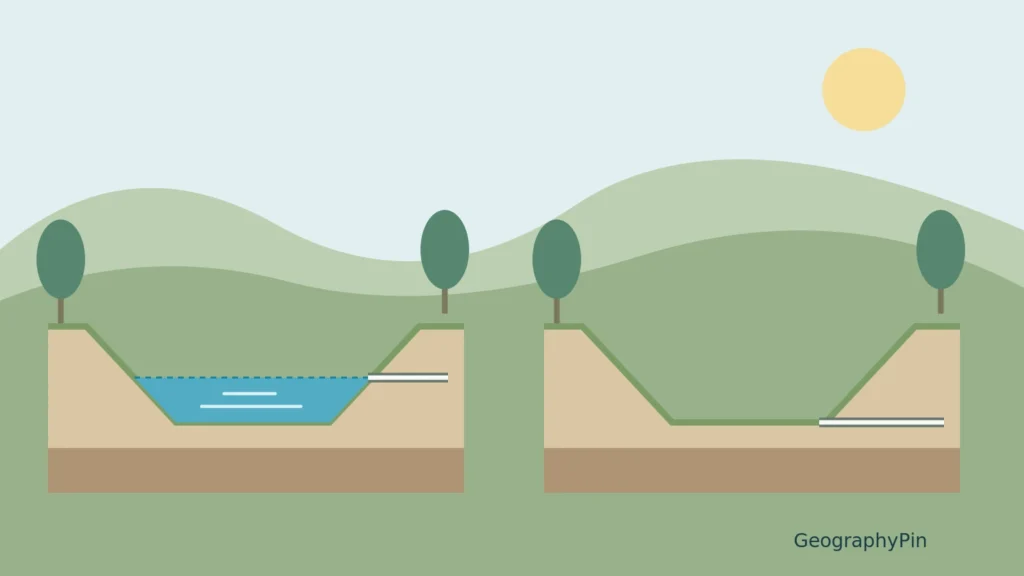
A pond that stays full and a grassy basin that fills after rain can both manage stormwater. The clearest comparison starts with what happens to the water, because engineers and local authorities do not always use the same names.
Under the EPA flow-control page’s convention, a retention pond keeps a permanent pool, while a detention pond is normally dry between storms. Both use storage to manage runoff and control its release. This is not universal terminology: wet detention ponds and dry retention ponds also exist.
How to use this article: Follow the storm sequence, clarify wet detention, or check what attenuation means. This is an educational comparison, not drainage-design guidance.
1. The Main Difference: Water Between Storms
This comparison follows the U.S. Environmental Protection Agency’s Flow Control Devices page. In that explanation, retention ponds keep a permanent pool, while detention ponds normally drain between storms. Both manage runoff through storage and controlled release.
| Question | Retention pond | Detention pond |
|---|---|---|
| Before rain | A pool remains | The main basin is normally dry |
| During runoff | Water rises above the usual pool | Water temporarily fills the basin |
| How does water leave? | Controlled release of water above the retained pool | Controlled drainage toward the basin’s low outlet |
| After drawdown | The pool remains | The basin returns toward its normally dry condition |
The useful visual question is therefore not simply “Is there water today?” It is “What remains after stormwater has drained?” A dry detention basin photographed during rain can look like an ordinary pond.
2. Follow the Inflow, Storage and Outlet
Before, during and after runoff
Think of a stormwater basin as a place where incoming and outgoing water need not move at the same rate. Oregon DOT defines detention around this slower release, and recognizes both wet and dry versions.
- Before rain: storage space is available. In a wet basin, that usable storm space lies above the existing pool, rather than replacing it.
- During runoff: water arrives through inlets or surface flow. When more enters than leaves, the level rises. Water can already be leaving through the outlet while rain is still falling.
- After inflow decreases: discharge continues and the temporary stored volume falls. The normal end condition depends on whether the design retains a pool.
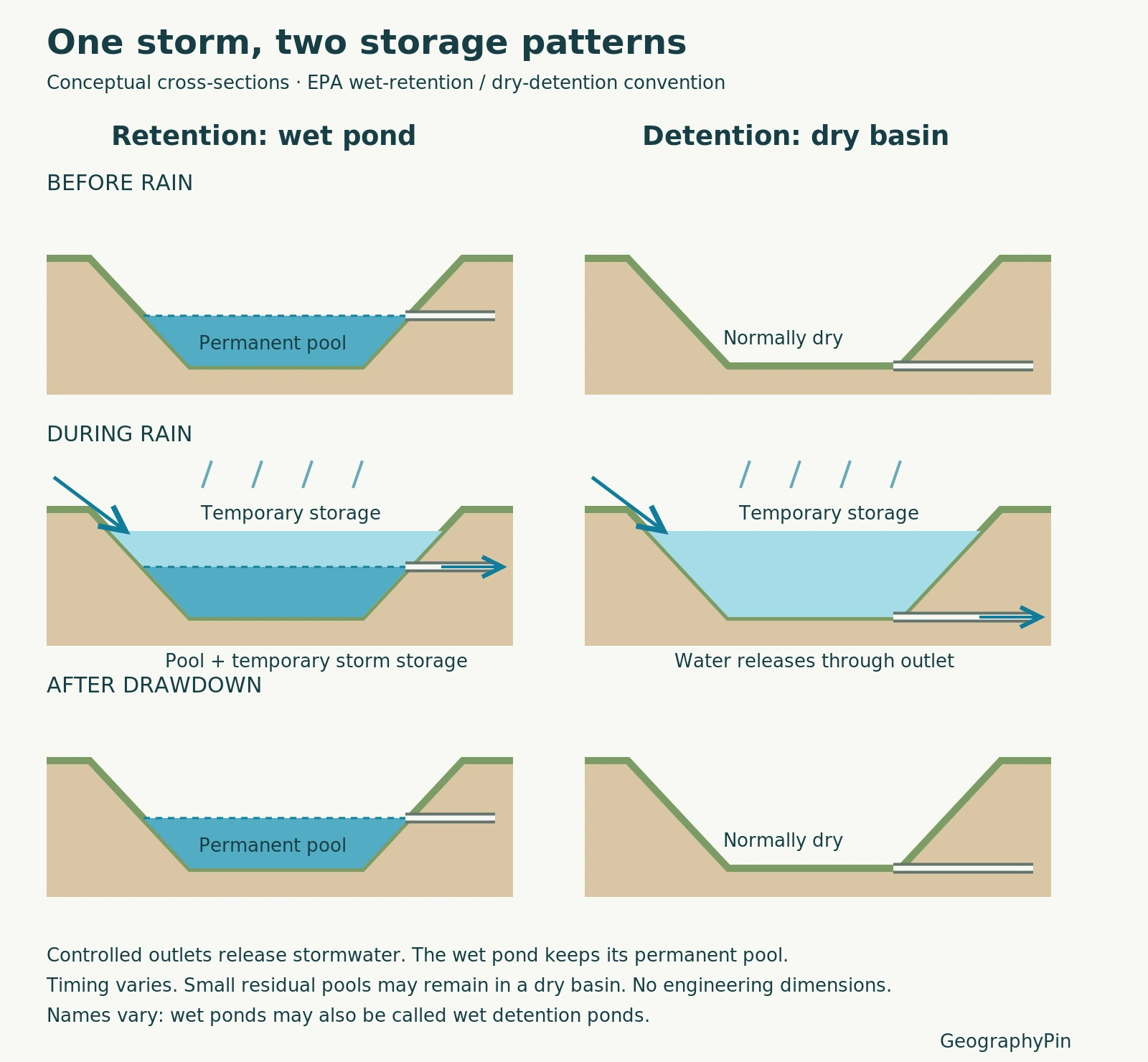
An inlet brings runoff into the facility; an outlet conveys it onward. A flow-control structure limits discharge. Real arrangements can include several openings or connected structures, so a conceptual drawing is not a construction plan.
What wet and dry examples show
Picture a landscaped neighborhood basin with open water on an ordinary dry day, compared with a grassed depression that fills after a storm. These illustrate the wet and dry forms, not two guaranteed local names. Look at the normal water regime and documented outlet behavior before deciding what either label means.
3. Why Wet Detention and Attenuation Are Not Contradictions
Wet detention: permanent water, temporary extra storage
EPA’s separate Wet Ponds fact sheet lists “wet extended detention ponds” among the names for wet stormwater ponds. There is no contradiction: wet describes the retained pool, while detention describes temporarily holding additional runoff.
The same fact sheet notes that a pool can persist year-round or at least through the wet season. “Permanent” describes the intended water regime, not an unchanging water level regardless of drought or water supply.
Attenuation: reducing the peak flow
In England’s national sustainable drainage standards, attenuation means lowering the peak flow and spreading discharge over a longer period. Attenuation storage is the space used when incoming flow exceeds controlled outflow.
That guidance distinguishes normally dry detention basins from permanently wet ponds, where temporary storage sits above the pool. An attenuation pond can therefore be wet. The word describes a runoff-control function rather than proving that a basin empties completely.
This is a specific example of UK terminology from England, not a claim that every authority across the UK uses identical names.
Dry retention: a different local use of retention
Brevard County, Florida, describes dry retention ponds that hold runoff temporarily while it infiltrates into the ground. Its stormwater guidance also describes wet detention ponds.
That local example is enough to show why “retention always means wet” is unreliable outside a stated convention. For a real property or drainage asset, consult its recorded design and the responsible authority’s terminology rather than relying on the name alone.
4. Flood Control and Water Quality Are Different Jobs
A basin can slow a surge of runoff without making all that water disappear. EPA’s dry-detention guidance distinguishes peak-flow reduction from total runoff-volume reduction: a dry detention pond alone generally does little to reduce the overall volume leaving a site.
Holding water also gives suspended particles time to settle. Dry detention provides limited treatment, however, and is not effective at removing dissolved pollutants simply by settling. Small pools near an inlet or outlet may remain even when the main basin is described as dry.
Wet ponds can combine sediment settling with biological nutrient uptake. Their performance depends on the facility and its condition; clear-looking water is not proof that pollutants have been removed.
Keep the two questions separate when reading a description: How is the runoff peak changed? and Which pollutants, if any, are treated? A label such as retention, detention or attenuation does not answer both.
5. How Is a Settling Pond Different?
A settling pond is named for a treatment purpose: slowing water so suspended sediment can fall out. Retention and detention comparisons usually emphasize how water is stored or released. The categories can overlap rather than describing mutually exclusive structures.
For example, the Environment Agency’s asset library describes a sedimentation pond as a temporary facility whose outlet allows dewatering slowly enough for suspended sediment to settle. This is not a definition of every pond that happens to accumulate mud.
A sediment forebay can also form a smaller pretreatment area before the main stormwater basin. Oregon DOT describes these areas as slowing incoming water so coarse sediment and debris settle before water reaches the main treatment or detention area.
For the broader geographic meaning, see what a pond is and how its water balance works. The lake definition covers the larger water-body context; neither everyday name alone identifies a stormwater-control design.
Frequently Asked Questions
How quickly should a detention pond empty?
There is no single time that defines every facility. The intended drawdown depends on its design and local requirements. Check the facility’s documentation rather than using a generic comparison article to judge whether a particular outlet is working correctly.
Does a wet pond’s existing water provide storm storage?
The existing pool already occupies space. Temporary storm storage is the additional space above that normal pool, which fills as the water rises.
What Did We Learn Today?
The most useful comparison follows the water before, during and after runoff. Distinguish the usual pool from temporary storm storage, and distinguish slower discharge from water-quality treatment. Retention, detention, attenuation and settling describe related functions, but their exact usage depends on the named guidance.
Sources & Data Notes
The main comparison follows EPA’s flow-control explanation, not a universal engineering definition. Other primary sources demonstrate different terminology. The SuDS example applies to England. Illustrations are conceptual; no dimensions, design rainfall or universal drainage times are implied.
- EPA: Flow Control Devices
- EPA: Dry Detention Ponds
- EPA: Wet Ponds
- Defra: National Standards for SuDS (England)
- Oregon DOT: Stormwater Ponds Standard Operation Manual
- Brevard County: Watershed Management Construction Projects
- Environment Agency: Sedimentation Pond
Visual credits: Original cover illustration and storm-sequence diagram by GeographyPin, following the EPA wet-retention/dry-detention convention above. Neither depicts a measured site. Symbolic outlets omit details that vary between actual drainage facilities.