The Persian leopard still lives in the Caucasus, but that is only one part of its range. The endangered cat survives in scattered mountain landscapes from Türkiye and the Caucasus through Iran to northern Pakistan. Roads and fences can separate those pockets of habitat.
The Persian leopard (Panthera pardus tulliana) is a leopard subspecies also called the Caucasian leopard. Iran holds the largest share of the wild population. The IUCN Cat Specialist Group reports an estimated 750–1,044 wild individuals across the whole range, including 450–626 mature animals. That is not a count for the Caucasus.
How to use this article: Find the main mountain landscapes, see what they hunt, or read what camera traps found in Armenia.
Where does the Persian leopard live?
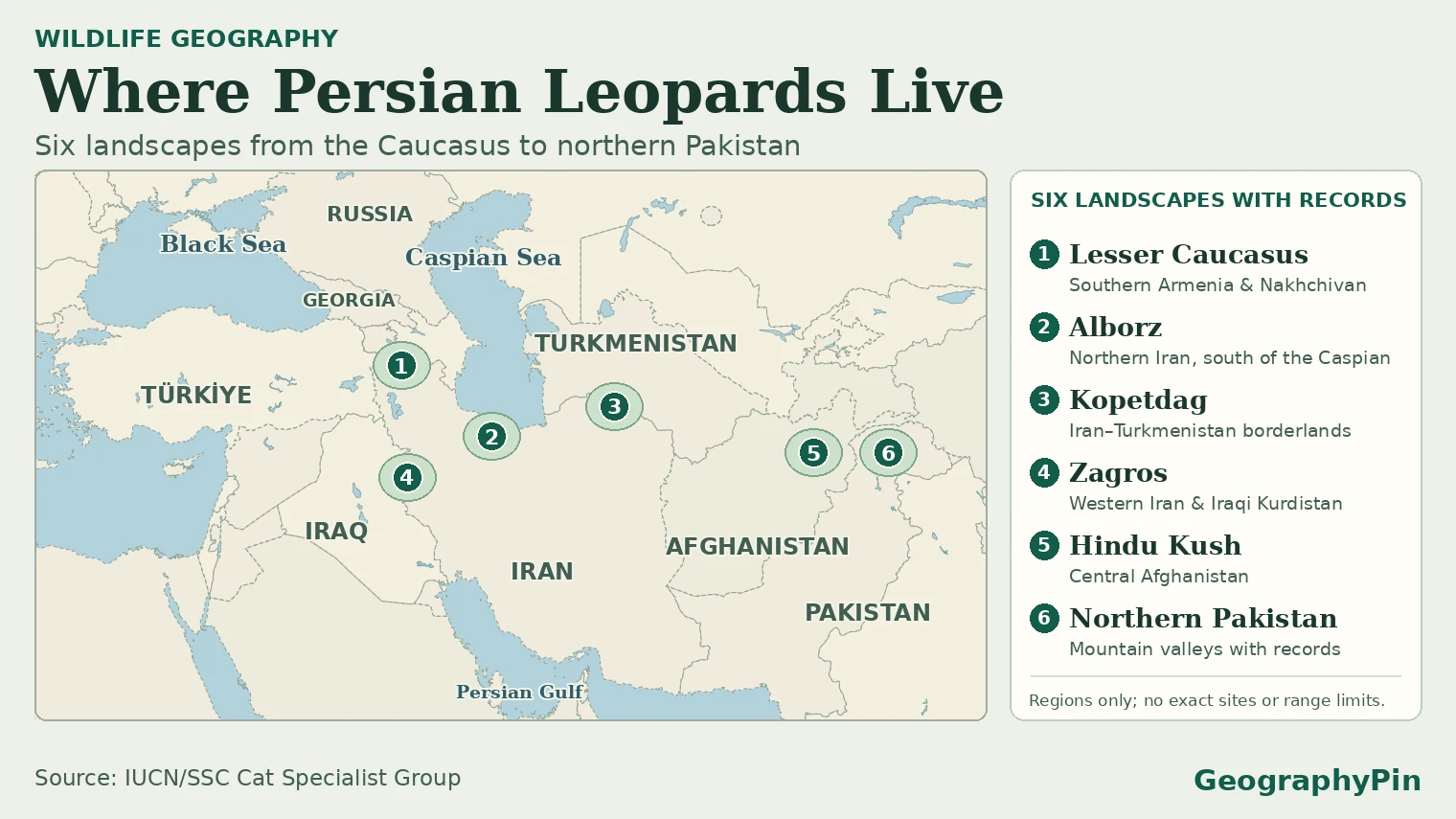
In the South Caucasus, an important cluster of records comes from the southern Lesser Caucasus, including landscapes in southern Armenia and Nakhchivan, Azerbaijan. Farther east, the Talysh Mountains near the Caspian also have records. Occasional records in Georgia tell a different story: a leopard can pass through without a breeding population being established.
Six landscapes that put the Caucasus in context

Iran is the center of the wider distribution. The Alborz runs south of the Caspian, the Zagros ties western Iran to Iraqi Kurdistan, and the Kopetdag follows part of the Iran–Turkmenistan border. East of Iran, records reach Afghanistan’s Hindu Kush and mountain valleys in northern Pakistan. Sightings in Türkiye and occasional records farther north, including Kazakhstan, do not mean the range between them is continuously occupied. See the specialist group’s full distribution map for its confirmed and uncertain areas.
Habitat and prey
Rocky slopes and ravines give leopards cover in very different climates, from the wooded slopes of the Alborz to semiarid hills near Turkmenistan. What these places have in common is cover for hunting and access to prey.
What leopards hunt in northeastern Iran
Researchers followed six adult leopards around Iran’s Tandoureh National Park from 2014 to 2017. Their recorded kills included wild pigs, bezoar goats and urial, a wild sheep. Some leopards also took domestic animals. Conserving wild prey matters, but it does not remove the need to protect livestock where farms and leopard habitat overlap.
How many Persian leopards are left?
The IUCN’s amended 2025 assessment lists the subspecies as Endangered. The Cat Specialist Group puts the range-wide estimate at 750–1,044 wild individuals, of which 450–626 are mature. The population is declining overall, even where some local groups show signs of stability or growth. The numbers are estimates from uneven field coverage, not a fresh head count.
Armenia: three individuals, not a population census
In an April 2023 report from Armenia’s Caucasus Wildlife Refuge, field staff distinguished a newly photographed adult male from a known resident male called Neo. Both appeared on cameras on the same day, and a third identified leopard, Nova, was recorded in the area. The refuge reported another detection in November 2025. These are local observations, not an estimate for Armenia or the entire Caucasus.
Leopards can pass several cameras, including cameras across a border. Researchers compare the cats’ spot patterns to avoid counting the same animal twice. In a 2021 paper, matching patterns identified the same individual in Nakhchivan and Armenia, at sites about 106 miles (170 km) apart in a straight line.
What keeps populations apart?
Roads, expanding settlements and some border fences can break up routes between patches of habitat. Poaching can reduce both the cats and their wild prey. Losses of sheep or goats can also lead to retaliatory killing. Keeping a reserve intact helps, but a leopard moving out of it still needs a route with cover and a reasonable chance of surviving the journey.
Conservation teams use shared monitoring, protected corridors and work with livestock owners to address different parts of that problem. A model of the Caucasus and northern Iran found that lowering persecution could do more for recovery there than restoring prey alone. That result does not make prey unimportant; it shows why the risks outside reserves matter.
Frequently Asked Questions
Why do older sources call it Panthera pardus saxicolor?
Older classifications used separate names, including saxicolor and ciscaucasica. This profile follows the IUCN Cat Classification Task Force’s broader tulliana convention. The Cat Specialist Group notes that further genetic comparisons would help clarify some populations at the edges of the range.
Is a Persian leopard the same as a snow leopard?
No. The Persian leopard is a subspecies of Panthera pardus. The snow leopard is a separate species, Panthera uncia. A leopard living in the mountains is not necessarily a snow leopard.
What Did We Learn Today?
The Persian leopard’s Caucasus range is one part of a patchwork of habitats stretching across Southwest Asia. Camera traps establish that particular cats are alive in a particular place and time; the larger population estimate answers a different question. Connecting habitat and reducing human-caused deaths both matter for the leopard’s survival.
Sources & Data Notes
View taxonomy, range, camera-trap sources and photo credit
Status and specialist sources checked November 28, 2026. The population figures are for the whole subspecies across its wild range. Camera-trap observations have their own area and date. The map summarizes selected mountain landscapes on a Natural Earth basemap; it does not identify camera sites, survey coordinates or occupancy boundaries.
- IUCN/SSC Cat Specialist Group: Persian leopard, modern distribution map, population estimate, threats and habitat; its 2025 Red List reference identifies the amended assessment, e.T15961A286174097.
- Kitchener et al., Cat Classification Task Force report (2017), taxonomic convention; Cat Specialist Group: snow leopard, species comparison.
- FPWC’s field reports: April 29, 2023, individual identification; November 27, 2025, subsequent detection. The observations, not the latter report’s population summaries, are used for the refuge case.
- Bleyhl et al., Ecological Applications (2021), matched camera-trap photographs and the modeled effect of reducing persecution.
- Farhadinia et al., Journal of Mammalogy (2018), prey data from tracked cats in northeastern Iran, 2014–17.
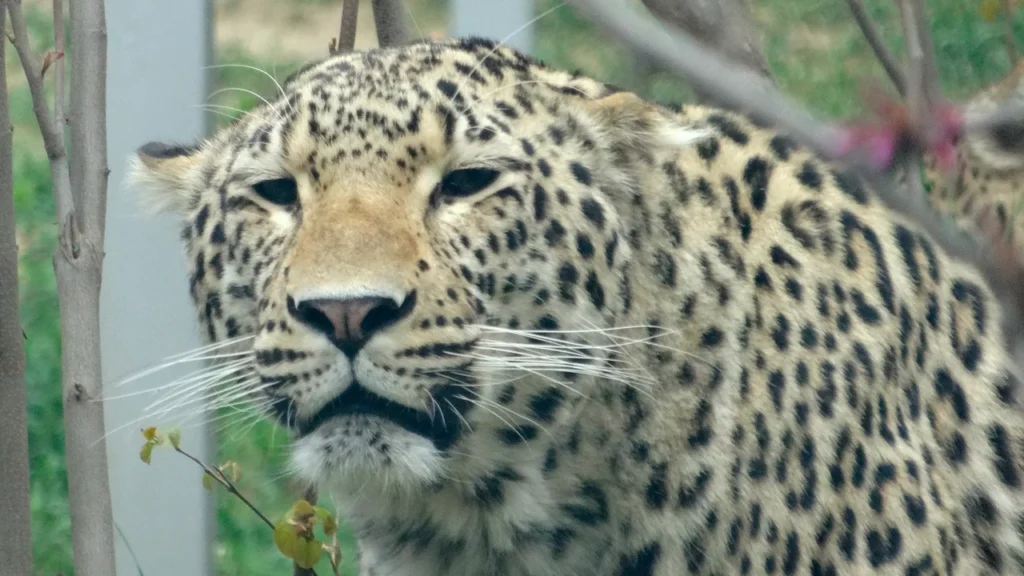
- Cover: Frida Nyberg, Persian leopard at Tbilisi Zoo, April 2017, CC BY 4.0, cropped. This is a zoo portrait, not an image from the camera-trap case.