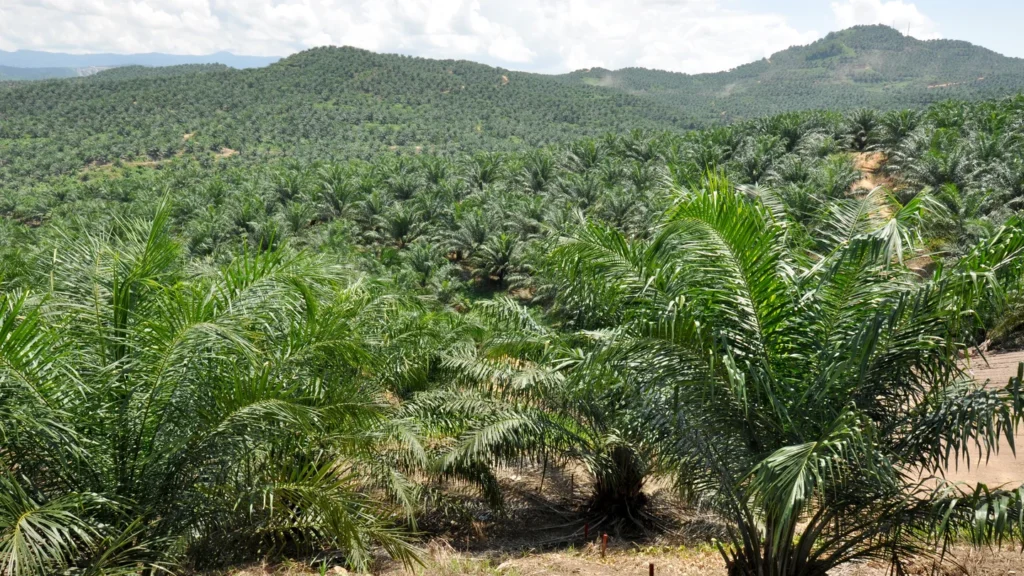
Indonesia and Malaysia produced the most palm oil in FAOSTAT’s 2023 data. Their lead comes into focus on the ground: Riau is on Sumatra, Central Kalimantan and two Malaysian states are on Borneo, and Peninsular Malaysia is separated from Borneo by sea. These are distinct growing and milling areas, not one continuous belt of plantations.
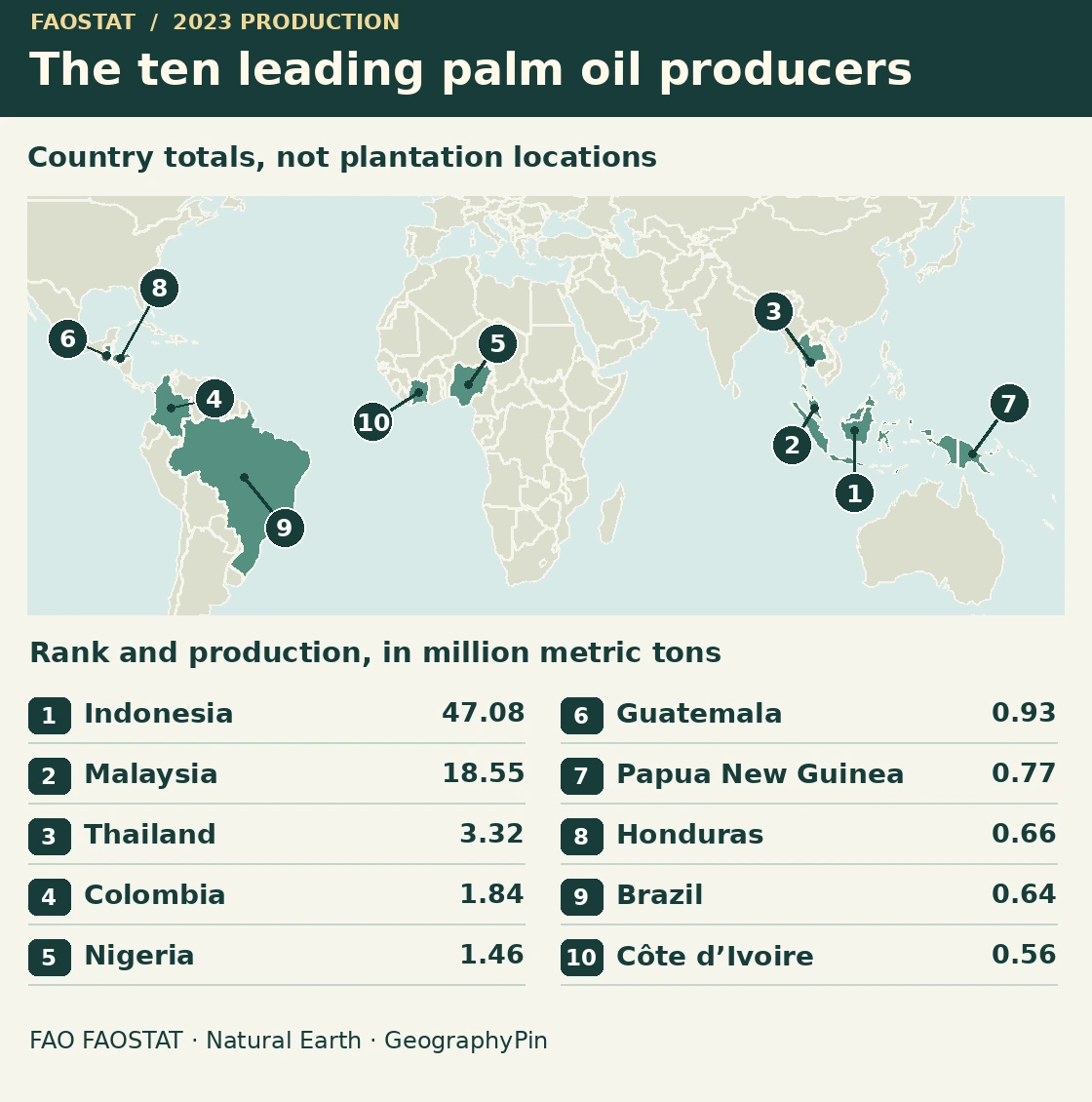
Indonesia produced 47.08 million metric tons of palm oil and Malaysia produced 18.55 million in FAOSTAT’s 2023 series. Together they accounted for about 82.5% of the published world total. Thailand was third at 3.32 million. The ranking excludes separately recorded palm kernel oil and does not use the weight of harvested fruit.
How to use this article: Start with the ten-country ranking, compare fruit and oil totals, or jump to the main production areas on Borneo and the peninsula.
The 2023 palm oil ranking
The ranking uses FAOSTAT’s Palm oil item and compares country records from 2023, the newest year for that item in the downloaded file. Later fruit figures and newer national crude-oil figures do not change that reference year. No regional totals enter the ranking, and countries without a usable record are not assigned zero.
Ten leading producers, ranked before rounding
| Rank | Country | Production (metric t) | FAOSTAT flag |
|---|---|---|---|
| 1 | Indonesia | 47,084,299 | A |
| 2 | Malaysia | 18,551,950 | A |
| 3 | Thailand | 3,323,200 | X |
| 4 | Colombia | 1,841,880.29 | A |
| 5 | Nigeria | 1,460,000 | X |
| 6 | Guatemala | 933,926 | A |
| 7 | Papua New Guinea | 770,000 | X |
| 8 | Honduras | 655,000 | X |
| 9 | Brazil | 637,353 | A |
| 10 | Côte d’Ivoire | 562,465 | A |
Flags in these rows: A = official figure; X = figure from an external organization. FAOSTAT records “Unofficial figure” as the note on the X rows shown here. Values are displayed at their supplied precision. No exact ties occurred in these ten rows.
Download the 2023 palm oil comparison (CSV)
For the combined share, add Indonesia’s 47,084,299 and Malaysia’s 18,551,950, then divide by FAOSTAT’s separate world total of 79,567,198.58. Multiply by 100 to get about 82.5%. The denominator includes more than the ten countries in the table.
One fruit, two different oils
The flesh of the oil-palm fruit yields palm oil. The kernel inside its hard shell yields palm kernel oil, a separate product. A fresh fruit bunch contains material besides either oil, so its weight belongs in a crop-harvest table, not in this oil table.
Malaysia shows the difference in one year
In 2023, FAOSTAT lists 94.95 million metric tons of oil palm fruit for Malaysia, 18.55 million of palm oil, and 2.12 million of palm kernel oil. These are three separately defined series. Adding the fruit number to either oil number would count mass at more than one stage of production.
Malaysia’s 18,551,950-ton palm oil record matches the national palm oil board’s figure for crude palm oil, or CPO, before refining. Indonesia’s FAOSTAT row likewise agrees with the rounded CPO total in its national report. The international table retains FAOSTAT’s broader Palm oil label because its statistical code is a class that contains both crude and refined subclasses. The table is not a separately verified crude-only series for every country.
From Sumatra to Borneo and the Malay Peninsula
Indonesia: Riau on Sumatra and Central Kalimantan on Borneo
Statistics Indonesia reports that Riau led its provinces in 2023 with about 9.22 million metric tons of crude palm oil. Central Kalimantan followed with about 8.47 million. The first province is on Sumatra; the second is on the Indonesian part of Borneo. The geography of Indonesia’s island chain helps explain why a single national total joins several sizeable production areas.
Malaysia: the peninsula, Sabah and Sarawak
The Malaysian Palm Oil Board recorded about 9.83 million metric tons of crude palm oil in Peninsular Malaysia in 2023. Sabah produced about 4.51 million and Sarawak about 4.22 million. Sabah and Sarawak are on Borneo, but are distinct from Central Kalimantan across the national border. In 2023 the peninsula alone made a little more crude palm oil than those two states combined.
| Area and location | Planted area (ha) | Crude palm oil (metric tons) |
|---|---|---|
| Riau, Sumatra (Indonesia) | 3,401,607 | 9,222,465 |
| Central Kalimantan, Borneo (Indonesia) | 2,171,000 | 8,466,673 |
| Peninsular Malaysia | 2,518,883 | 9,825,140 |
| Sabah, Borneo (Malaysia) | 1,510,025 | 4,507,460 |
| Sarawak, Borneo (Malaysia) | 1,623,661 | 4,219,350 |
These are reported planted hectares and oil, not harvested fruit or palm-kernel oil. The figures do not measure oil yield per harvested hectare or show individual fields.
Borneo does not belong to one country. Compare the political geography of Borneo to understand why nearby producing areas appear in different national rows. Neither the country map above nor these selected figures show each plantation’s exact boundaries.
Planted area is not harvested area
Planted land includes young stands that have yet to bear a commercial crop. Mature area counts stands old enough to produce; harvested area describes the land represented in the harvest series. These labels can refer to the same reported number in one dataset without being interchangeable in every country.
For Malaysia in 2023, MPOB gives 5,652,569 hectares planted and 5,130,172 hectares mature. FAOSTAT’s same-year harvested area for oil palm fruit also reads 5,130,172 hectares. The difference from planted area is 522,397 hectares, about 9.2% of the total planted. That is why dividing fruit tonnage by all planted land gives a different result from dividing it by the reported harvested area. Use the fruit and area rows for crop yield, not the oil output row alone.
Frequently Asked Questions
What does an oil extraction rate measure?
It is the weight of crude palm oil obtained relative to the weight of fresh fruit bunches going into milling. The Malaysian Palm Oil Board reported a 19.86% extraction rate for Malaysia in 2023. That measures oil recovered from fruit at mills, not the fruit yield per hectare or the output of palm-kernel oil.
Why not use Malaysia’s 2024 number in the ranking?
Malaysia’s palm oil board publishes 19.34 million metric tons of crude palm oil for 2024. That is useful as a national update, but it cannot be put beside the other countries’ 2023 records in a single-year ranking.
Does a high production rank also mean a high export rank?
Not necessarily. Production counts oil made during the reporting year. Export data record what crossed a border, after domestic use, inventory changes and sometimes re-exports. Match the product and year before comparing the two.
What Did We Learn Today?
Indonesia and Malaysia dominated the 2023 palm oil comparison, but their output came from distinct areas on Sumatra, Borneo and the Malay Peninsula. For a fair comparison, keep fruit, palm oil and palm kernel oil separate, and compare the same reporting year.
Sources & Data Notes
- FAO. FAOSTAT: Crops and livestock products. Rome. Accessed November 22, 2026. Normalized QCL bulk file served with a December 31, 2025 last-modified date. Filter year 2023; item 257, Palm oil (CPC class 2165); element 5510, Production; unit t. Keep country records (FAOSTAT area codes below 500 in this file), not aggregates; omit overlapping China components if present, since they would duplicate the combined China series. No such row affects the top ten. Only use records with a published value; exact ties would share rank. Use world code 5000 only for the combined-share denominator. Fruit is item 254 (production 5510, harvested area 5312); Oil of palm kernel is item 258 (production 5510). FAO statistical database terms and CC BY 4.0.
- United Nations Statistics Division, CPC class 2165 and its subdivisions; FAO, anatomy of the oil-palm fruit and palm oil processing.
- Statistics Indonesia, Indonesian Oil Palm Statistics 2023. Malaysian Palm Oil Board, 2024 and 2023 industry performance and JOPR, Malaysian oil palm performance and mature-area table.
- Map base: Natural Earth (public domain). Featured photo: oil palm plantation in Sabah, Malaysian Borneo, T. R. Shankar Raman, May 25, 2010; cropped and resized under the same CC BY-SA 4.0 license. The photograph illustrates the landscape, not its current extent.
- For the 2023 regional rows, see Statistics Indonesia, Indonesian Oil Palm Statistics 2023, Table 3.4.2, and Malaysian Palm Oil Board, 2023 industry summary, planted area and CPO tables.