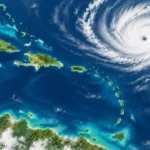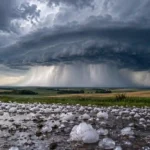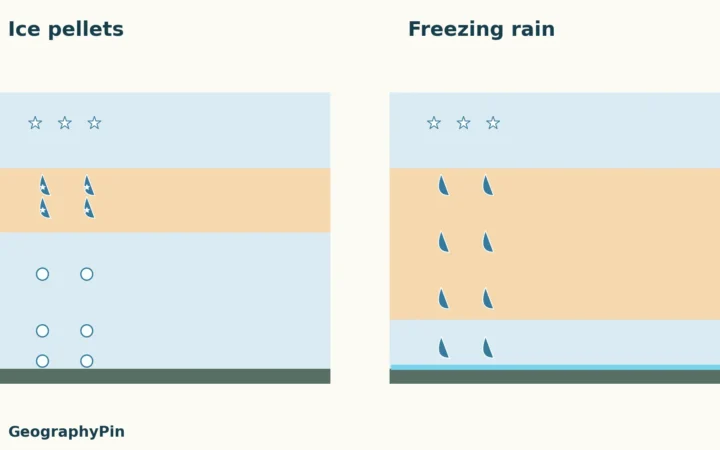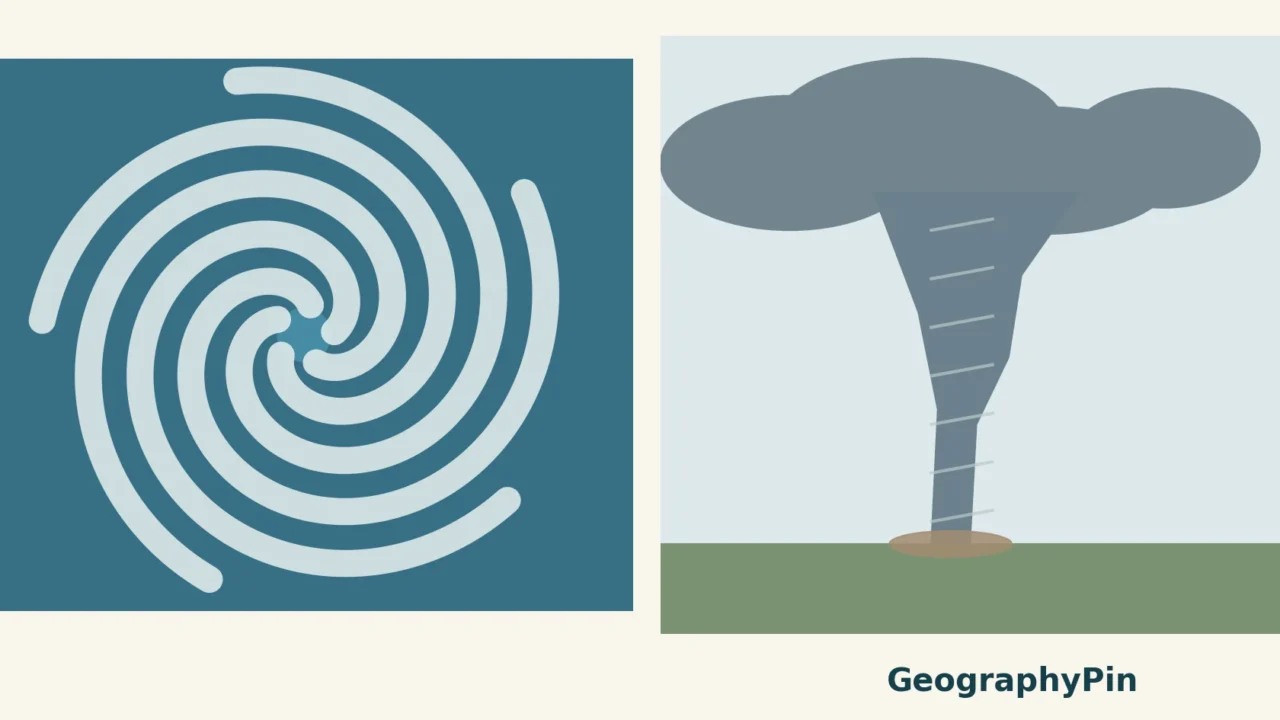
Both storms rotate, both can cause destructive winds, and both appear in dramatic weather images. Those similarities hide an important distinction: a hurricane is a whole weather system, while a tornado is a much smaller circulation associated with a thunderstorm.
A hurricane is a large tropical cyclone; a tornado is a localized, violently rotating column of air connecting a thunderstorm with the ground. Hurricanes develop over tropical or subtropical waters, while tornadoes occur in several thunderstorm settings. They use different intensity scales, and a hurricane can produce tornadoes.
Choose your starting point: compare their structure, understand why the ratings differ, or see how both can occur together.
1. Hurricane vs Tornado at a Glance
Compare the same features
| Feature | Hurricane | Tornado |
|---|---|---|
| What it is | A tropical cyclone that reaches hurricane-strength sustained winds | A violently rotating column of air connecting a thunderstorm with the ground |
| Relationship to thunderstorms | An organized system containing thunderstorms | A circulation associated with a parent thunderstorm |
| Typical setting | Develops over tropical or subtropical ocean waters; impacts can extend inland | Develops with thunderstorms in several weather settings, including tropical cyclones |
| Spatial scale | Much broader circulation and potential impact area | More localized circulation and damage path |
| U.S. intensity scale | Saffir–Simpson categories 1–5, based on maximum sustained wind | Enhanced Fujita ratings EF0–EF5, based on damage-related wind estimates |
| Important hazards | Wind, storm surge, rain flooding, dangerous surf and possible tornadoes | Violent localized winds and windborne debris |
The table does not rank which storm is “worse.” The answer changes with the question: wind at one location, the area affected, flooding, or the vulnerability of buildings and people. A compact tornado can be devastating along its path, while a hurricane can expose a much broader region to several hazards at once.
2. How Their Formation Differs
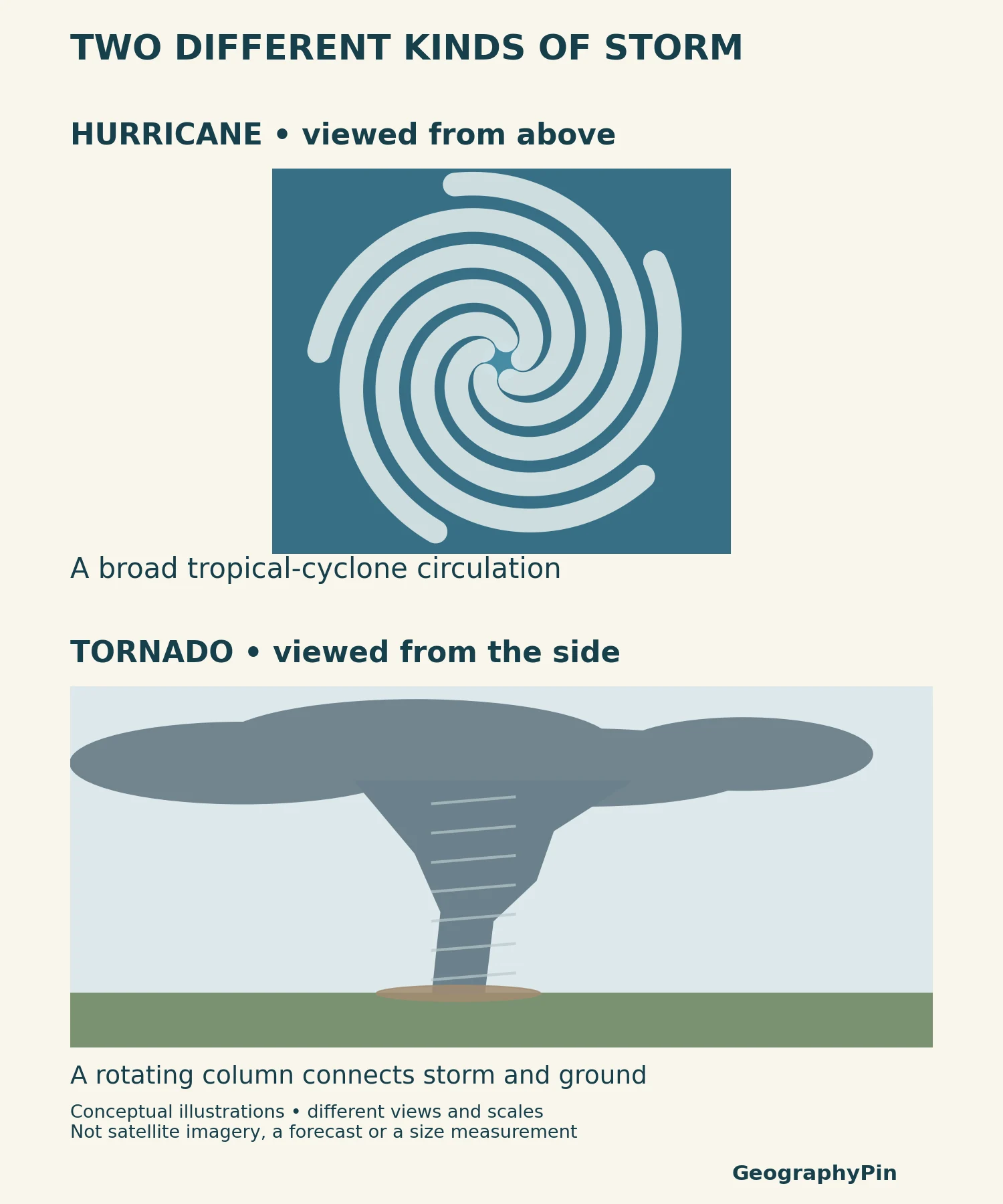
A storm system versus a storm-scale vortex
A hurricane is a type of tropical cyclone: an organized, rotating low-pressure system with thunderstorms. The name hurricane is used in the Atlantic and eastern and central North Pacific; other ocean basins use names such as typhoon for the corresponding tropical cyclone. It develops over tropical or subtropical waters. Warm ocean water, moist air and a favorable atmospheric environment support development; warm water alone does not guarantee that a hurricane will form.
NOAA identifies relatively weak changes in wind through the depth of the atmosphere as favorable for tropical-cyclone development. This contrasts with the strong vertical wind shear often associated with tornadic supercells. Wind shear means a change in wind speed or direction with height. The two statements describe different storm structures, not a contradiction.
A tornado is the smaller rotating column, not its entire parent thunderstorm. NOAA’s National Severe Storms Laboratory distinguishes tornadoes associated with supercells, which have rotating updrafts, from those produced in other thunderstorm settings. Not every supercell produces a tornado, and not every tornado forms beneath a supercell. There is no single cartoon sequence that captures every case.
Ground contact matters to the tornado definition, but the visible condensation funnel does not have to extend all the way to the surface. The rotating air can reach the ground even where the lower part is not outlined by condensed droplets. Conversely, a funnel aloft does not, by itself, establish a tornado at the ground.
The time scales differ too. Tornadoes are often brief, though NOAA notes that some persist for more than an hour. Do not treat a typical duration as a deadline after which a storm must become harmless. Nor should the duration of a whole tropical cyclone be confused with how long it retains hurricane-strength winds or how long a specific place experiences severe conditions.
3. Why the Wind Ratings Are Not Interchangeable
One-minute wind is not a three-second gust
In the U.S. hurricane convention, the threshold is a maximum one-minute sustained surface wind of 74 mph (119 km/h), or 64 knots. This defines hurricane intensity for a tropical cyclone; it does not mean any thunderstorm with a gust above that speed becomes a hurricane.
The Saffir–Simpson Hurricane Wind Scale sorts hurricanes into categories 1 through 5 using maximum sustained wind. The category is not a combined score for rain, storm surge, tornadoes or the size of the affected area. A lower-category hurricane can still cause severe water-related damage.
The U.S. Enhanced Fujita scale works differently. Surveyors examine damage to structures and vegetation, consider the relevant damage indicators and construction, and estimate the winds consistent with that evidence. The EF0–EF5 wind ranges refer to estimated three-second gusts. They are not a set of direct anemometer readings from every tornado.
Consequently, Category 3 and EF3 are not equivalent, and subtracting or comparing their numbers does not measure relative danger. Even when both descriptions include miles per hour, a sustained-wind statistic and a short gust estimate answer different questions. For the same reason, converting mph to km/h does not make the underlying measurements comparable.
Visible size is also a poor shortcut to intensity. NOAA cautions that a tornado’s shape or apparent width does not reliably establish its strength. A dramatic photograph and a damage-based rating are different kinds of evidence.
4. Can a Hurricane Produce Tornadoes?
Yes, the hazards can occur together
Hurricanes and tropical storms can produce tornadoes. The National Weather Service explains that these often develop in thunderstorms within rainbands away from the center, though they can also occur near the eyewall. The tornado is a distinct smaller circulation associated with the larger tropical system.
This is not a hurricane “turning into” one giant tornado. The broad storm remains a tropical cyclone while individual thunderstorms can generate tornadoes within its environment. That relationship also explains why a hurricane wind category cannot tell you whether a particular rainband will produce a tornado.
Landfall does not erase the remaining hazards. Rain flooding can extend inland, and tornado risk is not confined to the coastline. Equally, being outside a narrow tornado damage path does not establish safety from the broader storm’s wind or flooding.
For a different geographic task, our Caribbean hurricane-risk comparison examines historical center-track exposure by island. Its encounter counts are not tornado probabilities or complete measures of a destination’s risk.
Frequently Asked Questions
Is a hurricane just a very large tornado?
No. A hurricane is an organized tropical cyclone containing thunderstorms. A tornado is a rotating column associated with a thunderstorm. Enlarging a tornado does not turn it into a hurricane.
Can a tornado have hurricane-force winds without being a hurricane?
Yes. Hurricane-force describes a wind speed, while hurricane identifies a particular type of tropical cyclone. The weather-system definition matters as well as the wind.
Does a visible funnel have to touch the ground?
The rotating air must reach the ground for a tornado, but the condensation funnel may not be visible all the way down. A photograph of a funnel alone is not a reliable way to decide what is happening at the surface.
Which should I take more seriously in a warning?
Both can be life-threatening. Follow the current official warnings and local emergency instructions for your location rather than choosing which storm name sounds worse. This comparison explains terminology; it is not a current forecast or a substitute for an emergency plan.
What Did We Learn Today?
Compare the storm structure before the wind number. Hurricanes are broad tropical systems; tornadoes are localized rotating columns. Sustained-wind categories and damage-based gust ratings are not interchangeable, and neither replaces a full account of the hazards. The two storms can also overlap when a tropical cyclone produces tornadoes.
Sources & Data Notes
Wind conventions and ratings here use U.S. NOAA/NWS terminology. The illustrations are original conceptual artwork, not satellite observations, forecasts or matched-scale measurements. No universal width, lifespan, record wind or damage ranking is assigned. The metric hurricane threshold is rounded from the U.S. reference value.
- NOAA: What is a hurricane?: tropical-cyclone definition and category context.
- NWS glossary: Hurricane: one-minute sustained-wind convention.
- NOAA: Tropical Cyclone Introduction: favorable development environment.
- NOAA NSSL: Tornado Basics: rotating-column definition.
- NOAA NSSL: Tornado Types: supercell and non-supercell settings.
- NWS: Enhanced Fujita Scale: damage surveys and estimated three-second gusts.
- NOAA: Thunderstorm Hazards — Tornadoes: duration, visibility and size-versus-strength limits.
- NWS: Hurricane Preparedness: rainband tornadoes, multiple hazards and limits of wind categories.