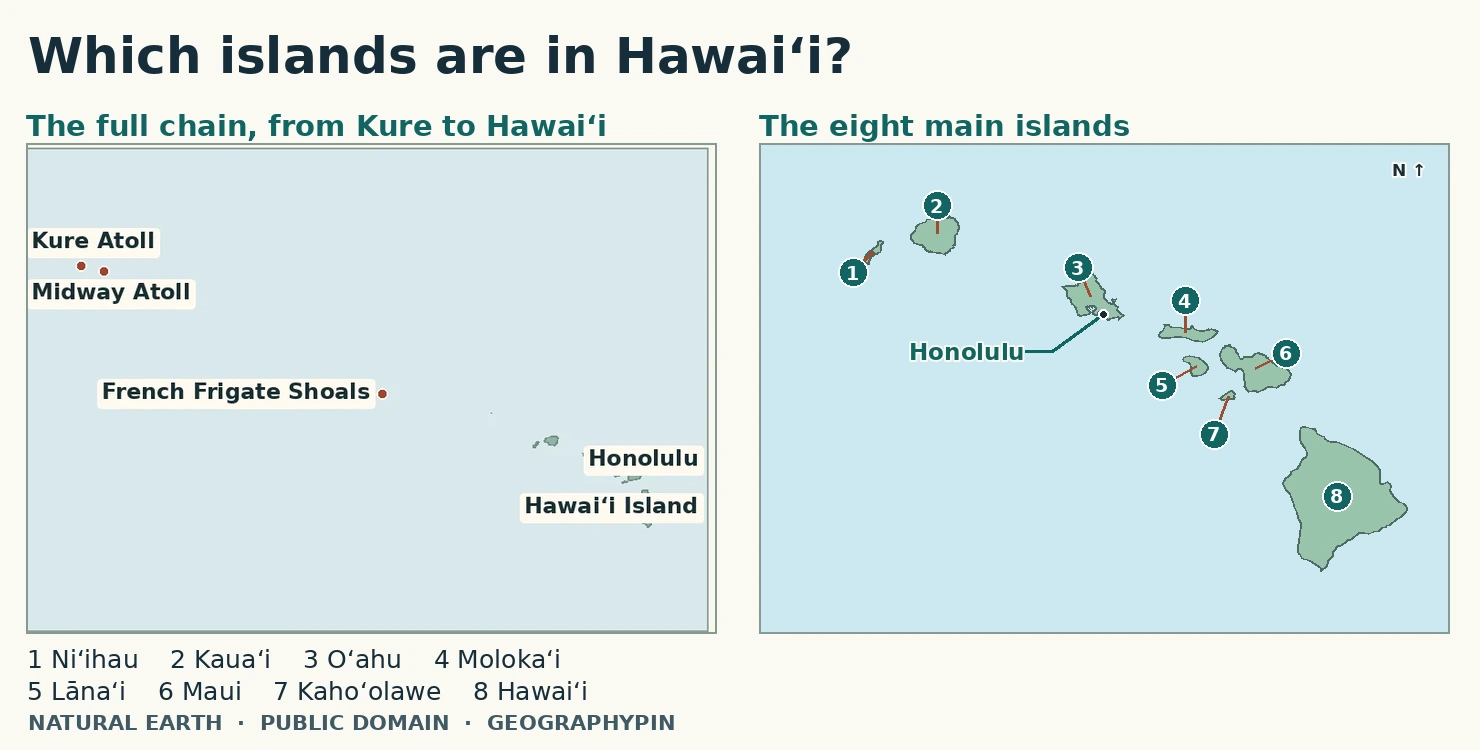
A map of the Hawaiian chain reaches far northwest of Honolulu. The state reaches far along that chain too, but one familiar atoll, Midway, is outside the state. The answer lies in the admission statute as well as in island geography.
Hawaiʻi became a U.S. state on August 21, 1959, after the Admission Act and a statehood vote. This followed the 1893 overthrow of the Hawaiian monarchy, U.S. annexation in 1898 and territorial government in 1900. The state includes the main islands and most of the Northwestern Hawaiian Islands, including Kure Atoll. Midway Atoll is outside the state.
How to use this article: Jump to the discussion you need: Why a straight perimeter around the main islands fails, Kure and Midway in reverse order or Why a later statehood vote cannot stand in for earlier consent.
Follow the archipelago beyond the main islands
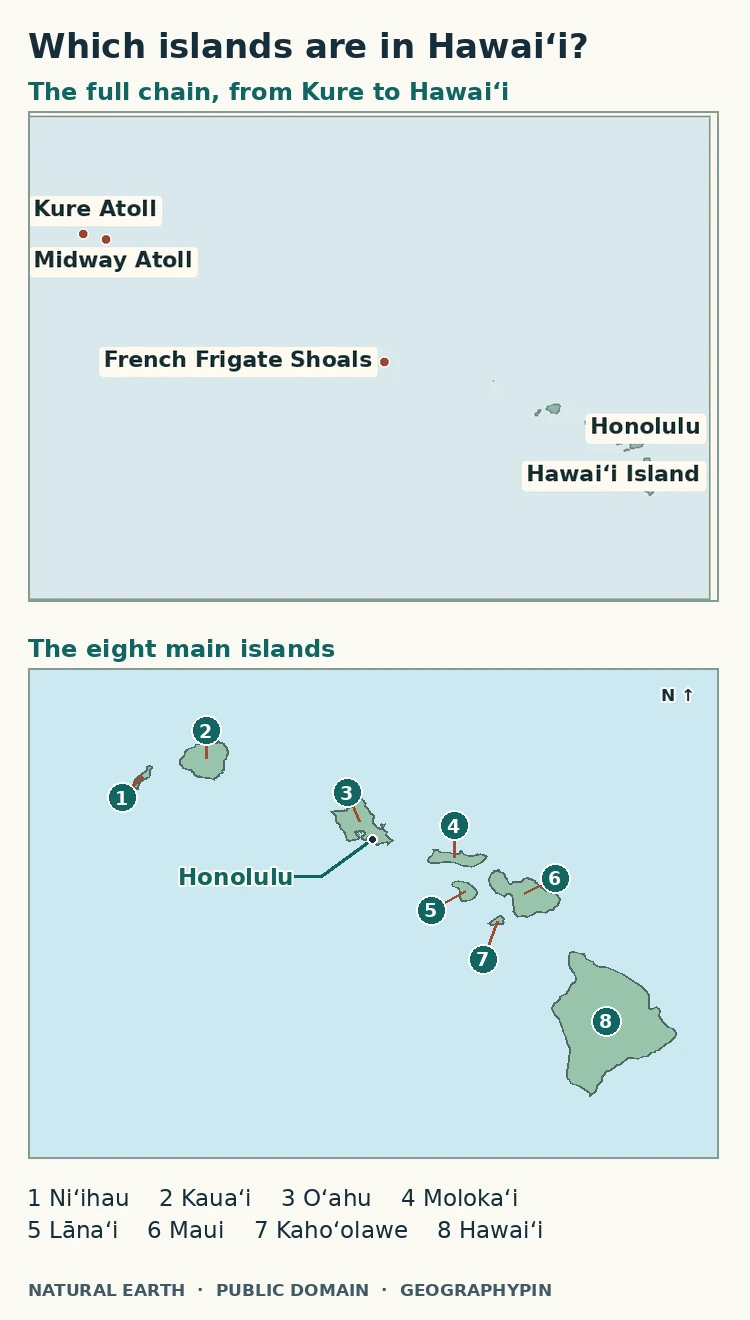
The main Hawaiian islands include Hawaiʻi, Maui, Kahoʻolawe, Lānaʻi, Molokaʻi, Oʻahu, Kauaʻi and Niʻihau. Honolulu, the state capital, is on Oʻahu. Hawaiʻi names the state as a whole and also its largest island. “Big Island” usually means the latter. Far northwest are smaller islands, reefs and atolls that rarely fit on the same detailed map as Honolulu.
| Place | Part of the Hawaiian chain? | Part of the state? |
|---|---|---|
| Oʻahu | Yes | Yes. Honolulu is here. |
| Midway Atoll | Yes | No. It is a separate U.S. possession. |
| Kure Atoll | Yes | Yes, even though it lies beyond Midway along the chain. |
| Palmyra Atoll | No. It is in the Line Islands. | No. The Admission Act expressly excluded it. |
Why a straight perimeter around the main islands fails
Section 2 of the Admission Act defined the state using the former territory and explicit exceptions. In addition to Midway it identifies Johnston Island, nearby Sand Island and Kingman Reef among places not included. It separately excepts Palmyra. A place mentioned in the legal exclusions does not thereby become geologically Hawaiian. Kure and Midway are the cleanest pair for comparing a natural archipelago with state jurisdiction.
Kure and Midway in reverse order
Start at Honolulu and travel northwest along the island chain. You encounter Midway before Kure. Midway is outside the state and Kure is inside it. Now approach from the far northwest and the sequence reverses. No single straight cutoff across the archipelago can reproduce this legal pattern; the exclusion of Midway has to be shown separately.
The kingdom, overthrow and annexation
The Hawaiian Kingdom had its own government and international relationships. Queen Liliʻuokalani was overthrown in 1893. The Republic of Hawaiʻi followed, and the United States annexed the islands by joint resolution in 1898. Native Hawaiians organized substantial opposition to annexation. The 1897 Kūʻē petitions preserved in the National Archives document that opposition in individual names.
Why a later statehood vote cannot stand in for earlier consent
The 1959 electorate was asked to decide statehood under the Admission Act. That vote did not ask the people living under the kingdom in 1893 or 1898 to approve the overthrow or annexation. The subject of the ballot, the population eligible to vote and the year all differ. A historically accurate timeline must keep those questions apart.
Territory in 1900, state in 1959
The Organic Act organized a U.S. territorial government in 1900. Congress passed the Admission Act in March 1959; voters approved statehood in June, and the presidential proclamation followed in August. On a map of the U.S. states, Hawaiʻi is often set into a box beside the continental states. That design helps fit a page but conceals how far it lies from the North American mainland and how long the island chain is.
What the petitions and the statehood ballot can tell us
The Kūʻē petitions against annexation survive as pages of names organized through Native Hawaiian political associations. They are direct evidence of organized opposition in the 1890s. The National Archives describes more than 21,000 signatures on the surviving anti-annexation petition. Names on such a document are a different form of evidence from the diplomatic correspondence of American officials or the debates of members of Congress.
The United States annexed Hawaiʻi by congressional joint resolution in 1898. The preceding proposed treaty and the resolution are different instruments. The 1900 Organic Act then established the territorial government. A timeline compressing overthrow, annexation and territorial organization into one moment loses seven years of distinct political choices. It also removes the setting in which the petitioners acted.
Nearly six decades later, the admission process gave the electorate a specific statehood proposition. The 1959 vote and presidential proclamation made Hawaiʻi the fiftieth state. The ballot represented the population and eligible voters of a later political era. It cannot function as a retrospective referendum by those who had lived under the kingdom. Reading each record in its own time allows both the opposition to annexation and the later admission vote to be described accurately.
A globe adds a final caution. A boundary around the eight principal islands leaves out much of the Northwestern Hawaiian chain. Extending it to take in all geologically related islands would wrongly include Midway in the state. The congressional definition and the island sequence are complementary evidence: one establishes the legal limit, the other shows why a simple geographical rule cannot reproduce it.
Frequently Asked Questions
Is Midway outside the United States because it is outside Hawaiʻi?
No. It is under U.S. sovereignty as a separate U.S. possession. State membership and national sovereignty are distinct categories.
Which was admitted first, Alaska or Hawaiʻi?
Alaska entered the Union in January 1959, and Hawaiʻi followed in August. They became the forty-ninth and fiftieth states, respectively.
What Did We Learn Today?
The volcanic chain, the old territory and the state each have different limits. Kure and Midway expose the geographic difference, while the 1893, 1898, 1900 and 1959 dates distinguish political events that are often collapsed into one.
Sources & Data Notes
State membership follows section 2 of the Admission Act. The timeline uses the National Archives’ Kūʻē petition materials and the act and proclamation records.
- U.S. Department of the Interior, Hawaiʻi Admission Act
- United States Code, State of Hawaiʻi
- U.S. National Archives, the 1897 Kūʻē petitions against annexation
- Hawaiʻi Department of Land and Natural Resources, historical testimony
- National Archives, Hawaiʻi statehood proclamation
- Natural Earth, source vectors for boundaries, coasts and rivers