A flight from Guam to Saipan follows a single island arc. It also moves between two different U.S. territorial governments. The Mariana Islands are the physical group; their modern political division has a separate history.
Guam is an organized, unincorporated U.S. territory governed under its 1950 Organic Act. The Northern Mariana Islands form a separate U.S. commonwealth under a negotiated Covenant. Guam includes Hagåtña; the Northern Marianas include Saipan, Tinian and Rota. Common U.S. sovereignty and the word Mariana in the island group’s name do not combine their governments.
How to use this article: Jump to the discussion you need: A route from Guam to the Northern Marianas, Trust territory does not describe Guam’s postwar status or Commonwealth is a legal relationship here.
Find Guam and Saipan on the same arc
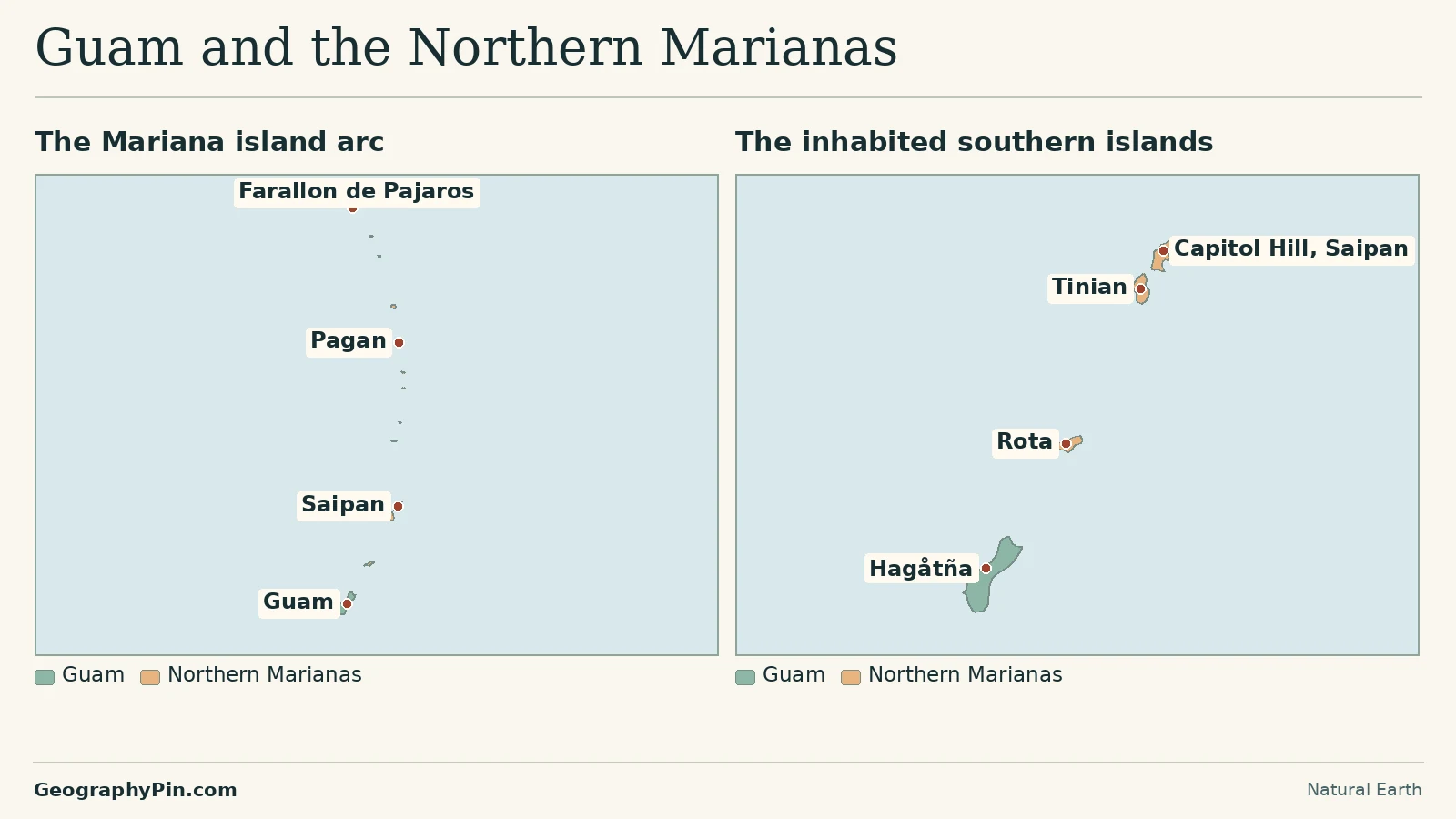
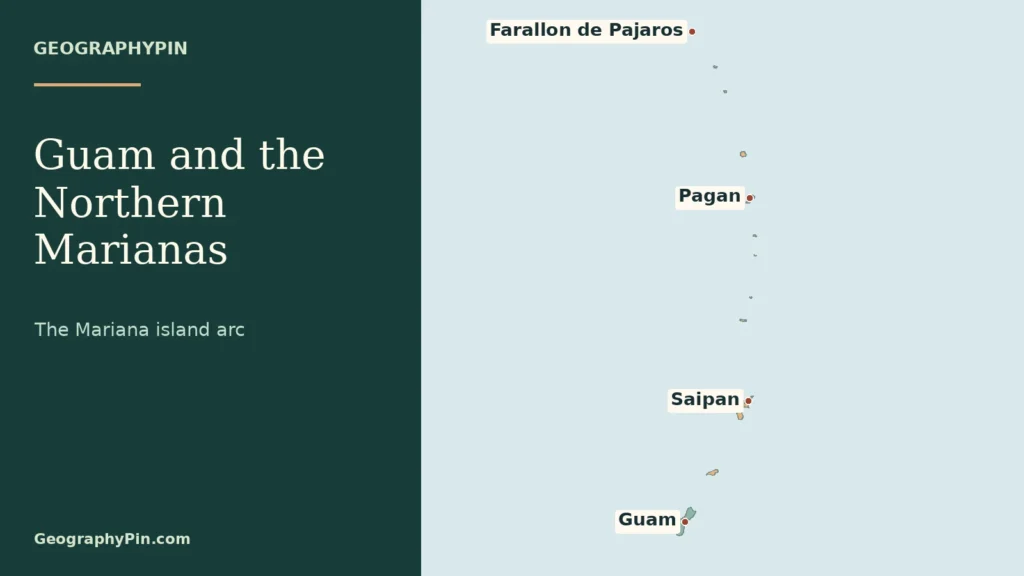
Guam is the southernmost and largest island of the Mariana chain. Rota lies north of Guam, followed by Tinian and Saipan farther north. Additional islands continue the arc. Hagåtña is Guam’s capital. Saipan is the island containing the Northern Mariana Islands’ seat of government at Capitol Hill. Saipan is not another name for Guam.

| Feature | Guam | Northern Mariana Islands |
|---|---|---|
| Governing framework | Organic Act of Guam, 1950 | Covenant approved by U.S. law in 1976 |
| Political designation | U.S. territory | Commonwealth in political union with the United States |
| Government seat | Hagåtña | Capitol Hill, Saipan |
| Time standard | Chamorro Standard Time, UTC+10 | Chamorro Standard Time, UTC+10 |
A route from Guam to the Northern Marianas
Leaving Guam to the north, the first main inhabited island in the Northern Mariana Islands is Rota. Farther north lie Tinian and Saipan. A Guam–Saipan flight crosses a territorial administrative boundary while remaining within U.S. sovereignty. This gives two defensible answers to “did the flight cross a border?” depending on whether the question concerns a national border or an internal territorial one.
The nineteenth-century split
Spain ceded Guam to the United States in 1898 after the Spanish–American War. The remaining Spanish-held Marianas went to Germany in 1899. Japan subsequently administered the northern islands under a League of Nations mandate. The different imperial histories meant that the two parts entered the postwar period through different political routes.
Trust territory does not describe Guam’s postwar status
The northern islands became part of the U.S.-administered Trust Territory of the Pacific Islands after World War II. Guam followed a separate path to a civilian territorial government through its 1950 Organic Act. Shared experience of wartime violence does not mean the two had the same prewar or postwar constitutional status.
What the Northern Marianas negotiated
Northern Mariana Islanders approved the negotiated Covenant locally in 1975, and Congress approved it in 1976. Its provisions came into force in stages. Important provisions concerning citizenship and political union took effect in November 1986. The later formal end of trusteeship at the United Nations was another milestone. A source can give different dates for signature, congressional approval and operation without describing different commonwealths.
Commonwealth is a legal relationship here
In this context commonwealth does not mean membership in the Commonwealth of Nations or independent statehood. The Northern Mariana Islands have their own local government within political union with the United States. Guam also has its own local executive and legislature. A map of the U.S. territories should label each separately even if it gives both the same national color.
Where Guam and Saipan went in different directions
Guam. Hagåtña is the capital. Travelers heading north leave a territory whose civilian government rests on a federal statute.
Northern Mariana Islands. A traveler reaches Rota before Tinian and Saipan. Capitol Hill on Saipan is the commonwealth’s seat of government. The volcanic arc continues across the administrative divide.
Frequently Asked Questions
Do travelers cross the International Date Line between Guam and Saipan?
No. Both are on the western Pacific side of the date-line convention and use UTC+10. Their longitudes are close together and their civil clocks agree.
Is the Mariana Trench a boundary between the governments?
No. The trench is an ocean-floor feature east of the island arc. Its name reflects regional geography, not the legal division between Guam and the commonwealth.
What Did We Learn Today?
The island arc explains why Guam and Saipan appear together. The 1898 split, Guam’s Organic Act and the northern islands’ Covenant explain why one modern administration does not govern them both.
Sources & Data Notes
Status dates distinguish congressional approval from the later effective provisions of the Covenant. Local names and political seats refer to the current jurisdictions.
- CNMI Law Revision Commission, text of the Covenant
- U.S. Government Accountability Office, constitutional treatment of insular areas
- U.S. Department of the Interior, history of the insular areas
- U.S. Department of the Interior, Guam
- United States Code, approval of the Northern Mariana Islands Covenant
- Natural Earth, source vectors for boundaries, coasts and rivers